
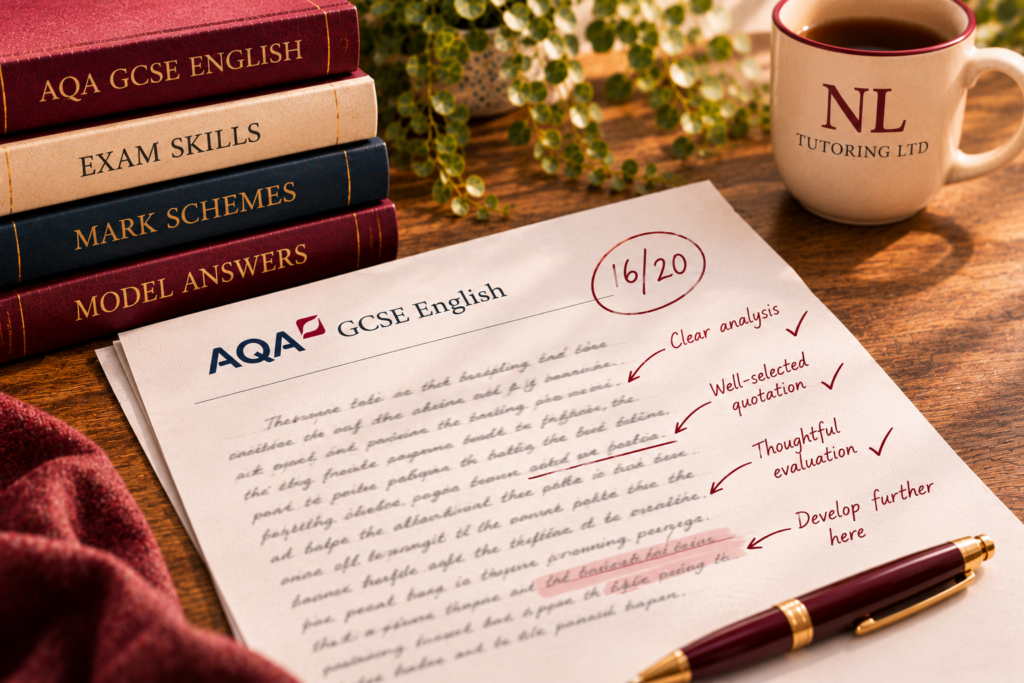
A student can spend hours revising quotations, completing practice papers, and writing essays, yet still feel unsure why their work remains stuck at the same grade. The missing piece is often not effort. It is precise feedback. Examiner marked responses show students how their writing performs against the assessment criteria that matter in GCSE English Language and English Literature.
For parents, this matters because a general comment such as “add more detail” or “analyze further” rarely tells a student what to do next. A marked response can identify the exact point at which an answer loses focus, misses an opportunity for analysis, or fails to meet the demands of the question. That turns revision from guesswork into a clear plan.
Why examiner marked responses matter
GCSE English assessments reward more than knowing a text or having good ideas. Students must select evidence carefully, explain it with precision, organize their response, and adapt their writing to the question under timed conditions. These are separate skills, and a weakness in one can limit the overall mark.
An examiner-informed marking process looks beyond whether an answer is “good.” It asks what the student has actually demonstrated. Have they developed a clear interpretation? Is their analysis of language specific rather than descriptive? Do they link methods to meaning? In English Language, have they responded to the task, shaped their writing for purpose and audience, and controlled their accuracy?
This distinction is particularly valuable for students aiming for Grades 7 to 9. At that level, a fluent essay is not automatically a top-band essay. Stronger responses tend to be conceptual, selective, and purposeful. They sustain an argument rather than working through a text quotation by quotation. Equally, students working toward a secure pass benefit from knowing which core habits will make the greatest difference first: answering the question, using relevant evidence, explaining ideas clearly, and writing in accurate sentences.
What effective examiner marking should reveal
Useful feedback should make a student’s next steps visible. It should not overwhelm them with corrections or leave them with a long list of vague targets. The best marking identifies patterns in their work and prioritizes the changes most likely to improve future responses.
For example, a student may understand Macbeth well but repeatedly use quotations as decoration. Their feedback may show that they need to zoom in on a key word, explore its implications, and connect that choice to Shakespeare’s wider message. Another student may write perceptive analysis but lose marks because their paragraphs do not build a line of argument. Their priority is structure, not more revision notes.
In English Language, examiner marking can expose a different set of issues. A creative writing response may contain ambitious vocabulary but lack a controlled structure. A reading answer may make sensible points but fail to support them with precise textual evidence. These are not fixed limitations. They are teachable skills, provided the student knows exactly what to practice.
Effective feedback normally explains three things: where the response sits against the relevant criteria, what is already working, and what the student should do differently in the next piece of writing. The final part is essential. A mark without a route forward may feel decisive, but it does not improve performance.
Marks are useful, but comments create progress
Students understandably want to know their grade. A grade can help establish a starting point and measure improvement over time. However, the number alone cannot tell a student why they received it.
Consider two essays that both receive a similar mark. One may need more developed analysis, while the other may need a clearer argument and better question focus. Giving both students the same generic advice would waste valuable revision time. Specific comments allow each student to improve the skill that is currently holding them back.
Parents should also be cautious of treating one practice score as a prediction. GCSE marking involves professional judgment, and performance can vary according to the question, text, timing, and student confidence on the day. A well-marked response is most valuable when it becomes part of a pattern: write, receive feedback, improve, and write again.
How to use marked work to improve grades
Feedback only has value when it changes what happens next. Students who read comments once and move on are unlikely to see lasting progress. The most effective approach is active and disciplined.
First, students should read the feedback alongside their own work. Rather than seeing corrections as criticism, they should identify the exact paragraph or sentence being discussed. This helps them recognize the difference between what they intended to say and what the examiner could actually credit.
Next, they should turn feedback into one or two focused targets. “Improve analysis” is too broad. “After each quotation, explain the effect of one word before moving to a new point” is specific and usable. “Make my conclusion longer” is less helpful than “return to the question and confirm my overall argument in the final paragraph.”
The crucial stage is redrafting. A student does not always need to rewrite an entire essay. Reworking one weak paragraph can be highly effective when they compare the original with the improved version. They begin to see how a stronger topic sentence, a more selective quotation, or a more precise explanation changes the quality of the response.
Finally, the target should appear in the next timed practice. This is where many students need support. It is one thing to improve a paragraph with notes and time; it is another to use that skill independently in 45 minutes. Repeated, focused practice builds the habits students can rely on in an exam room.
The limits of model answers and generic feedback
Model answers can be helpful, especially when students need to see what developed analysis or effective structure looks like. Yet they are not a substitute for feedback on a student’s own work. A high-level model can sometimes make a student feel that they must copy sophisticated phrasing rather than develop their own clear argument.
Generic feedback has a similar limitation. Advice such as “use more terminology” may encourage students to add labels like “metaphor” or “adjective” without explaining the writer’s purpose. Terminology only earns its place when it supports analysis. The goal is not to sound technical. The goal is to communicate a convincing interpretation.
There is also a practical trade-off. Detailed marking takes time, particularly when feedback is individualized and linked to assessment objectives. Quick comments may be useful for a small task, but a full response deserves careful consideration. Families should look for support that balances timely feedback with enough depth to make the next steps meaningful.
A structured route from feedback to confidence
At NL Tutoring, marked work forms part of a wider Assess, Build, Achieve approach. Assessment identifies the student’s current strengths and gaps. Teaching then builds the knowledge, writing habits, and exam technique required for their next stage. Further practice checks whether those improvements are becoming consistent.
This matters because feedback is not an isolated service. A student who is told to develop their analysis may need explicit teaching on how to select quotations, explore language choices, and shape an argument. A student who struggles with timing may need a repeatable planning method and timed practice broken into manageable stages. Once the cause of the problem is clear, progress becomes more realistic.
For Year 10 students, examiner-informed feedback can prevent misconceptions from becoming ingrained before the pressure of Year 11. For Year 11 students, it helps prioritize revision when time is limited. In both cases, it can replace the frustrating feeling of “I do not know what else to do” with a focused next step.
A well-marked response should leave a student with more than a score on a page. It should show them what they can already do, what to practice next, and why that practice will help them write with greater control when it counts.