
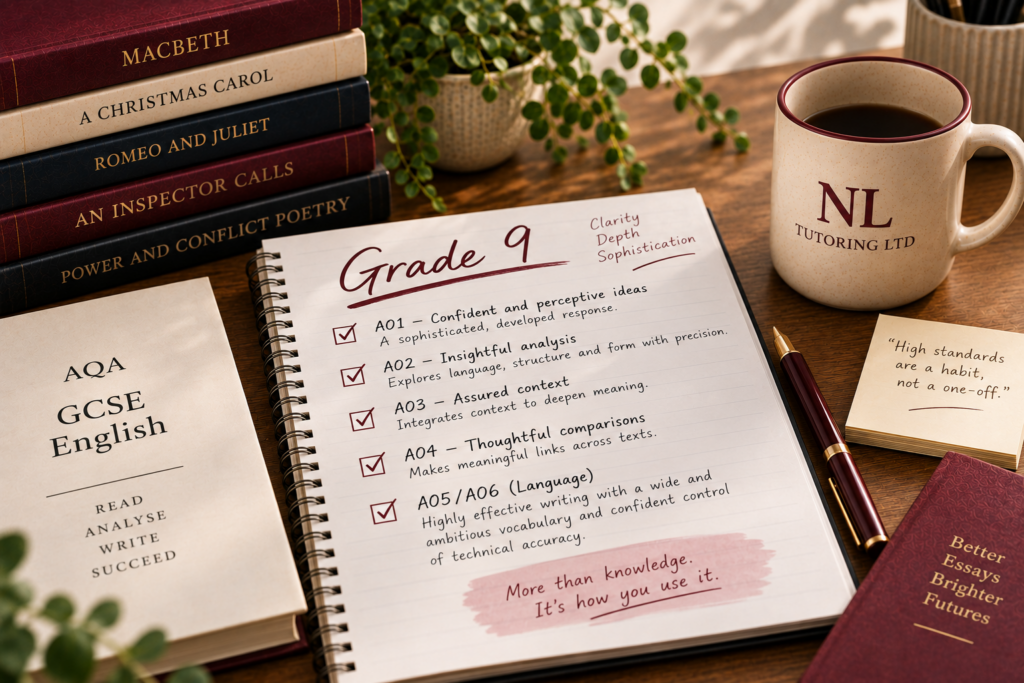
A Grade 9 in GCSE English is not awarded for using the longest quotation, spotting the most techniques, or writing as much as possible. It is awarded when a student responds with control, insight, and consistency under exam conditions. Understanding the Grade 9 criteria helps families move beyond the vague advice to “add more detail” and focus on the qualities AQA examiners can actually reward.
For ambitious students, the challenge is rarely a lack of effort. More often, they have strong ideas but do not develop them precisely enough, know the text but cannot shape an argument under time pressure, or write fluently but make choices that do not meet the assessment objectives. A top grade depends on bringing those skills together.
What Grade 9 criteria really mean
There is no single checklist that automatically produces a Grade 9. GCSE grades are awarded using grade boundaries, which can change slightly from year to year depending on the difficulty of the paper. A student therefore does not need a fixed percentage to demonstrate Grade 9-level work.
However, the mark schemes are clear about the standard of response associated with the highest levels. In AQA GCSE English Language and English Literature, students need to show perceptive understanding, a convincing and well-developed argument, careful use of evidence, and accurate, controlled writing.
The key word is consistency. One thoughtful paragraph is encouraging, but it will not carry an entire response. Grade 9 students sustain a high-quality line of argument across the full answer. They select evidence purposefully, explain its significance, and adapt their writing to the exact demands of the question.
This does not mean every sentence must sound complicated. In fact, forced vocabulary and overused terminology can make an essay less clear. The strongest students write with precision. They know what they want to say, why it matters, and how to communicate it effectively.
Grade 9 criteria in GCSE English Literature
In Literature, high-mark answers are built around interpretation. Students must do more than identify a theme or explain what a character does. They need to explore how the writer presents an idea and consider why that presentation may matter.
Perceptive analysis, not technique spotting
Many students can identify a metaphor, adjective, or rhetorical question. That is useful, but it is only the start. A Grade 9 response explores the effect of the writer’s choices in a precise and relevant way.
For example, rather than writing that a word “shows that Macbeth is ambitious,” a stronger response might consider how Shakespeare presents Macbeth’s ambition as private, unsettling, or self-destructive. The student then connects that interpretation to the wider argument of the essay.
This is where examiner-led teaching can make a significant difference. Students need to understand that analysis is not a hunt for devices. It is a process of making a convincing claim, selecting the best evidence, and explaining how language, structure, or dramatic method supports that claim.
A clear argument that develops
Grade 9 essays do not read like separate paragraphs placed next to one another. They have direction. The introduction establishes a thoughtful response to the question, and each paragraph moves the argument forward.
A student answering a question about power in An Inspector Calls, for instance, may begin with Mr. Birling’s confidence, move to the Inspector’s moral authority, and finish with Sheila’s capacity to change. That sequence can show how Priestley challenges selfish, inherited power and favors responsibility and social change.
The exact interpretation can vary. Examiners do not reward one approved opinion. They reward interpretations that are supported securely by the text and explored with judgment.
Context used with purpose
Context is another area where students can lose marks through well-intentioned but unfocused revision. A Grade 9 student does not attach a memorized fact about Victorian Britain or Jacobean beliefs to the end of every paragraph.
Instead, context helps deepen the interpretation. In a response on Macbeth, beliefs about kingship, witchcraft, and the Divine Right of Kings may help explain why Shakespeare’s original audience would view Macbeth’s actions as especially dangerous. In A Christmas Carol, knowledge of poverty and the Poor Law can sharpen an argument about Dickens’s criticism of social indifference.
The context must serve the essay, not interrupt it. If removing a contextual point makes no difference to the argument, it probably was not doing enough work.
Knowledge that supports flexibility
Detailed knowledge of a text matters, but memorizing dozens of quotations is not always the answer. Students aiming for Grade 9 need a secure bank of short, versatile quotations alongside a clear understanding of character arcs, themes, relationships, and writer’s intentions.
Short quotations are often easier to embed and analyze closely. More importantly, students should be able to select evidence in response to an unfamiliar question rather than forcing the same prepared paragraph into every essay.
Grade 9 criteria in GCSE English Language
English Language requires a different kind of control. Students still analyze closely, but they must respond to unseen texts and produce their own effective writing in a limited time.
Reading answers must stay focused
For reading questions, Grade 9 students address the wording of the question closely. They do not simply explain every interesting detail in the extract. If the question asks how a writer makes a setting seem threatening, every chosen quotation and comment should contribute to that focus.
High-level responses are selective. They may explore an individual word, consider a pattern in the language, and connect it to the reader’s response. They also recognize when structure matters, such as a shift in focus, a delayed revelation, or a change in pace.
A useful test is this: could the student explain why this particular quotation is the best evidence for the question? If not, they may be selecting evidence because it is easy to identify rather than because it is effective.
Writing needs deliberate choices
For the creative and transactional writing sections, Grade 9 is not about filling the page with ambitious words. Examiners reward writing that is crafted for purpose, audience, and form.
A persuasive speech should sound like a speech, with a clear viewpoint, logical development, and deliberate engagement with the audience. A story should create a convincing atmosphere, use structure intentionally, and avoid trying to cover too many events. A quieter moment written with control is often more effective than a dramatic plot that becomes rushed or confusing.
Technical accuracy is also important. Errors in punctuation, spelling, and sentence control can limit an otherwise promising response. This does not mean Grade 9 writing is error-free, but it should show consistent command. Students need to vary sentence forms purposefully and use paragraphs to shape meaning, not simply to make the work look organized.
Why strong students can still miss Grade 9
Students can be capable, well-read, and highly motivated yet fall short of the top band for understandable reasons. They may write too much on their first quotation and leave the final paragraph undeveloped. They may use impressive terminology without explaining its effect. They may know the content but struggle to plan a response quickly.
The difference between Grades 7, 8, and 9 is often not about working harder in a general sense. It is about refining the habits that convert knowledge into marks. Students need regular practice with targeted feedback, not just completed essays marked with a grade.
Feedback should identify the exact next step. Does the student need to make interpretations more precise? Build a clearer argument? Integrate context more naturally? Improve timing? Once the gap is clear, practice becomes more productive and confidence grows for the right reasons.
A practical route toward top-band responses
Students aiming for Grade 9 benefit from a disciplined approach. First, assess their current writing against the assessment objectives, looking beyond the overall grade. Next, build the specific skills that are holding them back through model paragraphs, guided practice, and focused revision. Finally, apply those skills in timed conditions so they become reliable in the exam.
At NL Tutoring, this Assess, Build, Achieve approach helps students understand exactly what AQA examiners are looking for and where their own marks are being lost. The goal is not to turn every student into the same writer. It is to give each student the knowledge, structure, and confidence to produce their strongest work.
A Grade 9 is an ambitious target, and it should be treated honestly. It requires sustained performance across papers, not a single excellent essay. But when a student learns to think clearly, write with control, and respond strategically to the mark scheme, top grades stop feeling mysterious and start becoming a realistic result of focused preparation.