
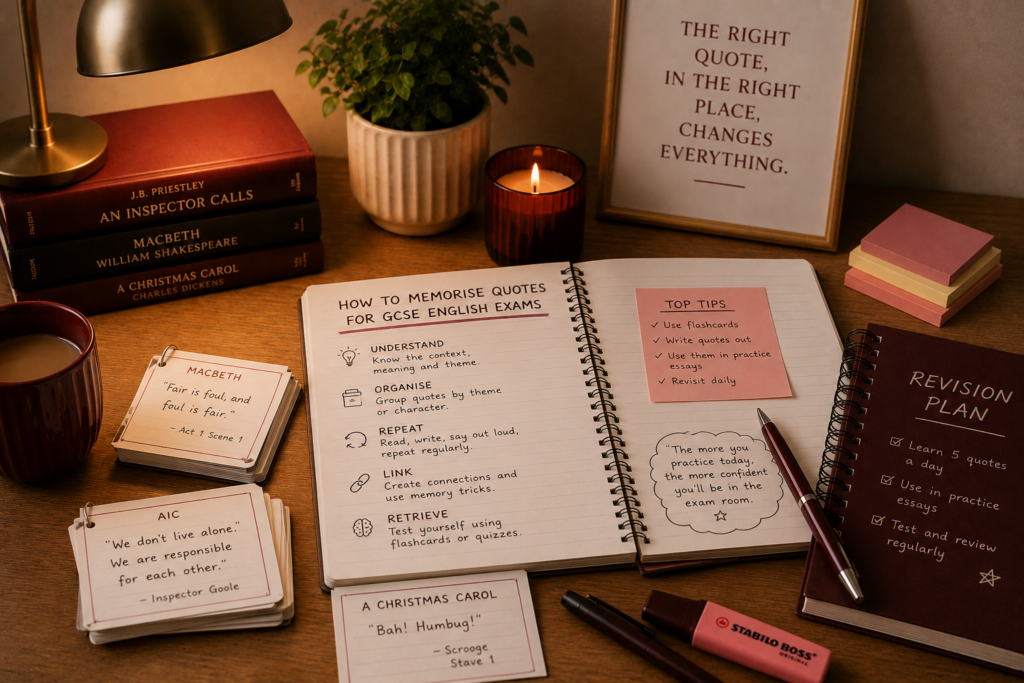
A student can understand Macbeth brilliantly in class and still freeze when the exam paper asks for a quotation. That is not a lack of ability. It usually means revision has focused on rereading rather than retrieval. Knowing how to memorise quotes for GCSE English means building a small, flexible bank of evidence that can be recalled and analyzed under pressure.
For GCSE English Literature, students do not need to recite whole scenes or learn every line spoken by every character. They need carefully chosen quotations, secure knowledge of where they fit, and the confidence to use them to answer the exact question. This is where focused revision makes a measurable difference.
Start with fewer quotes, chosen well
The most common mistake is trying to memorize 40 or 50 quotations for each text. It creates a huge workload and often leads to vague recall. Students may remember that a quote contains the word “blood,” for example, but cannot accurately use it or explain why it matters.
A better approach is to select a core quotation bank. For each main character and theme, choose short quotations that are versatile enough to apply to more than one question. A quotation such as Lady Macbeth’s “unsex me here” can support discussion of gender, ambition, power, and the disruption of natural order. One well-understood quotation can therefore earn marks across several possible questions.
Short quotations are particularly valuable. They are easier to remember accurately, easier to embed into a sentence, and leave more room for analysis. A Grade 7-9 response does not depend on filling a page with long quotations. It depends on making precise, purposeful points about language, structure, and ideas.
Build a quote bank around exam priorities
For each literature text, students should organize their quotation bank around the areas exam questions are most likely to assess: characters, relationships, central themes, and the writer’s message. Poetry requires a slightly different approach. Students need quotations that help them compare methods and ideas across poems, rather than treating each poem as an isolated text.
Aim for around 15 to 20 core quotations per text as a starting point. The right number depends on the student’s confidence, the text being studied, and the grade they are targeting. A student working toward a secure pass may benefit from a smaller bank they can use accurately. A student targeting the highest grades may add alternative quotations and more detailed contextual connections once the essentials are secure.
How to memorize GCSE English quotes using meaning first
Memorization works best when a quotation has a clear purpose. Simply copying a quote ten times may feel productive, but it does not guarantee that it will be available in an exam. The brain remembers meaningful connections more effectively than isolated words.
Each quotation should be learned alongside four pieces of information: who says it or where it appears, what it reveals, one word or method worth analyzing, and the themes it connects to. For example, when learning Macbeth’s “vaulting ambition,” a student should know that it occurs as he debates killing Duncan, that the metaphor presents ambition as dangerous and uncontrolled, and that it links to power, morality, and the consequences of unchecked desire.
This turns a quote from a string of words into usable evidence. It also prevents a familiar exam problem: remembering the quotation but having nothing specific to say about it.
A simple quote card can help. Put the quotation prompt on one side, such as “Macbeth – ambition,” and the exact quotation on the other. Underneath, add only a few concise notes: method, meaning, and theme. Keep the card focused. If it becomes a page of notes, it is no longer a retrieval tool.
Use active recall, not repeated reading
Active recall means testing what you can remember without looking at the answer first. It is one of the most reliable ways to make revision stick because it identifies gaps immediately.
Students can begin by reading a quotation, covering it, and writing it from memory. They should then check every word, correcting errors in a different color. Next, they can give themselves the theme or character and try to retrieve two relevant quotations. Finally, they should practice placing one quotation in an analytical sentence.
For instance, instead of looking at notes on Scrooge and thinking, “I recognize that,” a student might ask themselves: “What quotation shows Scrooge’s attitude to poverty at the start of A Christmas Carol?” If they can retrieve “Are there no prisons?” and explain the rhetorical question, they are revising in a way that prepares them for the exam.
The discomfort of not remembering is useful. It shows exactly what needs another review. Rereading can create a false sense of security because the answer is always visible.
Space out the reviews
A quote remembered once is not necessarily learned. Students need to return to it over time. Reviewing a new quotation later that day, then a few days later, then the following week is more effective than cramming it for an hour on one evening.
A practical routine might be 10 minutes of new quotes followed by 10 minutes of old ones. Parents can support this without becoming subject specialists by asking students to explain a quotation aloud. If a student can teach the meaning clearly, they are much more likely to use it independently in an essay.
It is also worth mixing quotations from different texts. This feels harder than revising one character at a time, but it strengthens recall because the student has to choose the right evidence rather than relying on the order of their notes.
Make quotations memorable without changing them
Students often invent memory tricks, which can be helpful, but accuracy still matters. A quotation should not be simplified so much that key language is lost or the wording becomes incorrect. In an exam, a short accurate quotation is stronger than a long, uncertain one.
Use imagery and associations to remember difficult lines. For “look like th’ innocent flower, / But be the serpent under’t,” a student might picture a flower hiding a snake. The contrast is already central to the quotation’s meaning, so the image supports both recall and analysis.
Chunking also helps. Break longer quotations into meaningful phrases rather than individual words. Say the phrases aloud, write them, then rebuild the full line. Hearing the rhythm of Shakespeare can be especially useful, provided students are checking the written version as well.
For students who struggle with spelling or working memory, focus first on retaining the key phrase accurately. “Stars, hide your fires” can be used effectively even if the student cannot confidently recall the rest of Macbeth’s speech. Examiners reward relevant textual references and thoughtful analysis, not a performance of flawless recitation.
Practice using quotes in exam-style paragraphs
Memorizing is only half the task. Students must be able to select a quotation that answers the question and analyze it with precision. A quote bank becomes powerful when it is regularly used in writing.
After learning a quotation, students should write one or two sentences that embed it naturally. For example: Shakespeare presents Macbeth’s ambition as dangerously excessive through the metaphor “vaulting ambition,” suggesting that his desire for power drives him beyond moral control. This is much more useful than writing the quotation alone on a flashcard.
Then move to timed paragraph practice. Give the student a question and ask them to plan three quotations in three minutes. They do not need to write a full essay every time. Frequent, short practice teaches them to retrieve evidence quickly and make choices under time pressure.
This is also where examiner-informed feedback matters. Strong analysis is not about naming every technique. It is about explaining how the writer’s choices shape meaning and linking that explanation to the question. At NL Tutoring, this is the bridge students are taught to build: from secure subject knowledge to clear, purposeful exam writing.
Avoid the revision habits that waste time
Highlighters, copied notes, and quote posters can have a place, but they should not be the main method. They are useful for organizing material, not for proving that it has been learned.
Students should also avoid learning quotations with no context. If they cannot remember who says the line, what happens around it, or why it matters, they may force it into an unsuitable answer. A smaller bank of flexible, understood quotations is always preferable to a longer list learned by rote.
Finally, do not wait until the final weeks before the exam. Quote recall improves through regular, low-pressure practice. Ten focused minutes several times a week will usually achieve more than a stressed weekend of cramming.
A student who can confidently retrieve a short quotation, explain one word in detail, and connect it to the question has a dependable foundation for GCSE English Literature. Build that habit steadily, and the exam becomes less about hoping the right quote appears and more about showing what they know.