
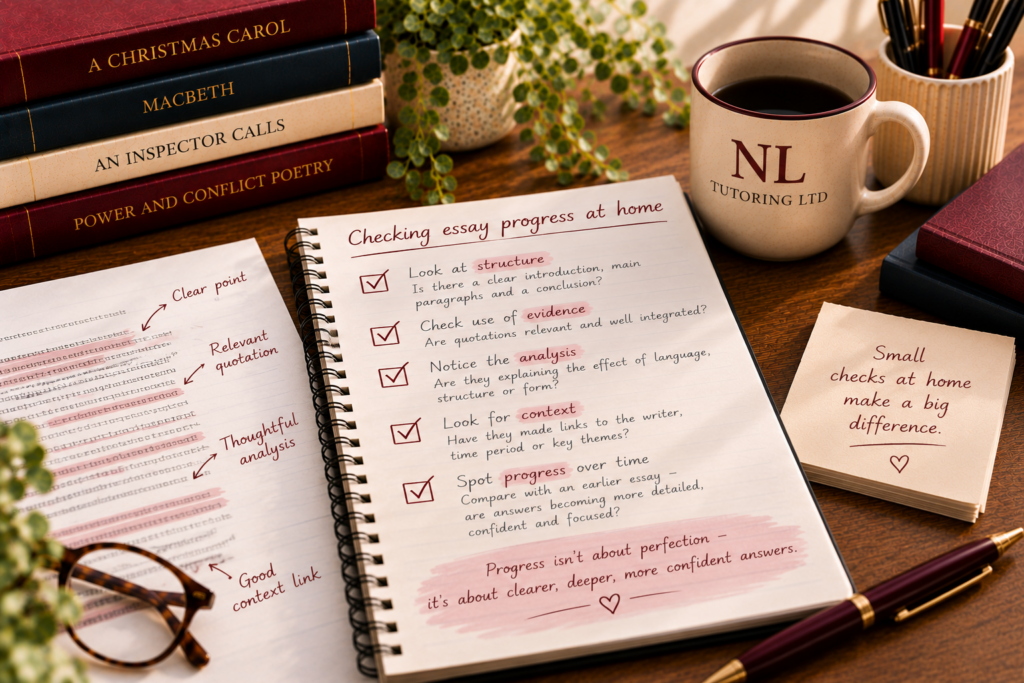
A student can spend an hour writing an English essay and still be unsure whether it is improving. That uncertainty is frustrating for families, especially when GCSE English grades depend on much more than effort. Knowing how parents check essay progress does not mean becoming the teacher or correcting every sentence. It means spotting whether a child is building the habits that lead to clearer, more analytical, and more confident writing.
For Years 10 and 11, the goal is not simply to produce longer essays. It is to help students make deliberate choices: selecting evidence carefully, explaining its effect, developing a line of argument, and shaping responses for the question. Parents can support that process at home without needing to know every AQA mark scheme detail.
Start by checking the task, not just the finished essay
Before reading a paragraph, ask your child what the question required them to do. In GCSE English Literature, was the focus on a character, theme, relationship, or writer’s methods? In English Language, were they asked to analyze language, compare writers’ viewpoints, or create a piece of descriptive or persuasive writing?
A strong essay can lose focus when a student writes everything they know about a text rather than answering the precise question. Ask them to point to their central argument in one sentence. If they cannot explain their overall view clearly, the essay may be descriptive, unfocused, or built from memorized points that do not quite fit.
This is a useful first check because it shifts the conversation away from, “Is this good?” and toward, “Does this answer the question?” That is the habit examiners reward.
How parents check essay progress without taking over
The most helpful parent role is interested reader, not editor. Correcting every spelling error or rewriting an awkward sentence can make a piece look better, but it does not show what the student can do independently. It can also make it harder for a teacher or tutor to identify the gaps that need attention.
Instead, read one paragraph and ask a few calm, specific questions. What is the point you are making here? Which word or detail from the quotation matters most? How does this link back to the question? What would you add if you had one more sentence?
These questions encourage a student to explain their thinking. If they can talk through a clear idea but have not written it fully, they may need support with structure or confidence. If they cannot explain the point at all, they may need to revisit the text, the question, or the underlying subject knowledge.
Progress is often visible in the quality of a student’s explanation before it is visible in a grade.
Look for a developing argument
Many students begin GCSE essay writing by making a point, adding a quotation, and then moving on. This is a sensible starting structure, but higher-level responses need more than a series of separate observations. They need a connected argument.
When checking work over several weeks, look for whether paragraphs build on one another. A student might begin by arguing that a character appears powerful, then explore how that power is challenged, and finally consider what the writer suggests about ambition or responsibility. That movement shows purposeful thinking.
A useful question is: “If I read only your first sentence from each paragraph, could I follow your argument?” If the answer is no, the student may need to plan more carefully before writing.
Check analysis, not quotation quantity
Students often believe that more quotations automatically mean more marks. Usually, carefully chosen evidence explained in depth is more valuable than several quotations dropped into a paragraph with little analysis.
Look for short quotations or individual words that are followed by explanation. Is your child commenting on why the writer chose that word? Are they considering an image, contrast, tone, or effect? Do they explain how the evidence supports their idea?
For example, a student who writes that a character is “angry” has identified a basic idea. A student who explores how a verb suggests suppressed anger, control, or threat is analyzing the writer’s method. That difference matters in both Literature and Language responses.
Do not worry if you cannot judge whether every interpretation is sophisticated. You can still ask, “What in the words makes you think that?” This keeps the student accountable to the evidence rather than encouraging unsupported statements.
Use a simple progress record
One essay never tells the whole story. A short record helps parents and students see patterns over time, especially when confidence is low. After each piece of writing, note the task, the time taken, one strength, one priority for improvement, and any teacher feedback.
You do not need a complicated spreadsheet. A notebook page or document is enough. The value comes from identifying whether the same issue keeps returning. Perhaps your child has thoughtful ideas but runs out of time. Perhaps they know quotations but do not explain methods. Perhaps their introductions are strong but conclusions repeat earlier points without developing them.
After three or four pieces, ask whether the improvement target has changed. If every essay still carries the same comment, such as “analyze more closely” or “answer the question,” more practice alone may not be the answer. The student may need direct teaching, worked examples, and guided feedback on how to make that specific improvement.
Compare work fairly
Comparing a current timed essay with a polished homework assignment can be misleading. Homework may have benefited from notes, feedback, multiple drafts, or parental discussion. Timed work shows a different but equally important skill: whether a student can apply their knowledge under exam conditions.
Keep both types of writing. Drafted work reveals how well a student responds to feedback. Timed work reveals how secure their planning, recall, writing stamina, and exam technique have become. By Year 11, students need practice with both.
It also helps to compare like with like. Compare two 45-minute Literature essays on similar question types, or two Language analysis responses written under the same conditions. A fair comparison will show whether the student is planning faster, sustaining paragraphs more effectively, selecting better evidence, or making fewer repeated errors.
Watch for confidence as well as technical skill
Essay progress is not always linear. A student may appear to struggle after being introduced to more demanding expectations, such as alternative interpretations or detailed language analysis. That does not necessarily mean they are going backward. It may mean they are moving beyond simple answers and learning to make more precise choices.
Listen to the language your child uses about English. “I do not know what to write” can point to gaps in knowledge, but it can also signal fear of getting it wrong. “I have ideas, but I cannot organize them” suggests a different issue: planning and paragraph structure.
The right support depends on the pattern. Students who lack text knowledge need structured revision and quotation retrieval. Students with sound knowledge but weak essays need explicit modeling of analytical writing. Students who understand the content but freeze in timed conditions need regular, manageable practice under time limits.
This is why generic advice to “write more essays” can be unhelpful. Writing more only works when a student knows exactly what they are practicing and receives feedback they can act on.
Make feedback actionable
Teacher comments can feel vague to students, particularly when they read phrases such as “develop analysis” or “be more conceptual.” Help them turn one comment into one practical action for the next essay.
For “develop analysis,” the action might be to explain one key word from every quotation. For “improve structure,” it might be to write a one-sentence argument before planning paragraphs. For “use context carefully,” it might be to link contextual knowledge directly to the writer’s purpose rather than adding a separate fact.
Avoid asking a student to fix five things at once. One focused target, repeated across several pieces of work, is more likely to become a secure habit. When that habit is established, move to the next priority.
At NL Tutoring, this kind of focused diagnosis sits at the center of the Assess, Build, Achieve approach. Clear feedback is most effective when it identifies the real barrier, teaches the missing skill, and gives the student an immediate opportunity to apply it.
Know when additional support may help
Parents should not have to decode assessment objectives alone. If your child is regularly writing essays but their feedback stays unchanged, if they avoid English because they lack confidence, or if you are unsure what a Grade 7 to 9 response should do differently, specialist support can provide clarity.
A qualified GCSE English teacher with examiner insight can distinguish between a knowledge gap, a writing issue, and an exam-technique problem. That matters because each needs a different response. The most effective support gives students a structure they can use independently, rather than a collection of impressive-sounding phrases to memorize.
The aim is not for parents to become markers. It is for students to recognize their own next step, act on it with confidence, and gradually see that stronger essays are built one deliberate choice at a time.