
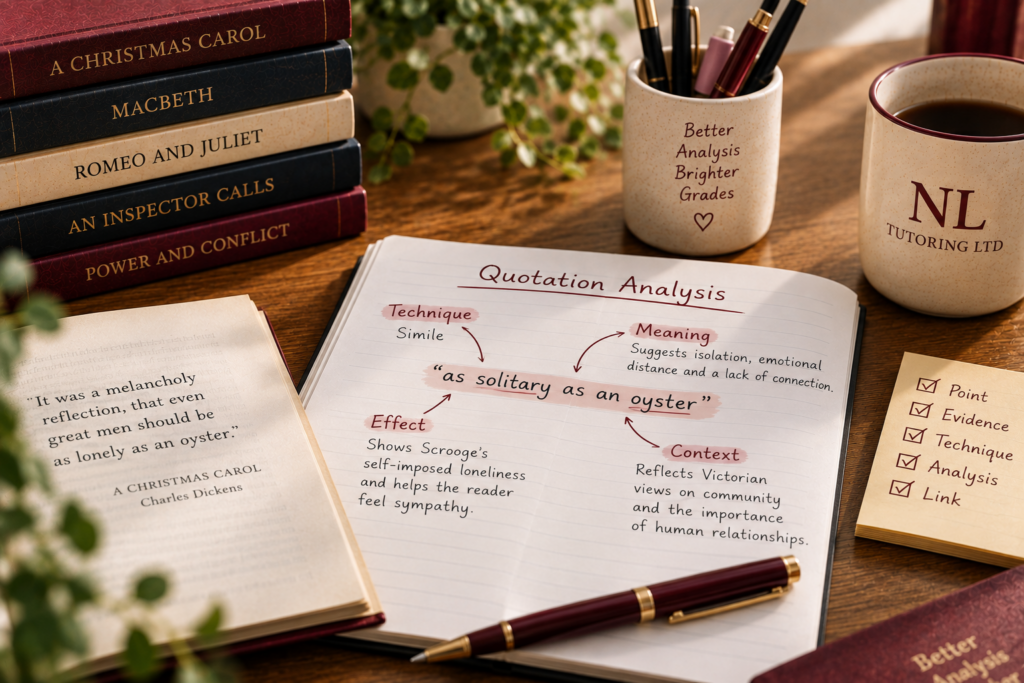
A student can know a text well, remember useful quotations, and still lose marks because their analysis stops too soon. Learning how to improve quotation analysis is not about making paragraphs longer or naming more techniques. It is about showing an examiner precisely how a writer’s choices create meaning, shape a reader’s response, and support an argument.
For GCSE English Literature, this is one of the clearest differences between a basic response and a developed one. Strong quotation analysis gives students control: they are no longer retelling the plot or adding a quotation as proof, but using evidence to build an insightful argument.
Why quotation analysis matters in GCSE English
A quotation is not the analysis. It is the starting point for analysis.
In AQA English Literature responses, students are rewarded for explaining writers’ methods and the effects of those methods, while also developing a clear interpretation. A short, carefully explored quotation will usually earn more credit than a long quotation followed by a vague comment such as, “This shows he is angry.”
Parents often see the same issue in practice. Their child may produce a full page of writing, use several quotations, and appear to have worked hard, yet the teacher’s feedback says “analyze language in more detail” or “develop your ideas.” This does not mean the student lacks ability. More often, they need a repeatable method for moving from evidence to explanation.
The goal is not to guess what the writer was thinking. It is to make a well-supported interpretation based on the words on the page.
Start with a quotation that can do real work
Students sometimes select quotations because they are long, dramatic, or easy to remember. That can create problems. A lengthy quotation encourages students to explain the whole line loosely rather than focus on a deliberate word or phrase.
Instead, choose concise evidence that directly supports the point being made. In an essay about Macbeth’s ambition, the phrase “vaulting ambition” is far more useful than a full speech if the paragraph is exploring how Shakespeare presents ambition as dangerous and uncontrolled.
A strong quotation choice should do at least one of three things: reveal a character’s attitude, expose a key theme, or demonstrate a significant change. It should also give the student language worth discussing.
For example, a student might write:
> Shakespeare presents Macbeth’s ambition as reckless through the phrase “vaulting ambition.”
This is a clear start, but it is not yet analysis. The next sentence needs to examine why “vaulting” matters.
Zoom in before zooming out
The most reliable way to improve quotation analysis is to zoom in on one or two carefully chosen words. Students should ask themselves: Why this word? What are its associations? What does it suggest about the character, situation, or theme?
Returning to “vaulting ambition,” a developed explanation might say that the verb “vaulting” suggests a horse leaping over an obstacle. Macbeth’s ambition is therefore presented as something forceful and difficult to restrain. However, Shakespeare also implies that Macbeth may leap too far and lose control, foreshadowing the destruction that follows.
Notice what this does. It does not simply label “vaulting” as a verb and move on. Terminology can be useful when it helps a student explain meaning, but it is never a substitute for an idea. Examiners do not reward a paragraph merely because it contains words such as “metaphor,” “adjective,” or “semantic field.” They reward precise comments about the writer’s choices.
A useful classroom prompt is: What is the writer making us notice here? If a student can answer that question, they are much closer to genuine analysis.
Avoid the feature-spotting trap
Feature spotting sounds like this: “Shakespeare uses an adjective. This makes the reader want to read on.” The comment is generic, and it could apply to almost any quotation in any text.
Replace it with a specific chain of thought. Identify the word, explain its associations, connect it to the argument, and then consider its effect. The reader’s response should follow naturally from the analysis, not be added as a stock phrase at the end.
For instance, rather than writing, “The word ‘fog’ creates mystery,” a student could explain that the recurring “fog and filthy air” in Macbeth blurs moral boundaries. Shakespeare creates a world in which good and evil are difficult to separate, preparing the audience for Macbeth’s increasingly confused judgment.
Build analysis in a clear sequence
Students who struggle with analytical writing often try to do everything at once. They introduce a point, insert a quotation, name a technique, mention context, and jump to another idea. A simple sequence creates much better control.
First, make a direct point that answers the question. Next, embed a short quotation. Then zoom in on the most meaningful word or phrase. Finally, link the analysis back to the character, theme, or writer’s overall message.
This might look like:
> Priestley presents Mr. Birling as complacent because he dismisses the possibility of conflict, claiming there is “no chance of war.” The certainty of “no chance” makes Birling appear overconfident and foolish. For an audience who knows that two world wars followed, his confident prediction becomes ironic, allowing Priestley to undermine Birling’s authority and criticize his narrow worldview.
This paragraph works because every sentence has a purpose. The quotation is brief, the language analysis is specific, and the wider idea is relevant. It also recognizes dramatic irony, but the terminology supports the explanation rather than leading it.
Let more than one interpretation strengthen the paragraph
The strongest GCSE responses do not need to force a complicated interpretation into every quotation. However, students aiming for higher grades should learn that words can carry more than one possible meaning.
Take Curley’s wife in Of Mice and Men, described as having “full, rouged lips.” A student could argue that Steinbeck presents her through the male characters’ suspicious and sexualized perspective. The word “rouged” may suggest artificiality, reinforcing the men’s judgment that she is dangerous or deceptive.
A more thoughtful response can then add that her appearance may also reveal the limited role available to her. She has been reduced to how she looks, just as she is denied a personal name throughout the novel. This does not mean every interpretation is equally convincing. The student must remain anchored to the quotation and the text as a whole.
This is where confident analysis becomes more nuanced. The best response is often not “this definitely means one thing,” but “this may suggest…, while also implying…”
Use context to sharpen analysis, not replace it
Context is valuable when it explains why an idea matters. It should not become a separate history paragraph dropped into an essay.
For example, when writing about An Inspector Calls, knowledge of Edwardian class divisions and Priestley’s socialist views can deepen a point about responsibility. But the paragraph should still begin with the play itself. Analyze Birling’s language, then explain how Priestley may use him to challenge the attitudes of a wealthy, self-interested generation.
The same principle applies to every Literature text. Context should illuminate the writer’s methods and message. If it could be pasted into any essay without changing a word, it is probably too general.
Practice one quotation at a time
Improvement does not always require a full essay. In fact, students often make faster progress when they practice short analytical tasks regularly. Choose one quotation and spend five minutes writing three sentences: a point, a zoomed-in analysis, and a wider link.
Afterward, check the response carefully. Has the student explained a word rather than repeated it? Does each sentence answer the question? Could the comment apply to any text, or is it rooted in this exact quotation?
Keeping a quotation bank can help, but it should not be a list of isolated lines to memorize. Organize quotations by theme, character, and moment in the text, with one or two notes on why each quotation is useful. Ten flexible quotations understood in depth are more valuable than thirty quotations remembered without analysis.
How to improve quotation analysis under exam pressure
In the exam, students do not need perfect paragraphs. They need clear, purposeful ones. Encourage them to select evidence they genuinely understand rather than reaching for the most impressive-sounding line they can remember.
A helpful habit is to underline the exact word they plan to analyze before they begin writing. This prevents the paragraph from drifting into plot summary. If time is limited, it is better to explore two quotations well than to include five with only a brief comment on each.
At NL Tutoring, this is developed through structured, examiner-informed practice: identifying the gap, building the analytical habit, and giving students repeated opportunities to apply it independently. Confidence grows when students know what to do next, even when the exam question is unfamiliar.
The next time your child revises a text, ask them not only, “What quotation could you use?” Ask, “Which single word would you explore, and what does it make you think?” That small shift turns quotation recall into the kind of thoughtful analysis that can change the quality of an entire GCSE English essay.