
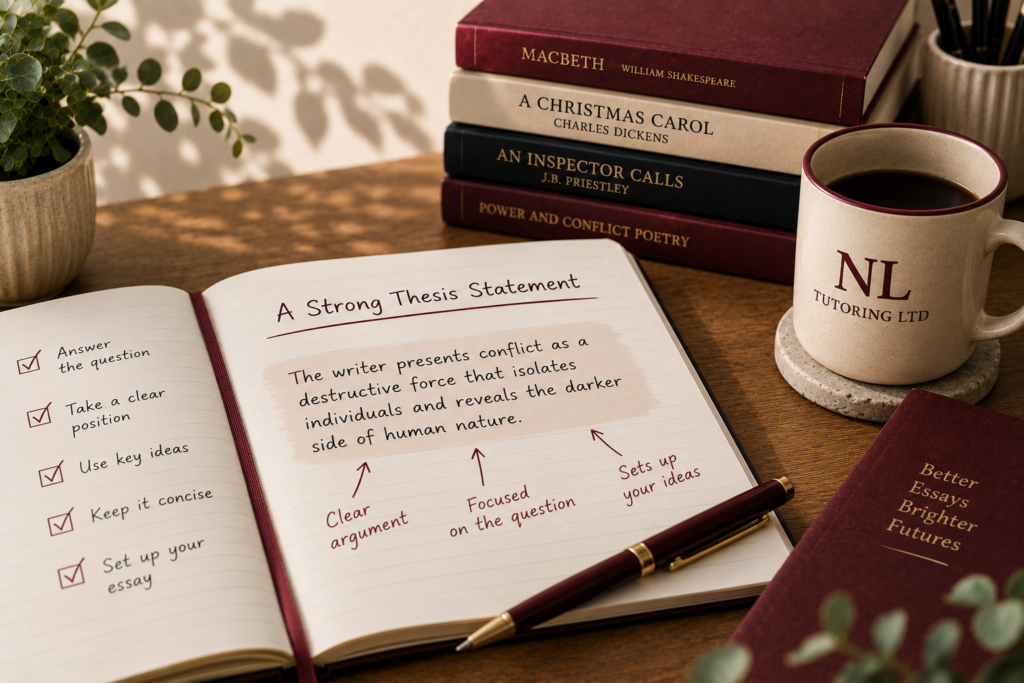
A GCSE English essay can lose direction before the first main paragraph begins. When a student starts with a broad comment such as “Shakespeare presents Macbeth as ambitious,” they may have a relevant idea, but they do not yet have an argument to prove. Learning how to write thesis statements gives that idea a clear line of reasoning. It helps students select evidence with purpose, develop analysis, and show an examiner that their response is answering the question from the outset.
For students working toward a secure pass, a thesis statement provides reassuring structure. For those targeting Grades 7 to 9, it creates the conceptual focus needed for a more thoughtful, developed interpretation. It is not a decorative opening sentence. It is the argument that holds the entire essay together.
What a thesis statement does in a GCSE essay
A thesis statement is a concise answer to the essay question that sets out the student’s main argument. It usually appears near the end of the introduction, after a sentence or two that directly engages with the focus of the question.
In English Literature, it should make a judgment about a character, theme, relationship, or writer’s method. In English Language, a thesis can establish an overall interpretation of a text or a clear viewpoint for transactional writing. In both subjects, it gives the reader a reason to trust that the response will be organized and purposeful.
Consider this question: How does Shakespeare present Macbeth as a tragic hero?
A weak opening might be: “Macbeth is a tragic hero because bad things happen to him.” This is too general, and it does not show an understanding of Shakespeare’s choices.
A stronger thesis statement would be: “Shakespeare presents Macbeth as a tragic hero whose admirable courage is gradually corrupted by unchecked ambition, warning a Jacobean audience about the destructive consequences of challenging moral and political order.”
This statement has an argument. It identifies Macbeth’s initial qualities, explains the change in his character, and connects the idea to Shakespeare’s wider message and context. The following paragraphs now have a clear job: prove that argument.
How to write thesis statements that answer the question
The strongest thesis statements are built from the question, not pasted onto it. Students should first identify the key focus and command word. Are they being asked how a writer presents something, how far they agree, or how a relationship changes? The thesis must respond to that precise task.
A useful sentence pattern is:
The writer presents [focus] as [clear argument], suggesting that [bigger idea or purpose].
For example, for the question How does Priestley present Sheila as a character who changes?, a student could write: “Priestley presents Sheila as increasingly socially responsible, using her transformation to suggest that younger people can reject the selfish values of the older generation.”
Notice that this does more than announce that Sheila changes. It explains the direction of that change and why Priestley may have made it significant. That is the difference between a topic and a thesis.
It depends on the question how much context belongs in the thesis. A brief, relevant reference can strengthen an argument, particularly in Literature. However, students should not force in historical facts they cannot connect to the point. “Priestley wrote after World War Two” is not, by itself, an argument. The context must clarify the writer’s purpose.
Move from a topic to an argument
Many students understand the text well but write introductions that merely list what they will discuss. A sentence such as “In this essay, I will write about Lady Macbeth, guilt, and ambition” gives no indication of the student’s viewpoint. It also wastes valuable time in an exam.
Instead, encourage students to ask three questions before writing their thesis:
- What is my direct answer to the question?
- What is the writer suggesting through this idea?
- How might this argument develop across the text?
Take the question: How does Dickens present Scrooge as an outsider?
A topic-based response might say: “Dickens presents Scrooge as an outsider because he is lonely and does not like Christmas.”
A more analytical thesis could be: “Dickens initially presents Scrooge as emotionally isolated from his community, using his rejection of Christmas to criticize the greed and indifference that divide Victorian society.”
The second version creates room to explore language, behavior, relationships, structure, and context. Crucially, it does not try to say everything. A thesis should be focused enough to guide the essay, while broad enough to support several paragraphs.
Avoid the most common thesis statement mistakes
The first mistake is being too vague. Phrases such as “the writer shows,” “this is important,” or “there are many ways” often delay the real argument. Students should replace general language with a precise judgment.
The second is turning the thesis into a list. A long sentence containing every point, technique, and quotation the student can remember may sound ambitious, but it often becomes unclear. A thesis needs one central argument, not a revision checklist.
The third is making a claim the essay cannot prove. For instance, “Shakespeare shows Macbeth is completely evil from the start” is difficult to sustain because Macbeth is presented with conflict, conscience, and moments of hesitation. Examiners reward a convincing interpretation supported by evidence, not an exaggerated claim.
Finally, students should avoid treating their thesis as fixed if their thinking improves while planning. A thoughtful plan may reveal a more interesting argument. Adjusting the thesis before writing is good exam technique, not a failure of confidence.
Building a thesis statement for English Language
Thesis statements are not only for Literature essays. In GCSE English Language reading responses, students often need an overview before they zoom in on details. A clear opening argument can help them avoid feature-spotting.
For a question asking how a writer presents a setting as threatening, a student might write: “The writer presents the setting as an oppressive and unpredictable force, using dark imagery and shifting descriptions to make the reader feel as vulnerable as the character.”
This gives each paragraph direction. One may explore dark imagery, another the changing weather, and another the character’s response. The student is not simply identifying techniques; they are explaining how methods contribute to an overall effect.
For persuasive or transactional writing, the equivalent is a firm central position. If writing a speech about school uniforms, the opening should establish a clear stance and audience awareness: “School uniforms should remain because they create a focused learning environment and prevent appearance from becoming another source of pressure for students.” The rest of the piece then develops and challenges that position with deliberate choices of tone and structure.
A practical check before the student starts writing
Before moving into the first paragraph, students should read their thesis back alongside the question. Can they underline the direct answer? Can they identify the bigger idea? Can they imagine at least three moments from the text that would support it?
If the answer is yes, the thesis is likely doing its job. If not, the student may need to make it more specific or more arguable. This short check is particularly useful under timed conditions, when an unfocused introduction can lead to repetitive paragraphs later on.
At NL Tutoring, this is part of the structured work that helps students move from knowing a text to writing about it with control. Examiner-informed feedback can identify whether a student’s difficulty is weak subject knowledge, unclear argument, limited analysis, or simply a lack of confidence in starting.
A strong thesis statement will not earn every mark on its own. It can, however, give a student something far more valuable at the beginning of an essay: a clear argument they believe in and can prove, one paragraph at a time.