
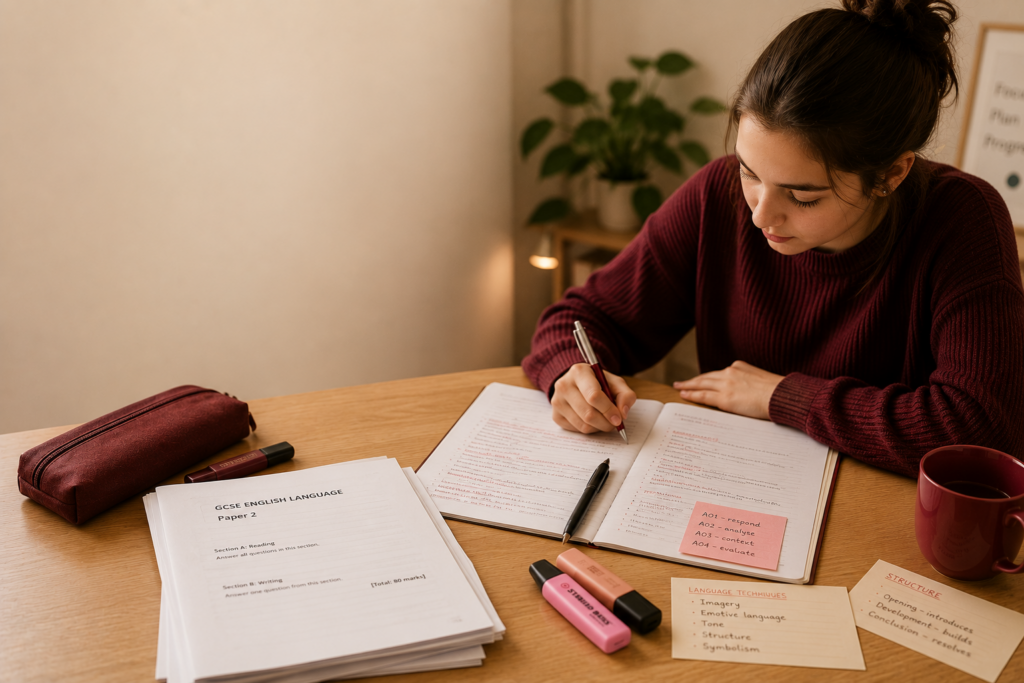
A student can know a quotation, understand a character, and have revised every weekend, yet still underperform in a timed paper. That is why GCSE English mock exam practice matters. It is where knowledge has to become a clear, purposeful answer under the same time pressure, question wording, and decision-making demands students will face in the real exam.
For parents, a mock result can feel alarming, particularly in Year 11. It is better viewed as evidence: a snapshot of what is secure, what is inconsistent, and what needs direct teaching before the final exams. Used well, mock practice does not simply measure performance. It gives a student a structured route to improve it.
Why revision alone does not guarantee marks
GCSE English Language and Literature reward more than subject knowledge. Students must select relevant evidence, explain it precisely, shape an argument, use terminology accurately, and manage their time. In English Language, they may need to shift quickly from close analysis to evaluation or transactional writing. In Literature, they must build a convincing response while keeping the question at the center of every paragraph.
This is why a student who says, “I knew it at home,” may still receive a disappointing mark. The issue is often not effort. It may be that they spend too long planning, retell the story instead of analyzing the writer’s choices, use quotations without explaining their effect, or leave a high-value question unfinished.
Regular timed practice exposes these patterns. More importantly, it gives students repeated opportunities to replace them with better habits before the final grade is at stake.
What effective GCSE English mock exam practice looks like
A useful mock should feel close enough to the real examination to reveal genuine strengths and gaps. That means working from an appropriate AQA-style paper, following the allotted time, and completing the paper independently. A half-finished answer completed later with notes is revision. It is not a reliable mock.
However, students do not need to sit a full paper every week. Full mocks are valuable for stamina, timing, and identifying broad priorities, but they can be demanding. Between full papers, focused practice on one question type is often the faster route to improvement. A student struggling with Language Paper 1 Question 4, for example, needs deliberate evaluation practice, not another vague instruction to “write more.”
The strongest approach combines realistic exam conditions with targeted follow-up. The mock identifies the problem. Focused teaching and shorter practice build the skill. A later timed response checks whether the improvement has held under pressure.
Start with an honest baseline
The first mock is not about proving a student is ready. It is about finding out where they are. Parents should look beyond the final score and ask more useful questions. Which questions earned marks consistently? Was time managed effectively? Did the student answer the question set, or write a prepared response? Are technical accuracy and handwriting affecting clarity?
For Literature, it also helps to separate gaps in text knowledge from gaps in writing. A student may know Macbeth very well but struggle to explain Shakespeare’s methods. Another may write thoughtful analysis but have too few quotations available to support it. Those require different next steps.
At NL Tutoring, this principle sits at the heart of the Assess, Build, Achieve framework. Accurate assessment should lead to specific teaching, rather than generic worksheets or repeated papers without feedback.
Use examiner-informed feedback, not just a score
A mark alone rarely tells a student how to improve. “Add more detail” can be particularly unhelpful because it may encourage longer answers rather than sharper ones. Students need feedback connected to the assessment objectives and translated into practical actions.
For example, a Literature student may be told that their argument is relevant but underdeveloped. The action is not simply to write more. It may be to begin each paragraph with a direct judgment, select a short quotation, and explain how one key word supports the point. A Language student who makes sensible comments but does not reach the top levels may need to make a clearer overall judgment before choosing evidence to prove it.
The best feedback identifies one or two priority improvements at a time. If a student is asked to fix structure, analysis, vocabulary, spelling, timing, and quotation knowledge in the next answer, confidence can disappear quickly. A disciplined plan creates progress that students can see.
A practical cycle for mock improvement
After a mock, students should avoid immediately starting another full paper. First, they need time to understand the result and act on it. A simple cycle works well: review the paper, reteach the weakest skill, complete a focused practice task, then return to a timed question.
Consider a student who loses marks because their Literature paragraphs become descriptive. Their next practice should not be a complete essay on a different text. It should be a short paragraph exercise focused on moving from quotation to analysis. Once that skill is stronger, they can use it in a timed essay section.
For English Language, the same principle applies. If a student runs out of time on creative writing, the answer may be a tighter planning routine and timed paragraph practice. If their writing lacks control, they may need sentence-level work before attempting another 45-minute response.
Progress comes from repetition with purpose. Each new attempt should have a clear focus, such as maintaining an argument, embedding quotations, evaluating a writer’s methods, or leaving five minutes to check accuracy.
Build timing gradually
Timing is one of the most common reasons capable students lose marks. Under pressure, some write far too much for early questions and rush the final section. Others spend several minutes staring at the paper because they are unsure how to begin.
Students should know an approximate time budget for each section of their specific paper and practice following it. A visible timer can help during home practice, but it should support calm decision-making rather than create panic. The goal is to help students recognize when to move on, not to make every response identical in length.
It depends on the student’s starting point. A student working toward a secure pass may first need extra time to plan and finish a coherent answer. An ambitious Grade 7 to 9 student may need to refine the quality and precision of every paragraph within stricter time limits. Both need timed practice, but the targets should be realistic and individual.
What parents can do at home
Parents do not need to become English teachers or mark every response. Their most valuable role is often to protect a consistent routine and make practice manageable. Agree a quiet time, make sure the right texts and papers are available, and ask the student to explain their next improvement target before they begin.
After practice, ask specific questions: “Which question took the longest?” “What did you do differently this time?” and “What will you repeat next time?” These questions encourage reflection without turning every session into a stressful interrogation about grades.
It is also worth watching for avoidance. If a student repeatedly revises notes but refuses to write timed answers, that usually signals low confidence or uncertainty about the process. Support is most effective when it addresses the reason behind the avoidance, whether that is a knowledge gap, weak essay structure, or fear of getting it wrong.
Turn mock results into calm, focused preparation
Mock exams are useful because they make the invisible visible. They show whether a student can apply what they know when the clock is running, the question is unfamiliar, and every paragraph needs a purpose. They should never be treated as a final verdict on potential.
With qualified, examiner-informed guidance, a mock can become the beginning of a much clearer plan: identify the gap, build the skill, and test it again. The next practice paper should not feel like a gamble. It should give a student one more opportunity to show themselves that focused preparation changes what they can achieve.