
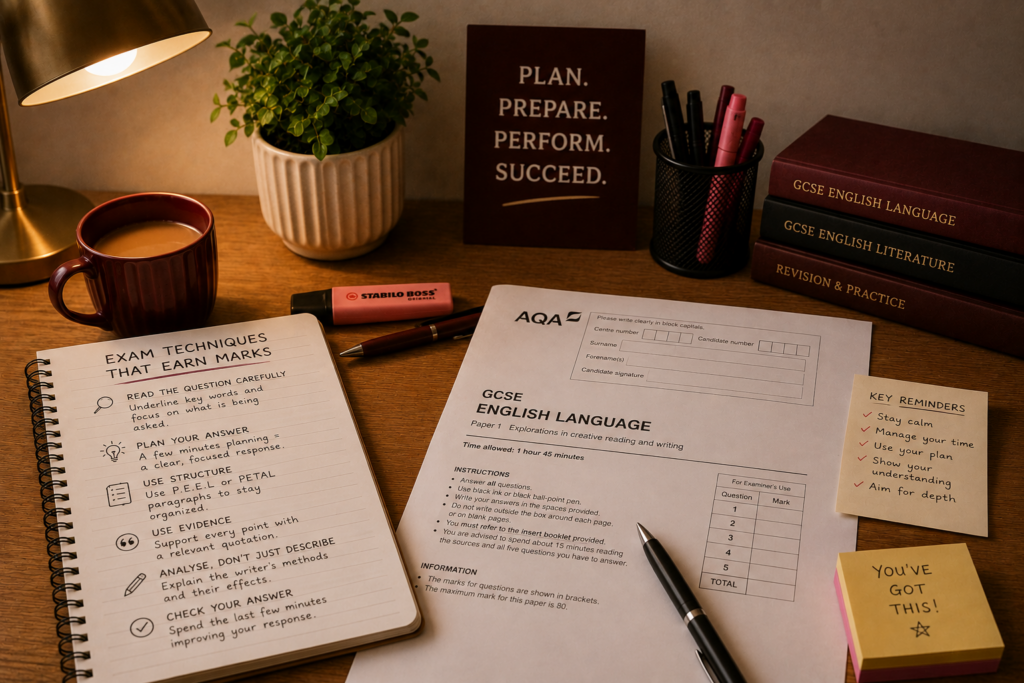
A student can know a text well, have sensible ideas, and still leave marks behind in a GCSE English exam. The difference is often not effort or intelligence. It is the ability to apply reliable English exam techniques when the clock is running, the question is unfamiliar, and every paragraph needs to earn its place.
For parents, this can be frustrating to watch. Your child may revise quotes, complete homework, and speak confidently about a novel at home, yet produce a rushed or unclear response in timed conditions. GCSE English rewards knowledge, but it also rewards controlled thinking: selecting the right evidence, explaining it precisely, and organizing a response that answers the question from start to finish.
English Exam Techniques Begin Before Writing
Strong exam answers are rarely created by students who start writing immediately. A short, deliberate planning stage prevents a common problem: a response that contains relevant ideas but loses direction halfway through.
Students should first identify the focus of the question. Is it asking about a character, a relationship, a theme, a writer’s methods, or a change across the text? They should underline the key words and turn the question into a simple statement they can test every paragraph against. If the question asks how a writer presents power, for example, every point must return to presentation and power, not simply describe events involving a powerful character.
Next, students need a manageable argument. This does not have to be complicated. A clear overall view, followed by three connected points, gives the response shape. For literature, those points may track a development across the text or explore different aspects of the central idea. For language, they may move through the source in order, following the writer’s choices and their effects on the reader.
Planning should be brief. Spending ten minutes producing a detailed plan can create a different problem: not enough time to write. The goal is a few purposeful notes, not a second essay.
Build a Paragraph Around an Argument
A high-mark paragraph does more than include a quotation and label a technique. It makes a point, supports it with carefully chosen evidence, and explains how the writer’s language or structural choices create meaning.
Students often lose marks by retelling the story. Retelling may show knowledge, but it does not demonstrate analysis. Instead of writing that a character is angry because of what happened, a stronger response considers how the writer makes that anger visible and why it matters at that moment in the text.
Short quotations are usually more useful than long ones. They are easier to embed, leave room for analysis, and help students focus on individual word choices. A student writing about the word “cold,” for instance, can explore its associations, its possible emotional meaning, and the atmosphere it creates. That is more valuable than copying an entire sentence and offering one general comment.
The best analysis remains precise without becoming forced. Not every word needs three possible meanings. A thoughtful explanation of one significant choice is stronger than a list of techniques with no real development.
Use Evidence With Control, Not Quantity
Students aiming for a secure pass need relevant evidence and clear explanations. Students targeting Grades 7 to 9 need greater precision, a convincing argument, and a confident sense of the writer’s intentions and choices. In both cases, the answer is not to memorize dozens of quotations without knowing how to use them.
For English Literature, students should learn a small bank of flexible quotations for each major character and theme. The most useful quotations are those that can be applied to several questions. A single line might reveal ambition, conflict, morality, or change depending on the question and the student’s explanation.
Context should also support the argument rather than interrupt it. A disconnected sentence beginning “In those days…” can feel bolted on. Context is strongest when it helps explain a writer’s purpose or an audience response. For example, a student might connect a text’s treatment of class, gender, power, or religion to the concerns of its original audience, then return directly to the quotation and question.
For English Language, the evidence comes from the source itself. Students should avoid hunting for a technique first and then deciding what to say about it. Start with the meaning or effect. What does the writer want the reader to notice, feel, or question? The method should serve that interpretation.
Time Management Is an Exam Skill
Many students know the feeling of reaching the final question with too little time left. This is not always caused by slow writing. It can happen because they spend too long on an early question, over-plan, or try to make every sentence perfect before moving on.
A useful approach is to divide the available time according to the marks, with a small allowance for reading and checking. The higher-mark questions deserve the larger share of time. Students should know their rough time limits before exam day and practice using them in timed work.
If a student gets stuck, they should write the strongest point they can make and move forward. One incomplete idea should not take time away from an entire final response. Examiners can only award marks for what is on the page.
Handwriting also matters in a practical sense. It does not need to be beautiful, but it must be readable. Clear paragraphs, sensible spacing, and accurate quotation marks make it easier for an examiner to follow the argument. Presentation will not replace analysis, but untidy work can make sound thinking harder to communicate.
Read Questions Like an Examiner
Exam questions often contain instructions that students overlook under pressure. Words such as “how,” “in this extract,” “elsewhere in the text,” “language,” and “structure” tell students exactly what to include.
For an extract question, students must give the extract enough attention before moving to the wider text. For a comparison question, they need genuine comparison throughout, not one paragraph on Source A followed by one paragraph on Source B with a final sentence saying both are similar. For a writing task, they must match the form, audience, and purpose. A speech should sound different from an article, and a letter should make deliberate choices about tone and address.
Students should also be cautious with vague phrases such as “this makes the reader want to read on” or “the writer uses a metaphor.” These may be a starting point, but they do not explain enough on their own. The next question should be: what specifically does the reader think or feel, and how has the writer created that response?
Practice Under Realistic Conditions
Revision that only involves reading notes can build familiarity, but it does not fully prepare students for an exam. They need regular opportunities to retrieve knowledge, plan answers, and write under timed conditions.
A balanced routine might include revisiting key quotations, annotating a short extract, planning one response, and completing one timed paragraph or question. Full papers are useful too, especially closer to the exam, but they should be reviewed carefully afterward. Students need to identify whether marks were lost through knowledge gaps, unclear analysis, weak organization, or timing. Each problem needs a different solution.
Feedback is most valuable when it is specific. “Add more detail” is less helpful than identifying that a paragraph needs a clearer topic sentence, closer word-level analysis, or a more direct link to the question. This is the thinking behind NL Tutoring’s Assess, Build, Achieve approach: identify the barrier first, then teach the exact skill that will move the student forward.
Confidence grows when students can see that exam performance is made up of learnable habits. They do not need to sound like a university lecturer or produce a perfect answer every time. They need to understand the question, make a clear argument, select evidence purposefully, and keep going when the exam feels demanding.
The most helpful next step is simple: choose one past-paper question, set a realistic time limit, and review the finished response against the question rather than against perfection. Small, focused practice now can give a student far more control when it matters most.