
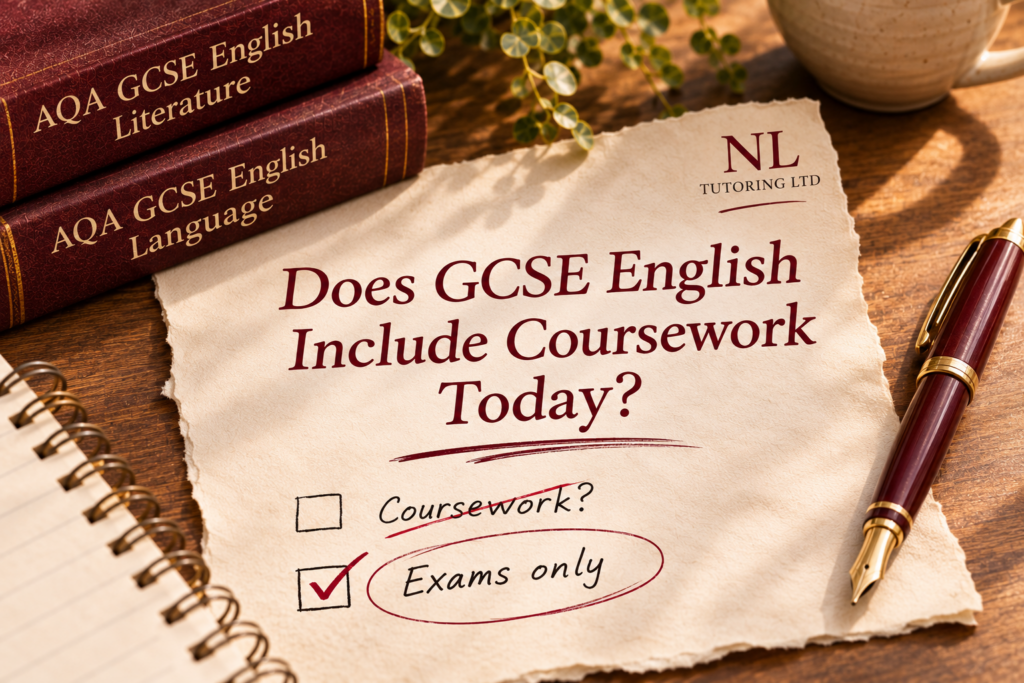
A student may spend weeks producing a polished essay in class and still ask, quite reasonably, does GCSE English include coursework? For most students taking the current GCSEs in England, the short answer is no: their final grade in GCSE English Language and GCSE English Literature is determined by written examinations, not by a folder of coursework completed over the year.
That answer needs one important qualification. English Language includes a spoken language assessment, and schools may still set extended writing, presentations, and projects throughout Years 10 and 11. These matter for learning and preparation, but they do not usually count toward the final 9-1 grade. Knowing the difference helps families direct time and energy toward the work that will make the greatest difference on exam day.
Does GCSE English Include Coursework in England?
For the reformed GCSE English qualifications used by most schools in England, including AQA GCSE English Language and AQA GCSE English Literature, there is no traditional coursework that contributes to the final grade.
GCSE English Language is assessed through two written exam papers. Students are tested on reading unfamiliar texts, analyzing writers’ methods, comparing ideas, and producing their own creative and transactional writing. GCSE English Literature is also assessed through written exams, where students answer questions on the set texts studied in school, such as a Shakespeare play, a nineteenth-century novel, modern drama or prose, and poetry.
The key point for parents is simple: a strong final grade depends on what a student can recall, analyze, organize, and write under timed exam conditions. A carefully edited homework essay is useful practice, but it is not submitted as a piece of grade-bearing coursework.
What About the Spoken Language Assessment?
This is the part that often causes confusion. As part of GCSE English Language, students complete a spoken language assessment. They normally give a presentation, respond to questions, and take part in discussion. It is assessed by the school and recorded separately as Pass, Merit, Distinction, or Not Classified.
The spoken language result appears alongside the GCSE English Language grade, but it does not add marks to or reduce the final 9-1 grade. A student could achieve a high written grade with a Pass in spoken language, or achieve a Distinction in spoken language without that changing their written exam grade.
That does not mean students should dismiss it. Speaking clearly, planning a line of argument, and responding thoughtfully to questions all build valuable confidence. It can also be a positive indicator for applications and interviews. However, families should keep the assessment in proportion. It is separate from the written exams that determine the GCSE grade.
Why Schools Still Set “Coursework”
Students and parents often use the word “coursework” to describe any substantial assignment completed at home or in lessons. A school may ask students to write a full literature essay, create a speech, complete an anthology comparison, or research context for a novel. These tasks can feel like coursework because they are completed over several lessons and receive detailed teacher feedback.
In most cases, they are classwork, homework, or assessment practice rather than formal GCSE coursework. They serve a real purpose: teachers use them to identify gaps in knowledge, improve writing, and prepare students for the demands of the exams.
The distinction matters because it changes the best strategy. If an assignment were worth a large proportion of a final grade, students would prioritize drafting and refining that single piece. Because GCSE English is exam assessed, students also need to practice planning rapidly, selecting evidence accurately, writing with control, and finishing answers within a fixed time.
Where the Final Marks Come From
The exact papers and question formats depend on the exam board, so parents should always check the specification their school follows. For AQA, the structure is clear.
In GCSE English Language, students complete Paper 1 and Paper 2. One paper focuses on creative reading and writing, while the other focuses on writers’ viewpoints and perspectives. Success requires more than spotting language techniques. Students need to explain how a choice creates meaning, use precise evidence, and shape their own writing for a clear purpose, audience, and form.
In GCSE English Literature, students answer questions on their studied texts and poetry. They need secure knowledge of plot, characters, themes, and quotations, but knowledge alone is not enough. Examiners reward students who develop a focused argument and analyze how writers create effects. For the highest grades, students must make thoughtful, well-supported interpretations while maintaining control of expression under pressure.
This is why students can sometimes be surprised by a mock result. They may understand a text in discussion and produce thoughtful homework, yet struggle to turn that understanding into a complete answer in 45 minutes. Exam practice is not an afterthought. It is part of learning the subject.
The Trade-Off: Polished Homework vs. Timed Practice
Homework still has a place. A slower, teacher-guided essay allows students to learn how to structure a paragraph, embed a quotation, and refine vocabulary. Particularly in Year 10, this deliberate practice builds the foundation for stronger independent work later.
By Year 11, however, students need a balanced approach. Spending two hours perfecting one paragraph may improve that paragraph, but it does not necessarily prepare them to answer an unfamiliar question against the clock. They must also practice making decisions independently: which evidence to choose, which points to prioritize, and how much time to give each section.
A productive study plan includes both. Students should complete untimed work when they are learning a new text or writing method, then revisit the skill in timed conditions. Afterward, feedback should identify one or two precise next steps, rather than simply telling a student to “add more analysis.” Clear targets create progress that students can see and repeat.
How Parents Can Help Without Becoming the Teacher
Parents do not need to know every poem or mark every practice essay to offer useful support. The most effective help is often practical and consistent: protecting a regular study time, asking a student to explain what they are revising, and encouraging them to use feedback on the next piece of work rather than filing it away.
It is also worth asking direct questions at parents’ evening or by email: Which exam board is my child taking? What are their current strengths and gaps? Are they struggling more with knowledge, writing quality, timing, or confidence? What should they practice before the next assessment?
If a student is repeatedly revising but not seeing results move, the issue is rarely effort alone. They may need to learn a more reliable essay structure, close gaps in text knowledge, or understand what the mark scheme is actually rewarding. Targeted support should begin with diagnosis, not a generic stack of worksheets.
A Better Way to Prepare for GCSE English
The absence of coursework can feel daunting because there is no portfolio of marks to fall back on. Yet it also gives students a clear route forward. Their grade is not dependent on one project completed months earlier. With the right teaching, focused practice, and feedback, students can make meaningful improvements before the final exams.
At NL Tutoring, the Assess, Build, Achieve framework begins by identifying the specific barriers holding a student back. From there, students build stronger subject knowledge, analytical writing, and exam technique through structured, examiner-informed teaching. This supports students working toward a secure pass as well as those aiming for Grades 7, 8, and 9.
The most helpful next step is not to worry about missing coursework marks. It is to make sure your child knows what their exams require, practices the right skills regularly, and receives feedback they can use. That is how confidence becomes a stronger GCSE English result.