
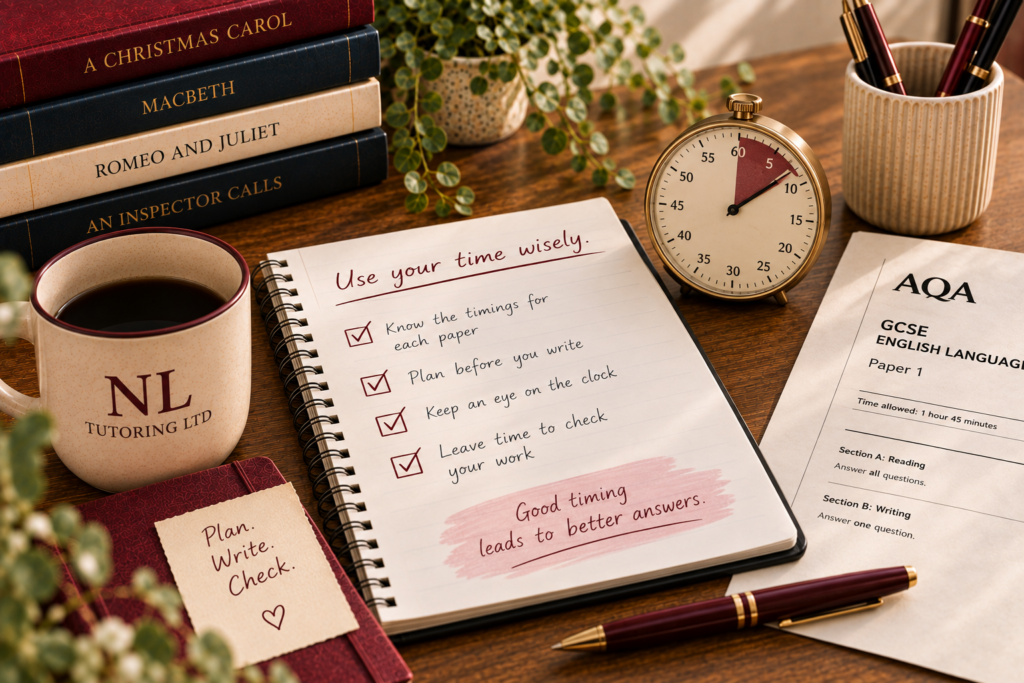
The short answer is yes: are GCSE English exams timed is one of the most common questions families ask because timing can affect a student’s grade as much as their subject knowledge. A student may understand a text, have strong ideas, and know relevant quotations, but still lose marks if they cannot plan, write, and check their response within the time available.
For many Year 10 and Year 11 students, the pressure does not come from writing itself. It comes from deciding what to say quickly, organizing it into a clear response, and keeping enough time for every question. That is why timed practice should be a deliberate part of GCSE English preparation, not something left until the final weeks before the exams.
Are GCSE English exams timed on every paper?
Yes. GCSE English Language and GCSE English Literature papers are completed under formal time limits. The exact length depends on the exam board and the qualification, so families should always check their school’s final timetable and the specification being studied.
For students taking AQA GCSE English, the usual exam lengths are as follows:
- English Language Paper 1: 1 hour 45 minutes
- English Language Paper 2: 1 hour 45 minutes
- English Literature Paper 1: 1 hour 45 minutes
- English Literature Paper 2: 2 hours 15 minutes
These are substantial exam sessions, but they pass quickly when a paper contains several reading questions, a longer writing task, or multiple literature essays. Students are expected to manage that time independently. The invigilator can announce time warnings, but they cannot tell a student when to move on from a question.
This is particularly challenging for students who are perfectionists. Spending too long searching for the “best” quotation or rewriting one paragraph can leave too little time for a high-mark question later in the paper. In GCSE English, a completed, well-structured answer is generally far more valuable than an unfinished response with a promising opening.
Why timing matters in GCSE English Language
English Language papers test reading, analysis, comparison, and writing. Each skill requires a different approach, yet all must fit inside one exam session.
On AQA English Language Paper 1, students respond to one fiction extract before completing a creative writing task. Paper 2 uses two nonfiction texts and finishes with transactional writing, such as a speech, article, or letter. The extended writing question carries significant marks, which means students need to protect enough time to plan, write, and proofread it.
A useful principle is that time should broadly reflect marks. If a question is worth a small number of marks, it should not receive the same attention as a longer analytical or writing response. This sounds obvious, but under pressure students often do the opposite: they linger over an early question because it feels manageable, then rush the question that could make the biggest difference to their final score.
Strong timing is not about writing at top speed. It is about making controlled decisions. A student needs to read actively, select evidence without overthinking, build paragraphs efficiently, and move forward when a question has been answered.
Planning is not wasted time
Some students avoid planning because they fear it will reduce their writing time. Usually, the opposite is true. A short, focused plan helps students avoid repetition, choose a clear line of argument, and create paragraphs with a purpose.
For a longer writing task, even three to five minutes of planning can make the response more coherent. For literature essays, a brief plan can establish the main ideas, supporting quotations, and the order of paragraphs before writing begins. The goal is not a detailed page of notes. It is a reliable route through the answer.
Timed GCSE English Literature exams require different decisions
English Literature timing can feel more demanding because students must recall knowledge as well as construct analysis. They may need to write about a Shakespeare play, a nineteenth-century novel, a modern text, poetry, or unseen poetry, depending on the paper.
AQA English Literature Paper 1 normally assesses Shakespeare and the nineteenth-century novel. Paper 2 covers modern texts, poetry, and unseen poetry. Students need to divide their time across the required sections carefully, including planning and checking time.
The strongest literature answers are not simply the longest. Examiners reward a focused argument supported by well-chosen evidence, thoughtful analysis of the writer’s methods, and relevant context where it adds genuine value. A student who writes three developed paragraphs that stay tightly connected to the question can outperform someone who writes far more but drifts into retelling the plot.
This matters for timing. Students aiming for Grades 7 to 9 do not need to include every quotation they have memorized. They need to select the most useful evidence and analyze it precisely. Students working toward a secure pass also benefit from this approach: a clear point, a short quotation, and an explanation of its meaning is more effective than a rushed list of disconnected ideas.
How students can manage exam time more confidently
Timing improves when students practice a repeatable method. They should not walk into the exam hoping they will “write faster” on the day. Instead, they need to know how long each stage of the paper should take and what to do if they fall behind.
Start by using a watch or visible timer during practice. Complete one question at a time under realistic conditions, then build toward full-paper practice. Afterward, review more than the final mark. Ask whether the student spent time in proportion to the marks available, whether they completed every question, and whether their final response was rushed.
It also helps to give each answer a simple internal structure. In reading and literature questions, students can make a point, use evidence, and explain the writer’s choice. In writing tasks, they can plan a clear purpose and audience, organize ideas into deliberate paragraphs, and leave a few minutes to check spelling, punctuation, and clarity.
When students get stuck, they should avoid freezing. They can write their strongest point first, use a shorter quotation, or move on and return later if time permits. Examiners can only award credit for what is on the page. A student does not need a perfect answer to earn worthwhile marks.
What about extra time and access arrangements?
Some students are entitled to access arrangements, such as extra time, rest breaks, a reader, or a computer. These arrangements are based on evidence and must be approved and organized through the school or exam center. They are not automatically granted because a student finds exams stressful or works slowly.
Families who believe an arrangement may be appropriate should speak to the school’s special educational needs coordinator or exams officer well before the exam season. Even with extra time, students need practice using it effectively. Extra time can support processing, reading, and writing, but it does not replace a clear exam strategy.
The right kind of practice builds calm as well as speed
A student’s first timed paper may be messy. They may run out of time, write too much for one question, or find that their ideas disappear when the clock starts. This is useful information, not a sign that they cannot succeed.
The most productive approach is to identify the specific gap. Does the student read too slowly? Do they struggle to select quotations? Is paragraph structure taking too long? Are they spending ten minutes deciding how to begin? Each issue needs a different solution, which is why generic advice to “manage your time better” rarely changes results.
Examiner-informed tuition can help students rehearse the decisions that matter under pressure: what a question is really asking, which evidence is enough, how much detail a mark level requires, and when to move on. At NL Tutoring, this is built through an Assess, Build, Achieve approach that identifies gaps before students practice the techniques needed to improve.
The aim is not to make students rush. It is to help them enter the exam knowing that they have a plan, can adapt if a question feels difficult, and have enough control over the clock to show what they truly know.