
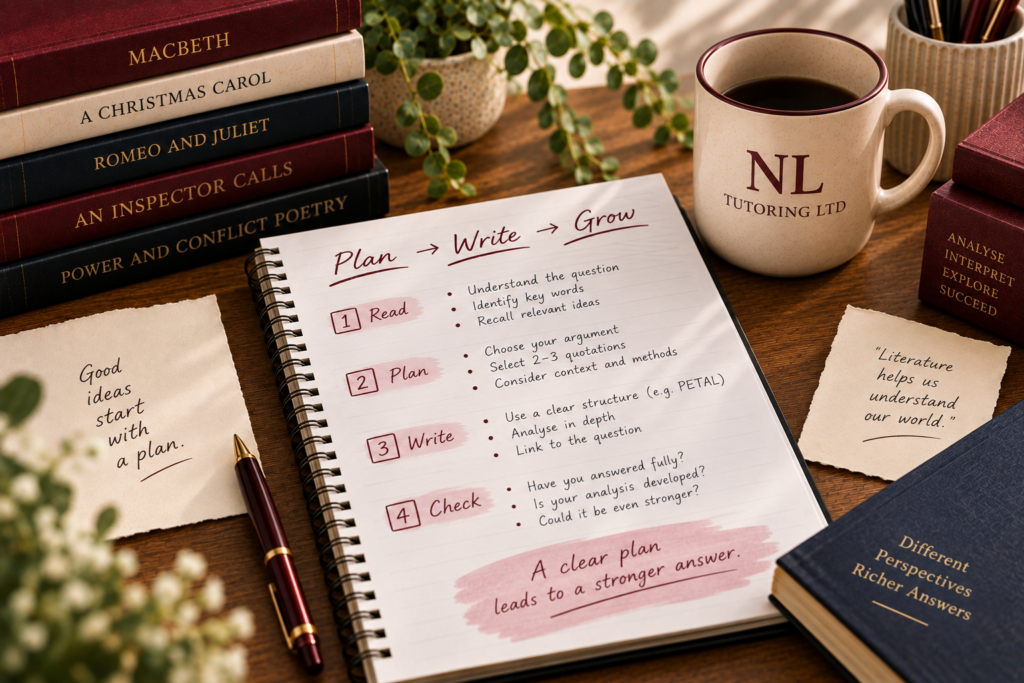
A student can know the text well and still lose marks because their essay has no clear direction. That is why learning how to plan literature answers matters: a short, purposeful plan helps students select the right evidence, develop a convincing argument, and stay focused when the clock is running.
For GCSE English Literature, planning is not about writing every sentence before the essay begins. It is about making the key decisions early, so the final response feels controlled rather than rushed. Students aiming for a secure pass need a reliable structure they can repeat. Students targeting Grades 7-9 need that same structure, with sharper ideas about the writer’s methods and the significance of the text.
Why planning earns marks in GCSE Literature
AQA examiners do not award marks for a plan itself. They award marks for a clear response to the question, thoughtful analysis of methods, and relevant understanding of context where it genuinely supports the point. A strong plan gives students the best chance of showing all of this in a limited time.
Without a plan, many students fall into familiar traps. They retell the plot, use every quotation they can remember, or write three paragraphs that repeat the same idea in slightly different words. These essays may sound busy, but they do not build an argument.
A plan prevents this by answering three questions before the main writing starts: What is my overall view? Which three ideas will prove it? Which evidence best supports each idea?
That clarity is particularly valuable for students who lose confidence in exams. They no longer have to invent the whole essay as they write. They can work through a sequence they have already chosen.
How to plan literature answers in five minutes
The best plan is brief enough to create under timed conditions and detailed enough to guide the whole response. Five minutes is usually sufficient once the method has been practiced consistently.
1. Decode the question before choosing quotations
Read the question twice and underline its focus. If a question asks how Shakespeare presents Macbeth as a conflicted character, the focus is not simply “Macbeth.” It is his conflict and Shakespeare’s presentation of it.
Students should also notice the command word. “How does the writer present…” requires analysis of the writer’s choices. “How far do you agree…” requires a clear viewpoint and room for nuance. “Starting with this extract…” means the extract must be used, but the answer must also range across the wider text.
A useful habit is to turn the question into a short statement. For example: “Shakespeare presents Macbeth’s conflict as a battle between ambition, conscience, and fear.” This becomes the argument that holds the essay together.
2. Write one clear thesis
A thesis is the student’s direct answer to the question. It should be specific enough to guide the paragraphs but not so complicated that it becomes difficult to prove.
Weak thesis: “Priestley presents Sheila in different ways.”
Stronger thesis: “Priestley presents Sheila as initially sheltered but increasingly morally aware, using her development to challenge the audience’s attitudes toward responsibility.”
The stronger version gives the student a route through the essay. It suggests a starting point, a change, and a reason why Priestley may have written the character this way. That is far more useful than beginning with a broad comment and hoping the argument appears later.
For higher-grade responses, encourage students to avoid absolute claims unless the text truly supports them. Words such as “initially,” “increasingly,” “largely,” and “ultimately” allow for a more precise, mature argument.
3. Choose three distinct paragraph ideas
The three main ideas should not be three versions of the same point. They should show development, contrast, or different aspects of the character, theme, or relationship.
For a question on power in An Inspector Calls, a student might plan how power is first controlled by Mr. Birling, then disrupted by the Inspector, and finally reconsidered through Sheila and Eric. For a question about fear in Jekyll and Hyde, the plan may move from public fear of Hyde, to Jekyll’s private fear of himself, to Victorian fears about hidden human nature.
The exact number of paragraphs can vary. Some students will write three substantial paragraphs; others may write four shorter, well-developed ones. What matters is that every paragraph moves the answer forward. If two planned points sound almost identical, combine them or replace one.
4. Match evidence to each idea
Students do not need to memorize long quotations to plan effectively. In fact, forcing in lengthy quotations often creates awkward analysis. Short, precise references are easier to remember and give students more control over language analysis.
For each paragraph, select one or two pieces of evidence that genuinely fit the point. Write only key words in the plan. A student writing about Scrooge might note “solitary as an oyster,” “decrease the surplus population,” and “I will honor Christmas.” Those small prompts are enough to trigger detailed knowledge without filling valuable exam time.
The crucial question is not, “What quotation do I know?” It is, “What quotation helps me answer this question?” This distinction helps students avoid prepared essays that have been awkwardly reshaped to fit a new task.
5. Add a method and a purpose
Beside each quotation, students should identify one writer’s method to explore. This might be a word choice, image, contrast, stage direction, structural shift, or pattern in the character’s speech. Then they should consider why the writer made that choice.
A simple planning note could look like this:
- Point: Sheila becomes morally independent.
- Evidence: “But these girls aren’t cheap labor.”
- Method: Emotive language and contrast with Birling’s business-focused view.
- Purpose: Priestley encourages the audience to value people over profit.
This is not a paragraph to copy. It is a set of prompts that keeps the writing analytical. The student can now explain how the language works, connect it to the character’s development, and consider Priestley’s message.
Use the extract as a launch point, not a limit
Extract questions can cause students to spend too long on one small section of the text. The extract matters, especially at the beginning of the response, but it is not the whole answer.
A secure approach is to make the first main paragraph closely focused on the extract. Students can then use two or three later paragraphs to track the same idea elsewhere in the text. This creates a response that is rooted in the printed passage while showing wider knowledge.
Before writing, students can add a small note to their plan: “Extract first, then elsewhere.” It sounds simple, but it prevents a common exam error. For top grades, the move beyond the extract should feel purposeful. Do not jump to random scenes just because a familiar quotation is there. Choose moments that deepen, challenge, or develop the initial point.
Plan context carefully
Context should strengthen an interpretation, not become a separate history lesson. A plan does not need a long list of facts about Victorian society, Jacobean beliefs, or postwar Britain. It needs one relevant contextual idea attached to the right paragraph.
For example, when writing about responsibility in An Inspector Calls, a student may connect Priestley’s message to his socialist beliefs and the inequalities of 1912 Britain. When analyzing Macbeth, a student might link the disruption caused by regicide to a Jacobean audience’s beliefs about the divine right of kings.
The trade-off is simple: a relevant contextual point can sharpen analysis, while a memorized point that does not connect to the question can distract from it. Students should never add context merely because they feel they ought to.
Practice planning separately from full essays
Many students only practice literature by writing complete essays. Full essays are valuable, but planning deserves its own practice because it develops speed, selection, and confidence.
Set a five-minute timer and give the student a past-paper-style question. Ask them to write a thesis, three paragraph ideas, selected evidence, and one method for each point. Then review the plan before any essay is written. Are the points distinct? Does every quotation answer the question? Is there a clear route from beginning to end?
This is also an effective way for parents to support revision without needing to be English specialists. Ask the student to explain their three ideas aloud. If they can explain the argument clearly, they are much more likely to write it clearly.
At NL Tutoring, this kind of focused planning sits within an Assess, Build, Achieve approach: identify the gap, teach the structure, then practice it until it becomes dependable under exam conditions.
A literature essay should never feel like a test of who can write the fastest. Give students a reliable planning routine, and they can enter the exam knowing exactly how to turn their knowledge into a focused, persuasive answer.