
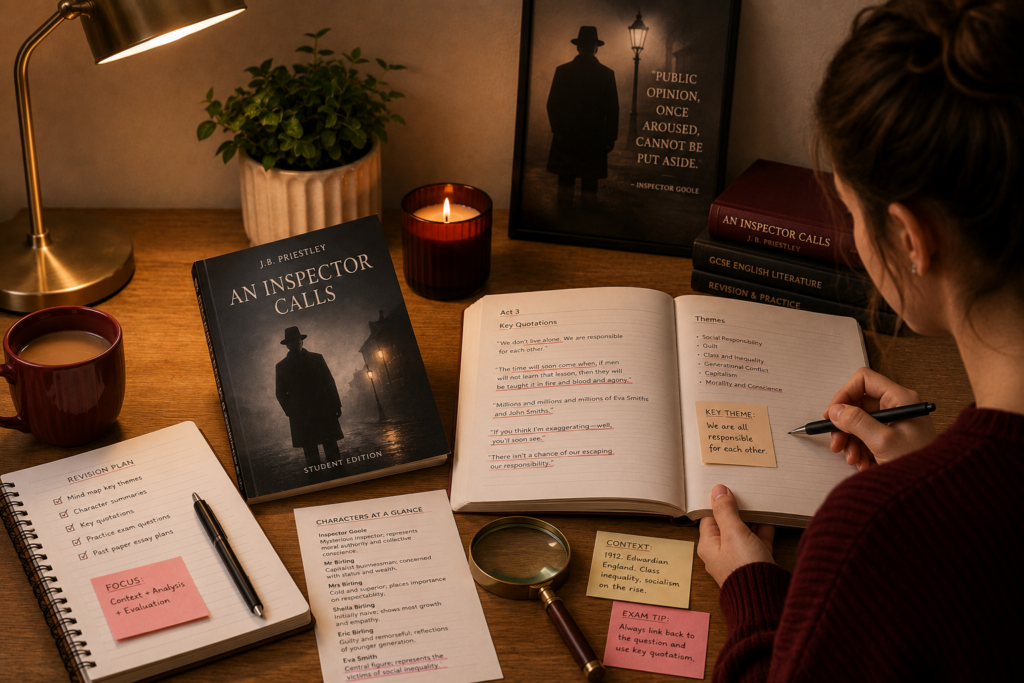
The telephone rings just as the Birlings believe the evening is safely over. That final moment matters because J. B. Priestley leaves the audience with the same uncomfortable question that should sit at the center of every An Inspector Calls revision guide: have the characters actually changed, or have they only been frightened by the consequences?
For GCSE English Literature, revising this play is not about memorizing a long list of quotations. Students need to understand how Priestley constructs his message, select evidence precisely, and turn ideas into a clear argument under timed conditions. That is where secure grades are built – and where students aiming for Grades 7 to 9 can separate thoughtful analysis from a simple retelling of the plot.
What AQA examiners want from an An Inspector Calls essay
On AQA GCSE English Literature Paper 2, students may answer a question focused on a character or a theme. Either way, the strongest response does three things consistently: it presents a convincing argument, analyzes Priestley’s methods, and connects the play to its social and historical purpose.
This means that a paragraph should not stop at, “Sheila is selfish.” A more developed point would explain that Priestley initially presents Sheila as sheltered and careless so that her later remorse feels significant. Her change suggests that younger people can reject the attitudes that protect inequality.
Students should keep the assessment objectives working together rather than treating them as separate boxes. AO1 is the quality of the argument and use of references. AO2 is analysis of language, structure, and dramatic methods. AO3 is relevant context, such as the play being set in 1912 but first performed in 1945. Context earns its place when it explains Priestley’s choices, not when it becomes a history paragraph.
A useful test is this: after every quotation, can the student explain why Priestley chose those words or that dramatic moment? If not, the response may be describing rather than analyzing.
The big idea: responsibility
Responsibility is the thread holding the whole play together. Inspector Goole challenges the Birlings’ belief that people can pursue wealth, status, and comfort without considering the effect on others. Each family member contributes to Eva Smith’s suffering, even if no individual action alone causes her death.
Priestley’s clearest statement is the Inspector’s claim that “we are members of one body.” The collective pronoun “we” rejects the individualism of Arthur Birling, while the metaphor of “one body” makes society seem connected and vulnerable. If one person is harmed, everyone bears some responsibility.
This is more than a theme to label. In an essay, students should trace how Priestley develops it. Birling dismisses responsibility at the beginning, the Inspector exposes its consequences in the middle, and the final telephone call proves the lesson is not over. That circular structure leaves the audience with no easy escape.
Why the 1912 and 1945 dates matter
Priestley deliberately sets the action before the First World War, when class divisions were sharper and wealthy industrialists such as Birling often resisted workers’ rights. Birling’s confidence that the Titanic is “unsinkable, absolutely unsinkable” makes him look foolish to a 1945 audience, who knew both the disaster and the devastation of two world wars.
The dramatic irony does more than make Birling seem unreliable. It encourages the audience to question his political certainty too, especially his insistence that a man should “mind his own business.” Priestley, who supported greater social responsibility, uses Birling as a warning about complacency and selfish capitalism.
Character revision: follow change, denial, and power
Students often revise characters as isolated profiles. A stronger approach is to compare how each person responds after being confronted. The Inspector does not simply reveal information. He tests whether the Birlings can accept moral responsibility.
Sheila changes most visibly. At first, she is presented through childish language and stage directions such as “very pleased with life.” After learning what happened to Eva, however, she refuses to hide behind excuses. Her warning that the family must not “try to build up a kind of wall” shows that she understands both the Inspector’s lesson and her parents’ instinct to avoid it.
Eric also accepts blame, though his behavior reveals the damaging privilege available to young men. His admission that he was “in that state when a chap easily turns nasty” is evasive at first, but it exposes a culture that normalizes male aggression. Students should avoid presenting Eric only as a victim or only as a villain. Priestley shows that he is responsible for his actions, while also criticizing the social conditions that made those actions easier.
In contrast, Mr. and Mrs. Birling largely resist change. Mrs. Birling’s contemptuous phrase, “girls of that class,” reduces Eva to a social category rather than recognizing her humanity. Her language reveals entrenched class prejudice. Birling’s concern for a “public scandal” shows that he fears damage to his reputation more than Eva’s death.
Gerald is more complicated. He shows genuine concern when he remembers Daisy Renton, but he ultimately welcomes the possibility that the Inspector was a hoax. This makes him useful in essays about responsibility because Priestley suggests that sympathy without lasting change is not enough.
Quotations worth knowing well
A student does not need twenty quotations for every character. It is more effective to know a small number securely, understand their methods, and use them flexibly across different questions. These six can support a wide range of arguments:
- “Unsinkable, absolutely unsinkable” – Birling’s arrogance, dramatic irony, and unreliable authority.
- “Girls of that class” – Mrs. Birling’s prejudice and dehumanizing class attitudes.
- “We are members of one body” – the Inspector’s collective message and Priestley’s moral purpose.
- “Fire and blood and anguish” – a prophetic warning, linked to war and the consequences of ignoring responsibility.
- “You’re beginning to pretend now that nothing’s really happened at all” – Sheila’s moral clarity and the older generation’s denial.
- “I did what I did” – Eric’s acceptance of guilt, contrasting with Birling’s excuses.
When using a quotation, students should zoom in on one or two words rather than explaining every word in the line. For example, “fire and blood and anguish” uses a tricolon to make the warning sound relentless. The violent nouns foreshadow suffering on a national scale and make the Inspector’s message impossible to dismiss as polite advice.
Turn revision into better essays
Knowledge only improves grades when students can retrieve and apply it. A practical revision routine should move from learning to writing. First, choose one theme or character and create a one-page plan with three arguments, each linked to a quotation and a dramatic method. Then practice explaining each point aloud without notes. If the explanation is vague, the knowledge is not yet secure.
Next, write one focused paragraph in timed conditions. Aim for a clear topic sentence, embedded evidence, close language analysis, and a link to Priestley’s wider purpose. A strong paragraph might begin: “Priestley presents Sheila as capable of change in order to challenge the complacency of the older generation.” That opening gives the paragraph direction before the quotation appears.
Finally, review the paragraph with an examiner’s eye. Has the student answered the question throughout? Have they analyzed methods rather than simply named them? Is context connected to the argument? Accurate spelling, punctuation, and sentence control also matter, as AQA awards additional marks for technical accuracy.
At NL Tutoring, this is the kind of structured process used to identify what a student knows, build the missing analytical skills, and help them write with greater confidence under exam pressure.
Common mistakes that limit marks
The most common issue is plot retelling. Students may know exactly what happens to Eva Smith but lose marks because they do not explain why Priestley reveals events in that order. The interrogation structure is crucial: each revelation increases tension and prevents the Birlings, and the audience, from treating Eva as a distant stranger.
Another mistake is forcing context into every paragraph. A sentence about 1945 is useful when discussing Priestley’s political message or the audience’s knowledge of war. It is less useful when it has no connection to the quotation being analyzed. Precision is stronger than repetition.
Students should also be careful with the Inspector. It is tempting to state that he is definitely supernatural, but the play leaves this uncertain. A thoughtful answer can say that Priestley presents him as mysterious and almost omniscient, giving his moral message greater authority whether he is a ghost, a conscience, or simply an unusually determined inspector.
The goal is not to produce an essay that sounds complicated. It is to make every paragraph purposeful: a clear idea, carefully chosen evidence, and an explanation of how Priestley wants the audience to think or feel. With regular, focused practice, the final telephone call becomes more than a memorable twist. It becomes the moment students can use to show they understand the play’s warning – and exactly how Priestley makes it impossible to ignore.