
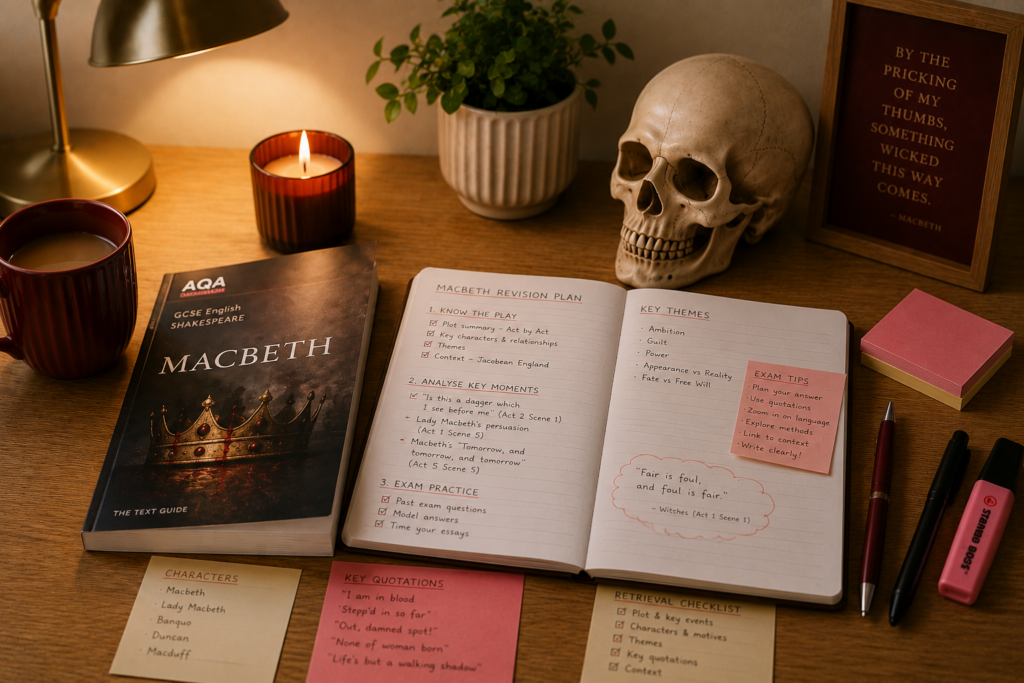
A student can know the story of Macbeth perfectly and still struggle to earn the marks they want. GCSE Literature questions do not reward plot retelling. They reward a clear argument, precise quotation choices, thoughtful analysis, and an understanding of how Shakespeare shapes meaning. That is why learning how to revise Macbeth GCSE effectively means revising for the essay you will need to write, not simply rereading the play.
For families, the goal is not to make revision longer or more stressful. It is to make it structured. A secure pass requires a student to explain ideas clearly and support them with evidence. Grades 7 to 9 require a more developed response: students need to explore Shakespeare’s methods, make meaningful connections, and sustain a convincing interpretation under timed conditions.
Start with an honest Macbeth revision assessment
Before making flashcards or highlighting quotations, identify what is actually holding the student back. Revision is most productive when it begins with a diagnosis rather than a generic checklist.
Ask your child to write a short paragraph responding to a typical question, such as: “How does Shakespeare present Macbeth as a conflicted character?” They should work without notes for 10 to 15 minutes. This reveals far more than asking whether they “understand the play.”
Look for three things. First, do they answer the question directly, or do they retell the plot? Second, can they use short quotations accurately? Third, do they explain how Shakespeare’s language, structure, or dramatic choices create meaning?
A student who has strong ideas but cannot organize them needs writing practice. A student who writes fluently but uses vague evidence needs quotation knowledge. A student who knows quotations but cannot explain them needs guided analytical work. These are different gaps, so they need different revision priorities.
At NL Tutoring, this is the principle behind Assess, Build, Achieve: establish the starting point, teach the missing knowledge or skill, then practice until the student can apply it independently in an exam response.
How to revise Macbeth GCSE without memorizing the whole play
Students do not need to memorize every line of Macbeth. In fact, attempting to do so often creates panic and leaves little time for the skills that produce marks. They need a compact bank of versatile quotations that can be used across several questions.
A useful target is 20 to 30 short quotations, grouped by character and theme. Short quotations are easier to recall accurately and easier to analyze in detail. For example, “vaulting ambition,” “fair is foul,” “unsex me here,” and “out, damned spot” can each support discussion of more than one theme.
The strongest revision method is to learn every quotation alongside three pieces of information: who says it, what it suggests, and where else it could be used. “Stars, hide your fires” is not just a quotation about Macbeth. It can support an essay on ambition, appearance versus reality, guilt, masculinity, and the corrupting effect of power.
Avoid copying pages of quotation notes. Instead, test retrieval. Cover the quotation and recall it from a theme prompt. Then cover the theme and explain why the quotation matters. Finally, practice embedding it in a sentence, such as: Shakespeare presents Macbeth’s ambition as dangerous when he asks the “stars” to conceal his “black and deep desires.”
This final stage matters. Examiners do not award marks for a quotation list. They reward students who use evidence purposefully within an argument.
Build a small but flexible quotation bank
For most students, it is sensible to know several quotations for Macbeth and Lady Macbeth, alongside a smaller selection for Banquo, the witches, Macduff, Malcolm, and King Duncan. Characters should not be revised in isolation, however. Link them to the big ideas of the play: ambition, power, kingship, guilt, violence, fate and free will, the supernatural, gender, loyalty, and appearance versus reality.
There is a trade-off here. A huge quotation bank may look impressive, but it is not helpful if students cannot recall or analyze it. A smaller bank, learned deeply and practiced repeatedly, is usually more valuable.
Revise themes through Shakespeare’s choices
Theme revision becomes much stronger when students move beyond broad statements. “Ambition is bad” is not a developed point. A better idea is that Shakespeare presents unchecked ambition as a force that destroys moral judgment, personal relationships, and political order.
Encourage students to track how a theme develops across the play. Macbeth’s ambition begins as a private desire, becomes a decision to murder Duncan, and eventually leaves him isolated and emotionally numb. This creates a clear line of argument for an essay.
For each major theme, students should be able to explain three things: how it appears at the beginning, how it changes, and what Shakespeare may want the audience to think by the end. This is particularly useful for AQA-style questions because it helps students write about the whole play rather than relying on one scene.
Context should support the interpretation, not take over the essay. A student might explain that a Jacobean audience would have viewed regicide as a serious crime against God’s appointed ruler. They should then connect this directly to Shakespeare’s presentation of Duncan’s murder and the disorder that follows. Context earns its place when it clarifies meaning.
Practice analytical writing, not formulaic paragraphs
Many students have been taught paragraph models that help them get started. These can be useful, especially for students who lack confidence. But rigid formulas can become limiting if every paragraph sounds the same or analysis is reduced to spotting a technique.
A strong paragraph has a clear argument, carefully selected evidence, and an explanation of Shakespeare’s choices. Rather than writing, “This shows Macbeth is ambitious,” students should ask: Why has Shakespeare chosen this word? What does it reveal about the character? How does it connect to the question and the play as a whole?
Take the phrase “vaulting ambition.” A student might explain that “vaulting” suggests something leaping too far or moving beyond control. Shakespeare implies that Macbeth’s ambition is not measured or honorable; it is reckless, and it causes him to “o’erleap” himself. That is analysis because it explores the effect of the language rather than simply naming ambition.
Students aiming for higher grades should also feel confident offering a thoughtful alternative reading when it is supported by the text. For instance, Lady Macbeth may initially seem powerful because she challenges conventional expectations of femininity, yet Shakespeare also shows that her apparent control is fragile. Her later guilt complicates the idea that she is simply the stronger character.
Use extract questions as a two-part task
In AQA GCSE English Literature, students are given an extract and asked to write about the extract and the play as a whole. A common mistake is spending almost the entire essay on the extract. Another is barely referring to it at all.
Teach students to see the extract as a launch point. They should analyze it closely, selecting two or three useful details, then connect its ideas to relevant moments elsewhere in the play. If an extract shows Lady Macbeth persuading Macbeth, the wider play might include her reaction after Duncan’s murder and her sleepwalking scene.
Planning does not need to take long. Under timed conditions, five minutes is enough to decide on a central argument and three main points. A simple plan could follow the character’s development: Lady Macbeth begins as forceful and manipulative, becomes increasingly unsettled by guilt, and ends broken by the consequences of the violence she encouraged.
Create a revision routine that leads to exam readiness
A realistic routine is more effective than an ambitious schedule that lasts three days. Two or three focused Macbeth sessions each week can create real progress when each session has a specific purpose.
One session might focus on recalling and analyzing quotations. The next could develop a theme map or character journey. The third should involve writing: a single high-quality paragraph at first, then a timed plan, and eventually a full response.
Students should mark their own work against clear questions. Have they answered the question in every paragraph? Is each quotation accurate and integrated? Have they analyzed Shakespeare’s methods? Have they moved beyond the extract where needed? This builds independence and makes feedback more useful.
Timed essays are necessary, but they should not be the first step. A student who has not yet learned the content or paragraph structure will simply practice struggling quickly. Build knowledge and confidence first, then gradually add time pressure.
When revision feels uncertain, return to the next manageable task: learn three quotations, explain one theme, improve one paragraph, or plan one essay. Consistent, examiner-informed practice gives students something far more valuable than a last-minute cram session: the confidence to walk into the exam knowing exactly how to show what they know.