
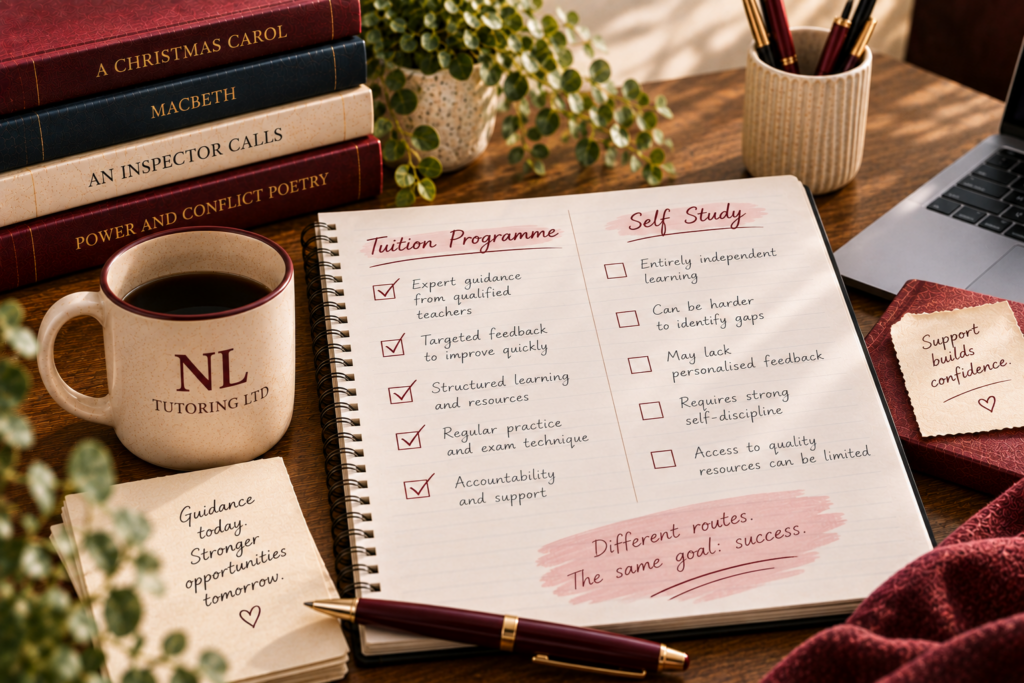
A student can spend three hours revising English and still make little progress if they are practicing the wrong skill. They may reread a quote bank, complete another worksheet, or write an essay without knowing whether it meets the assessment criteria. That is the central question in the tuition programme versus self study decision: not simply how much a student works, but whether their effort is directed toward the marks available in the exam.
For families preparing for GCSE English Language and English Literature, both routes can be valuable. Independent study builds ownership and routine. Structured tuition can provide the diagnosis, teaching, feedback, and accountability that turn effort into measurable improvement. The right choice depends on the student’s current confidence, gaps in knowledge, and ability to act on feedback independently.
Tuition Programme Versus Self Study: The Real Difference
Self study gives students flexibility. A motivated student can revise at a time that suits them, revisit classroom materials, learn quotations, and complete practice questions. It is also an essential part of GCSE preparation. No weekly lesson can replace the regular reading, planning, memorization, and practice a student completes between sessions.
The difficulty is that GCSE English is not only a knowledge-based subject. Students must select evidence carefully, develop an interpretation, analyze a writer’s methods, organize a convincing response, and adapt their writing to a particular question under time pressure. In English Language, they must understand how to approach unfamiliar texts and create purposeful writing for different forms, audiences, and purposes.
A tuition programme adds structure to this process. Rather than asking, “What should I revise tonight?”, the student works from a clear understanding of what is currently limiting their marks. A qualified teacher can identify whether the main issue is weak subject knowledge, unclear paragraph structure, thin analysis, inaccurate writing, slow planning, or exam technique. From there, teaching and practice can be targeted rather than generalized.
For students taking AQA GCSE English, examiner-informed guidance is particularly useful because mark schemes reward specific qualities. A student may have perceptive ideas but lose marks because those ideas are not developed clearly. Another may know the text well but rely on retelling the plot. Knowing what examiners are looking for helps students make better decisions in the moment.
When Self Study Can Work Well
Self study is often effective for students who already have a secure foundation. They understand the texts, can explain what strong analytical writing looks like, and are willing to review their own work honestly. They also need a practical revision plan, not a collection of resources they dip into when they feel like it.
A student is likely to benefit from self study when they can answer three questions clearly: What skill am I working on? What does success look like? How will I know whether I have improved? If they can use teacher feedback to redraft an essay, compare their response against a model, and correct repeated errors, independent work can be highly productive.
Self study is especially useful for retaining knowledge. Learning key quotations, revisiting vocabulary, rereading set texts, and completing short retrieval tasks are regular habits that do not always require direct instruction. The strongest students usually combine this independent discipline with expert feedback at key points.
The risk is assuming that being busy means revision is working. Highlighting notes, watching videos, or writing several essays can feel productive, but none of these activities guarantees progress. Without precise feedback, students may repeat the same habits for months.
When a GCSE English Tuition Programme Makes Sense
Tuition is most valuable when a student needs clarity, consistency, and specialist guidance. This may be a Year 10 student whose confidence has dropped after receiving a disappointing assessment grade, or a Year 11 student who understands classwork but freezes when faced with a full exam paper.
It can also help ambitious students aiming for Grades 7 to 9. Higher grades require more than long answers or sophisticated vocabulary. Students need a controlled, well-supported interpretation, thoughtful analysis of methods, and writing that stays focused on the question. These are teachable skills, but they need repeated modeling and feedback.
A structured programme should begin with assessment rather than assumptions. At NL Tutoring, the Assess, Build, Achieve framework is designed to identify the student’s individual barriers first, then build the relevant skills through focused teaching and practice. This matters because two students with the same current grade may need very different support.
One may need to strengthen sentence control and paragraph organization before attempting more complex analysis. Another may already write fluently but need to select quotations more strategically and develop their explanations. A focused programme avoids giving both students the same generic advice.
The value of immediate, specific feedback
Feedback has the greatest impact when students understand exactly what to do next. “Add more detail” is vague. “Zoom in on one word in the quotation, explain its connotations, and connect it back to the writer’s intention” gives a student a usable action.
Over time, this kind of feedback helps students become independent. They learn how to check whether a paragraph has a clear argument, whether evidence supports the point, and whether their explanation is analytical rather than descriptive. Tuition should not create dependency. It should give students the tools to revise with greater confidence when they are working alone.
The value of exam practice that is actually reviewed
Past papers are useful only when students learn from them. A timed answer followed by no meaningful review can reinforce weak technique. A reviewed answer can reveal whether the student misunderstood the question, spent too long planning, missed an opportunity to analyze language, or failed to leave enough time for accuracy checks.
This is where experienced GCSE teaching and current examiner insight can make a difference. Students need to know not just that an answer is “good,” but why it is earning marks and what would move it forward.
A Better Answer Than Choosing One Route
For many families, the most effective approach is not tuition or self study. It is tuition plus self study, with each doing a different job.
Tuition provides the plan, models the skill, addresses misconceptions, and gives targeted feedback. Self study reinforces learning between sessions. A student might learn how to structure a Literature paragraph in a lesson, then spend the week memorizing quotations, completing a short plan, and improving a paragraph using the feedback they received.
This balance also makes support more sustainable. Students are not expected to solve every problem alone, but they are still responsible for their progress. Parents can feel reassured that revision has direction, while students gain the confidence that comes from seeing their own work improve.
How Parents Can Decide
Look beyond the most recent grade. A grade is useful information, but it does not explain the cause. Consider how your child responds when asked to write an essay independently. Do they know how to begin? Can they explain what an examiner rewards? Do they use feedback in their next piece of work, or do the same comments appear again?
If they are organized, secure in the core skills, and able to improve from classroom feedback, self study may be enough alongside school teaching. If they avoid English revision, lack confidence, produce inconsistent work, or are unsure how to reach the next grade boundary, a structured programme may offer the clarity they need.
The goal is not to fill every hour with extra work. It is to make the work count. When a student understands their next step and has the right support to take it, GCSE English becomes less of a guessing game and more of a skill they can steadily build.