
A student can know a text well and still lose marks if they do not understand the task in front of them. That is why parents often ask, what is in the GCSE English Literature exam? The answer is not simply “four books and some poems.” Students need secure knowledge of their set texts, but they also need to write focused analysis, select evidence under time pressure, and show examiners exactly how they have met the assessment objectives.
For most students following AQA GCSE English Literature, the qualification is assessed through two written exams. The papers are closed book, so students cannot take annotated copies of their texts or poetry anthology into the exam. They need to recall quotations, ideas, characters, themes, methods, and relevant context independently.
What is in the GCSE English Literature exam for AQA?
AQA GCSE English Literature covers four main areas: a Shakespeare play, a 19th-century novel, a modern text, and a poetry anthology. Students also answer questions on poems they have not studied before, known as unseen poetry.
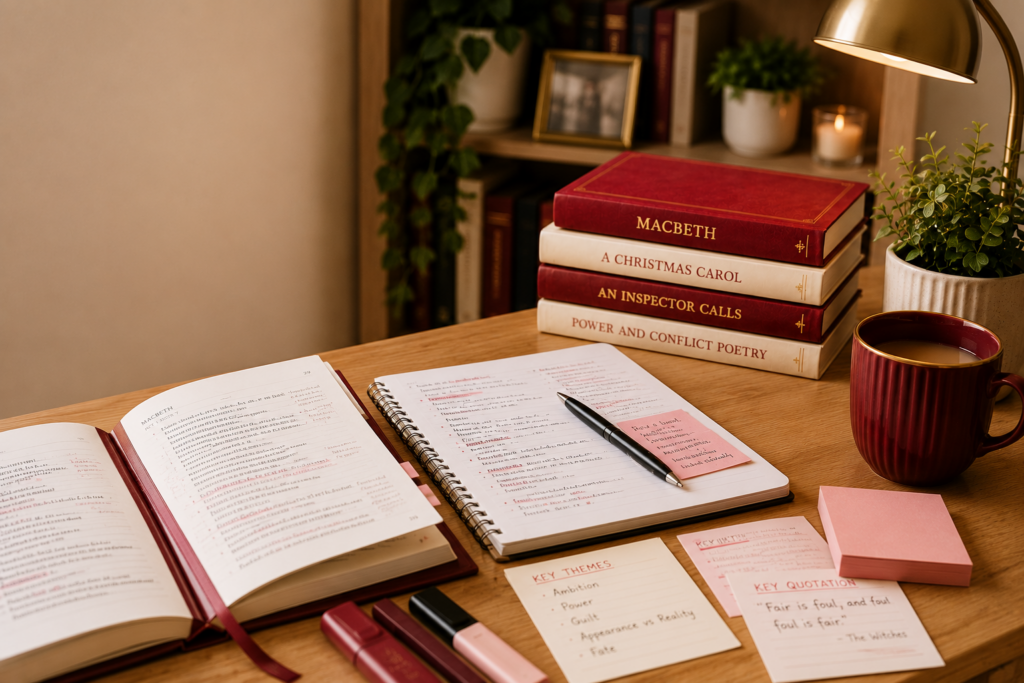
The exact texts vary between schools. One student may study Macbeth, A Christmas Carol, An Inspector Calls, and the Power and Conflict poetry cluster, while another may study entirely different set texts. Parents should always confirm their child’s school choices before buying revision resources or setting a revision plan.
There are no tiers in GCSE English Literature. Every student sits the same papers, whether they are aiming for a secure Grade 4 or working toward Grades 7 to 9. This makes careful preparation particularly valuable: ambitious students need sophistication and precision, while students who lack confidence need a dependable method for building clear, relevant answers.
Paper 1: Shakespeare and the 19th-century novel
Paper 1 lasts one hour and 45 minutes. It is worth 64 marks and covers two of the student’s major set texts.
Shakespeare
The Shakespeare section begins with an extract from the play. Students answer one question that asks them to analyze the extract and connect it to the play as a whole. For example, a question on Lady Macbeth may require students to explore her presentation in the extract before considering how Shakespeare develops her character elsewhere in Macbeth.
This is where students need more than a bank of isolated quotations. They must understand character journeys, key scenes, dramatic methods, and the wider concerns of the play. A strong response moves purposefully between the extract and the whole text rather than treating them as two separate essays.
This question is worth 30 content marks, plus four marks for spelling, punctuation, and grammar. Technical accuracy matters, but it cannot compensate for weak analysis. Clear sentences help an examiner follow the argument; they do not replace it.
The 19th-century novel
The second section focuses on a novel such as A Christmas Carol, Dr Jekyll and Mr Hyde, Frankenstein, or Pride and Prejudice, depending on the school’s chosen text. Students answer one essay question on the novel as a whole.
Questions usually focus on a character, relationship, or theme. Students need to build an argument, use well-chosen references from across the novel, analyze the writer’s choices, and apply context where it genuinely sharpens the point. Listing facts about Victorian poverty, gender, religion, or class without linking them to the novel will not gain high-level marks.
Paper 2: Modern texts, poetry, and unseen poetry
Paper 2 lasts two hours and 15 minutes. It is worth 96 marks, so it requires both knowledge and stamina. Students answer questions on a modern text, their studied poetry anthology, and two unseen poems.
Modern texts
The modern text may be a play such as An Inspector Calls or a novel such as Lord of the Flies, Blood Brothers, or Animal Farm. The question asks students to write about the text as a whole, usually focusing on a character or theme.
Like the Shakespeare and novel questions, this section rewards a clear line of argument. Students should avoid retelling the plot. Examiners are looking for an explanation of how a writer presents an idea, why particular methods matter, and how the text’s meaning develops.
This question carries 30 content marks and four marks for spelling, punctuation, and grammar. For many students, it is an opportunity to show their strongest text knowledge, provided they have practiced turning that knowledge into a focused essay.
Poetry anthology
Students study one AQA anthology cluster chosen by their school. The most common options are Power and Conflict or Love and Relationships, though the school’s specification determines the cluster.
In the exam, students compare a named poem from their anthology with one other poem of their choice from the same cluster. They need to compare ideas and methods throughout, not write one full essay on the first poem and add a short paragraph about the second at the end.
Effective comparison is built into the argument from the start. A student might explore how two poets present the effects of conflict, then compare imagery, structure, tone, and viewpoint as they develop each point. The best second-poem choice depends on the question. It is not always the poem a student knows most easily.
Unseen poetry
The final section gives students poems they have not encountered in lessons. The first question asks for analysis of one poem. The second asks students to compare that poem with another unseen poem.
This can feel intimidating because students cannot rely on memorized quotations or historical research. Yet it is also a section where a calm, structured approach makes a real difference. Students should read for the central idea first, identify the speaker’s perspective and emotional journey, then select a small number of useful language and structural details to analyze.
Unseen poetry does not assess contextual knowledge. Students should not invent background information about the poet or period. Their marks come from close reading, sensible interpretation, and clear explanation.
What are AQA examiners looking for?
Across the set-text questions, students are mainly assessed on three areas. They need to show thoughtful knowledge and understanding of the text, analyze the writer’s methods, and make relevant links to context. These are often referred to as AO1, AO2, and AO3.
AO1 is about responding to the question with a developed argument and supported references. AO2 is the analytical work: explaining the effect of language, form, and structure. AO3 is context, but it must be relevant and connected to the writer’s choices or the text’s ideas.
A Grade 7 to 9 response is not simply longer or filled with complicated vocabulary. It is precise. It keeps returning to the question, develops ideas rather than naming techniques, and selects evidence that allows the student to say something meaningful. For students targeting a pass, the same principles apply: a clear point, a useful quotation, and an explanation of the writer’s method can build reliable marks.
How should students revise for the exam?
Revision needs to reflect what the exam actually demands. Reading summaries alone may help a student remember plot, but it will not prepare them to analyze a quotation or plan an essay in five minutes.
Students should know each text’s main characters, themes, pivotal moments, and a manageable bank of flexible quotations. They should also practice planning answers, writing analytical paragraphs, and completing timed questions. Memorizing full essays is rarely effective because exam questions change. A better approach is to learn adaptable ideas and evidence, then practice applying them to different prompts.
For poetry, students benefit from organizing poems around themes and contrasts rather than revising them in anthology order. For example, a Power and Conflict student might group poems around power, identity, trauma, nature, memory, and the impact of war. This makes comparison choices more confident in the exam.
At NL Tutoring, examiner-informed preparation focuses on identifying the student’s precise gap first: subject knowledge, quotation recall, analytical writing, comparison, timing, or confidence. Once that gap is clear, revision becomes more disciplined and far less overwhelming.
A strong GCSE English Literature result is built through repeated, purposeful practice. When students know their texts, understand the mark scheme, and have a reliable way to shape an answer, the exam becomes a chance to show what they can do rather than a test they have to fear.