
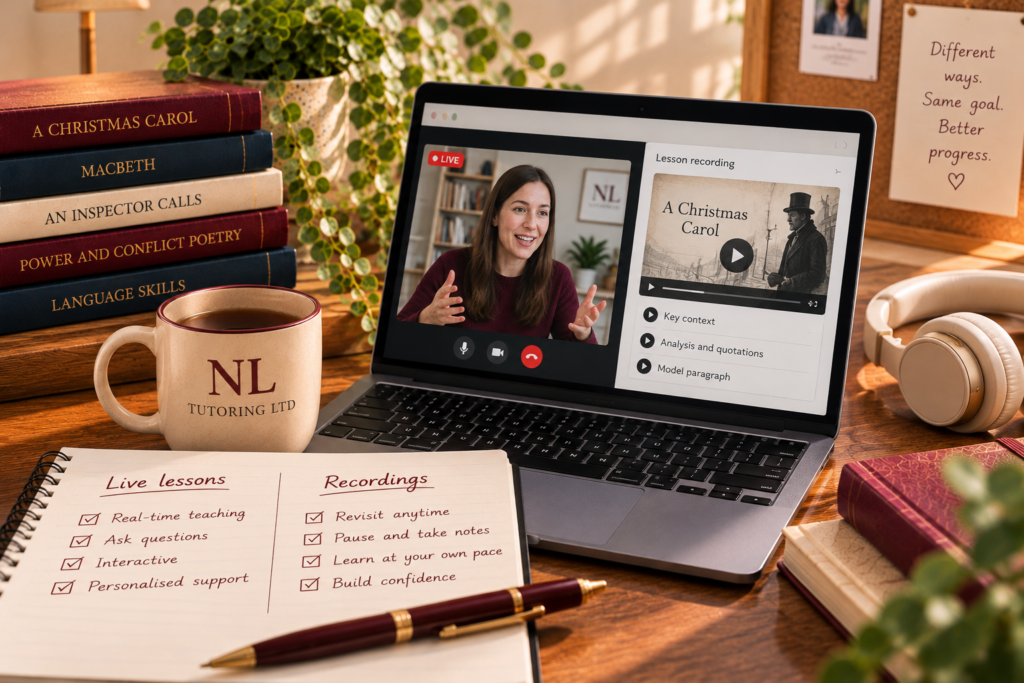
A student can watch an excellent explanation of how to analyze a quote, nod along, and still freeze when faced with a blank exam page. That is the central question in live lessons versus recordings for GCSE English: not which format is more convenient, but which one helps a student turn understanding into marks when it counts.
For many families, recordings look like the obvious answer. They are flexible, can be replayed, and often cost less than ongoing live tuition. Live lessons, meanwhile, create regular accountability and immediate feedback. Both have a place in effective GCSE preparation, but they do different jobs. The strongest support rarely treats one as a complete substitute for the other.
Live lessons versus recordings: the key difference
The difference is interaction. A recording delivers teaching. A live lesson allows a qualified teacher to see what a student has understood, what they have misunderstood, and what they are avoiding.
In GCSE English, that distinction matters because progress is not only about remembering information. Students must select relevant evidence, explain effects precisely, organize a convincing response, and make decisions under timed conditions. A student may know that they should analyze language or include context in Literature. The harder question is whether they can do it independently, clearly, and at the level required for their target grade.
A live teacher can ask, “What does this word suggest?” and then wait for the student to think. They can spot when an answer is too general, when a quotation has been dropped in without analysis, or when a paragraph has lost focus on the question. That responsive teaching is difficult to recreate through a recording alone.
Recordings cannot adjust to a student who is writing far below their potential because they are rushing. They cannot challenge an ambitious student whose analysis is accurate but predictable. They cannot read an uncertain expression and change the explanation before confusion becomes a habit.
What live GCSE English lessons do particularly well
Live tuition gives students something school lessons cannot always provide in a busy classroom: sustained attention to their individual writing and thinking. This is especially valuable in Years 10 and 11, when gaps in reading, knowledge, and written expression can quickly affect confidence.
Feedback becomes part of the learning
English improves through feedback that is specific enough to act on. “Develop your ideas” is not a useful instruction unless a student understands exactly how to do that in their next sentence.
In a live lesson, feedback can be immediate. A teacher might identify that a student is retelling the plot rather than analyzing the writer’s method, then model the shift from description to analysis. The student can try again there and then. That cycle of attempt, feedback, and improvement is where stronger analytical writing is built.
For a student aiming for a secure pass, live teaching may focus on producing clear, relevant paragraphs consistently. For a student targeting Grades 7 to 9, it may involve refining conceptual arguments, selecting evidence with greater precision, and developing interpretations that remain securely tied to the text. Neither student benefits from generic advice.
Accountability supports revision discipline
Many students intend to revise English regularly. Fewer know what effective English revision looks like or maintain it independently alongside other subjects.
A scheduled live lesson creates a useful rhythm. Students know they will need to discuss a text, complete a practice paragraph, or apply feedback from the previous session. This is not about pressure for its own sake. It is about preventing revision from becoming passive reading, last-minute panic, or a collection of unfinished notes.
Regular teaching also gives parents clearer reassurance. Progress can be discussed in practical terms: which skills are improving, where gaps remain, and what the student should do before the next lesson.
Exam technique can be practiced under real conditions
AQA English assessments reward more than knowledge. Students need to understand timing, question focus, mark schemes, and how to structure a response when the clock is moving.
Live lessons allow a teacher to observe the process behind an answer. If a student spends ten minutes choosing a quotation, writes an overly long introduction, or misreads the wording of a Language question, those habits can be addressed directly. Examiner-informed guidance is most useful when it is connected to the student’s actual work, rather than offered as a general tip.
Where recordings are genuinely valuable
Recordings should not be dismissed. Used well, they are a powerful part of a structured GCSE English program.
Their greatest strength is repetition. A student can revisit an explanation of sentence forms, a model paragraph, a key quotation, or an approach to an unseen text as often as needed. This can be particularly helpful for students who need more processing time than a live classroom allows, or who missed a lesson because of illness, sports, or competing school commitments.
Recordings also work well for building subject knowledge. A focused lesson on a character, theme, poem, or Language method can help students organize their notes and strengthen recall. Before a live session, watching a short recording can give students the foundation they need to ask better questions and take part with more confidence.
They are also useful during the final revision period, when students may need quick refreshers on several topics. Rewatching a concise explanation is often more efficient than searching through scattered exercise books or trying to reconstruct a teacher’s advice from memory.
The limitation is that watching feels productive more easily than it produces independent skill. A student may recognize a strong analysis when they hear it, but recognition is not the same as writing one. Recordings need an active follow-up: annotate a quotation, plan an answer, write a paragraph, or complete a timed response.
When recordings alone may be enough
For some students, recordings can provide enough support for a limited period. This is more likely when a student already has strong reading and writing habits, understands how to use feedback, and needs help with a specific topic rather than ongoing tuition.
For example, a confident Year 10 student who wants to revise a missed poetry unit may benefit greatly from a carefully structured recording and accompanying practice task. A student who has already mastered essay structure may use recordings effectively to refresh content before mock exams.
However, recordings alone are less likely to be sufficient when a student lacks confidence, avoids extended writing, repeatedly receives similar teacher feedback, or is unsure how to improve a grade. They are also a weaker option when a student is working hard but not translating that effort into higher marks. Those situations usually require diagnosis, not simply more content.
The most effective model: live teaching supported by recordings
For GCSE English, the best approach is often not live lessons or recordings, but a deliberate combination of both.
Live teaching should lead where personalization matters most: assessing gaps, teaching difficult skills, responding to writing, and preparing for exam conditions. Recordings should support that teaching by making key explanations available for review and helping students maintain momentum between sessions.
This approach reflects a disciplined learning process. First, identify what is holding the student back. It may be weak quotation knowledge, unclear paragraph structure, imprecise analysis, limited vocabulary, or timing. Then build the relevant skills through direct teaching and repeated practice. Finally, test those skills in exam-style tasks so the student can perform independently.
At NL Tutoring, this is the purpose behind the Assess, Build, Achieve framework. Students do not simply receive more English work. They receive targeted support based on where they are now and what will move them toward their best GCSE result.
Questions parents should ask before choosing
Before investing in any GCSE English support, ask how the program identifies individual gaps and how students receive feedback on their writing. Ask whether exam technique is taught explicitly, whether resources match the relevant exam board, and whether recordings are paired with tasks that require active practice.
It is also worth asking what happens when a student gets stuck. If the answer is simply “watch the lesson again,” the support may not be enough for a student who needs explanation, reassurance, or a different route into the skill.
The right choice depends on the student. Recordings can make revision more flexible and reinforce excellent teaching. Live lessons can provide the expert feedback and accountability that turn effort into measurable progress. For a student preparing for GCSE English, the goal is not to consume more content. It is to become confident enough to read closely, write purposefully, and show an examiner what they can do when it matters.