
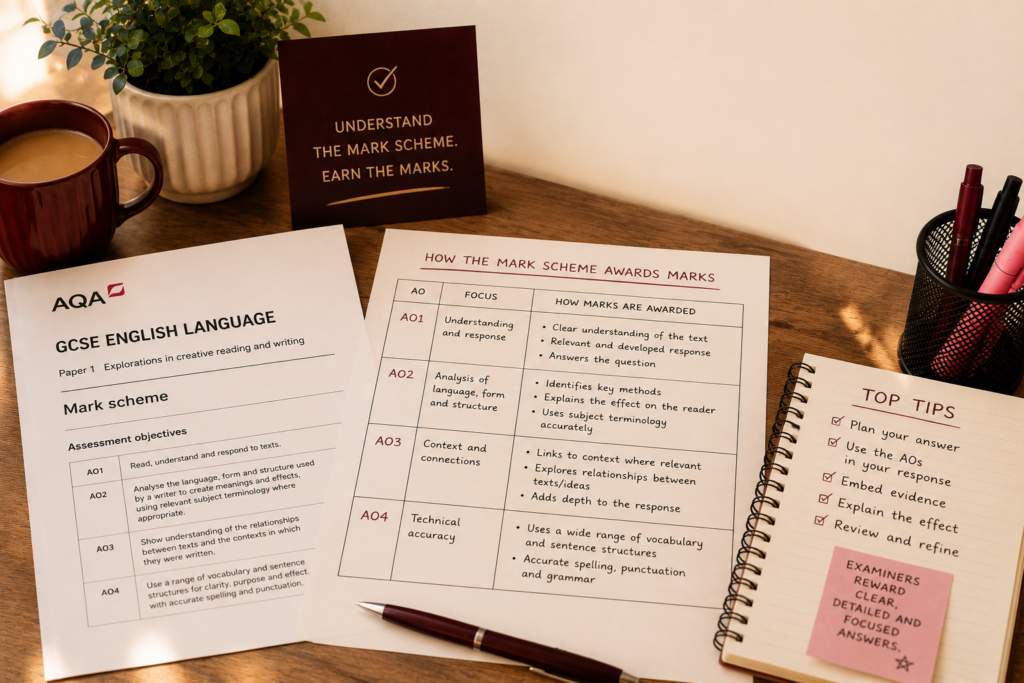
A student can know a text well, have read the question carefully, and still lose marks if their answer does not meet the AQA English mark scheme. That is why GCSE English progress is not simply about working harder. It is about understanding what each question is asking, choosing evidence with purpose, and communicating ideas in a way an examiner can reward.
For parents, this can feel frustrating. A teacher may say an essay needs “more analysis” or a response needs to be “developed,” but those phrases can sound vague. The mark scheme gives them a much clearer meaning. It shows the difference between a student who spots a technique and a student who explains its effect, explores alternative meanings, and keeps their answer focused on the question.
What the AQA English Mark Scheme Really Does
A mark scheme is not a secret formula that students can memorize the night before an exam. It is the framework examiners use to make fair, consistent decisions about the quality of a response. It sets out assessment objectives, often called AOs, and describes the characteristics of answers at different levels.
Examiners do not generally award one mark for every technique named, quotation included, or paragraph written. They read the response as a whole, identify the level that best matches its quality, and then decide where within that level it sits. This is often called a “best-fit” judgment.
That distinction matters. A long essay with several disconnected quotations may earn fewer marks than a shorter answer that makes a clear argument and analyzes evidence carefully. Equally, a student with thoughtful ideas can be held back if their writing is too brief, unclear, or poorly organized for the examiner to follow.
The strongest responses are not those that try to sound complicated. They are precise, relevant, and sustained. They make the student’s thinking visible.
The Assessment Objectives Behind GCSE English Marks
Although the exact wording and weighting vary by paper and question, the assessment objectives explain what AQA is looking for.
English Language: Reading With Purpose, Then Writing Clearly
In AQA GCSE English Language, students are assessed on how well they understand, analyze, compare, and evaluate unfamiliar texts. They also complete extended writing tasks that assess the quality and accuracy of their own writing.
For reading questions, the key objectives include selecting and interpreting information, analyzing a writer’s methods, comparing viewpoints, and evaluating a text critically. A student might identify that a writer uses a metaphor, for example, but that is only the starting point. Higher-level analysis explains why that image was chosen, what it suggests, and how it shapes the reader’s response.
A useful comparison is this:
A basic response might say, “The writer uses the word ‘crashed’ to show the storm was powerful.”
A more developed response might explain that “‘crashed’ makes the storm seem violent and uncontrollable, suggesting the setting has become an attacking force rather than a background detail.”
The second answer earns more because it explores meaning rather than simply labeling a method.
For writing, AQA rewards both content and technical accuracy. Students need to communicate effectively for the purpose, audience, and form of the task. They also need secure spelling, punctuation, grammar, sentence control, and paragraphing. Ambitious vocabulary can help, but only when it is natural and accurate. A forced sophisticated word, used incorrectly, is not a shortcut to a high grade.
English Literature: A Clear Argument, Not a Quotation Hunt
AQA GCSE English Literature assesses a student’s response to a text, their analysis of language, form, and structure, and their understanding of relevant context. Technical accuracy is also assessed in designated extended responses.
The most common issue in Literature is the quotation hunt: students remember many lines but do not build a response to the question. Examiners reward references that are selected and used to support an argument. A short quotation, analyzed closely, can be far more effective than a long quotation dropped into a paragraph without explanation.
Context needs similar care. Higher-mark responses do not bolt on a historical fact at the end of each paragraph. Instead, they connect contextual understanding to the interpretation. For example, a student writing about power in Macbeth might explain how Jacobean concerns about kingship and the divine right of kings make Macbeth’s ambition particularly threatening. The context strengthens the point because it helps explain the play’s meaning.
How Marks Build From a Pass to Grades 7-9
No mark scheme can guarantee a final grade because grade boundaries change from year to year. However, the qualities of stronger answers are consistent.
Students working toward a secure pass often need to establish the foundations first: answer the actual question, use relevant evidence, explain clear ideas, and write accurately enough for meaning to remain clear. This is not “basic” work to rush through. These habits are the platform for every higher-level skill.
As students move upward, their analysis becomes more developed. They begin to explore the implications of a word or structural choice rather than stopping at an obvious effect. Their paragraphs link back to a central argument, and they make more deliberate choices about which evidence to use.
For Grades 7 to 9, the difference is usually control. High-attaining students sustain a thoughtful interpretation across the whole answer. They may consider alternative readings where relevant, but they do not add them mechanically. Their writing is coherent, selective, and closely focused on the question.
This does not mean every sentence must be exceptional. Examiners are looking for a consistent standard across a response. One insightful point will not compensate for several undeveloped paragraphs, just as one weaker sentence will not ruin an otherwise strong essay.
Common Misunderstandings About the AQA English Mark Scheme
One misunderstanding is that students must identify as many techniques as possible. In reality, a feature only matters when the student can explain how it contributes to meaning. Naming “alliteration,” “pathetic fallacy,” and “semantic field” without analysis can make an answer sound formulaic.
Another is that more quotations always mean more marks. Evidence should be purposeful. Students should learn a manageable bank of flexible quotations for Literature, then practice adapting them to different questions. For Language, they should select brief, telling details from the extract rather than copying large sections.
Students can also become too dependent on rigid paragraph formulas. A clear structure is valuable, especially for students who lack confidence, but a formula should support thinking rather than replace it. An examiner wants to see a connected argument, not the same sentence frame repeated four times.
Finally, students sometimes assume that neat handwriting, lengthy answers, or sophisticated vocabulary will carry the response. Presentation can help readability, and ambitious language has its place, but marks come from meeting the assessment objectives. Quality and relevance matter more than decoration.
Turning Mark-Scheme Knowledge Into Better Answers
The most productive revision uses the mark scheme actively. After completing a practice question, students should not only ask, “What mark did I get?” They should ask, “Which assessment objective limited me?”
If a Literature essay has relevant quotations but remains descriptive, the next step is targeted analysis practice. If a Language response makes good points but does not compare both writers closely enough, the student needs to practice comparative sentence structures and linked evidence. If writing tasks lack control, the focus may need to be planning, paragraph sequencing, or sentence accuracy.
This is where specific feedback matters. General advice such as “add more detail” can leave students uncertain about what to do differently. Effective feedback identifies a precise gap and gives the student a method for closing it. For example: use one short quotation, zoom in on a key word, explain two possible suggestions, and link the point directly to the question.
At NL Tutoring, the Assess, Build, Achieve framework is designed around this principle. Students first identify the gaps affecting their marks, then build the knowledge and writing habits needed to improve, before applying those skills under exam conditions. Examiner-informed feedback helps students understand not just what was missing, but how to make the next answer stronger.
What Parents Can Look For in Practice
Parents do not need to become English teachers or memorize every assessment objective. The most useful questions are practical ones. Can your child explain what the question is asking? Can they show how a quotation supports their point? Can they identify one clear target after feedback and apply it in the next piece of work?
It also helps to look beyond a single practice score. A student may initially receive a modest mark while learning to write more analytically, but that work can be a sign of genuine progress if their explanations are becoming more precise and their answers more focused. Confidence grows when students can see the connection between a specific skill and an improved result.
The next time your child completes an English practice question, encourage them to choose one mark-scheme skill to improve rather than trying to fix everything at once. A focused change, repeated until it becomes a habit, is often what turns effort into marks.