
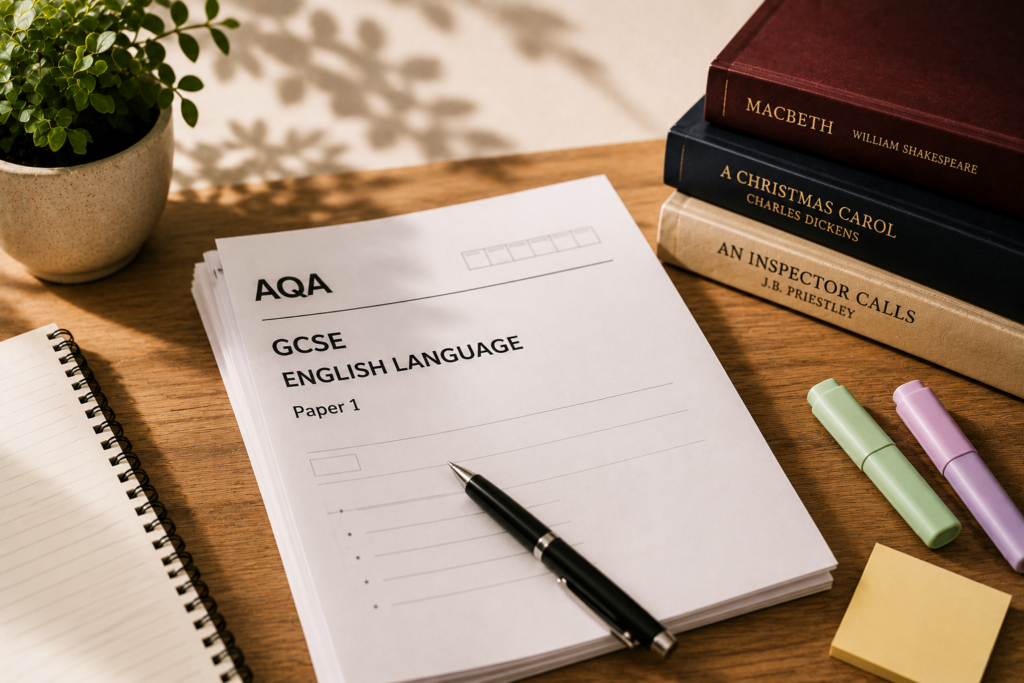
A GCSE English Language paper guide should do more than explain what happens on exam day. It should show students where marks are won, why capable writers can underperform under time pressure, and how to turn a vague response into one that meets AQA’s assessment objectives. For many families, English Language feels difficult because there is no set text to memorize. The reassuring truth is that success comes from repeatable reading, writing, and timing habits.
For students in Years 10 and 11, the aim is not to produce a perfect answer every time. It is to understand each question, select useful evidence, communicate clearly, and make deliberate choices under exam conditions. That is how confidence becomes marks.
Understanding the GCSE English Language Papers
AQA GCSE English Language has two written papers, each lasting 1 hour 45 minutes and worth 80 marks. Each paper combines reading and writing, so students need to shift between close analysis of a source and crafting their own effective piece of writing.
Paper 1 focuses on creative reading and writing. The reading section is based on one fiction extract, while the writing task asks students to produce a creative response, usually a description or narrative. Paper 2 focuses on writers’ viewpoints and perspectives. Students read two nonfiction sources from different time periods and complete a transactional writing task, such as an article, letter, speech, or essay.
The papers test different source material, but the underlying skills overlap. Students must read attentively, make inferences, explain effects, compare ideas, organize their writing, and adapt their language to audience and purpose. A student who treats every question as a completely new challenge is likely to feel overwhelmed. A student who recognizes the recurring skills has a far clearer route through the paper.
GCSE English Language Paper Guide: Paper 1
Paper 1 asks students to respond to a fiction extract. The opening reading questions generally move from retrieving information to explaining language and structure, before asking for an evaluative judgment. The key is to answer the question set, rather than offering a memorized paragraph about techniques.
Reading fiction with precision
On the shorter questions, students should be exact. If a question asks them to list four things, they do not need lengthy analysis. They need four clear, correct details from the specified lines. This sounds straightforward, but lost marks often come from selecting evidence outside the line range or adding interpretation when retrieval is all that is required.
For language analysis, students need to move beyond spotting a metaphor or adjective. Naming a technique is only the beginning. Strong answers explain the writer’s choice and its effect in context. For example, rather than writing that a verb “creates imagery,” a student might explain how a verb suggests sudden movement, making a character appear panicked or unpredictable.
The structure question can be particularly challenging because students often write about language again. Structure is about how the writer shapes the extract across time: what is introduced, what the reader’s attention is drawn toward, where the focus shifts, and how tension or interest develops. A useful habit is to track the extract from beginning to end before writing. Students should ask: what does the writer want the reader to notice first, next, and last?
The final reading question requires evaluation. Students are given a statement and must decide how far they agree. This is not an invitation to write “I agree” repeatedly. It is an argument supported by carefully chosen evidence and analysis. Students aiming for higher grades should engage with the wording of the statement, develop their judgment, and consider complexity where it is genuinely present.
Writing creatively without losing control
The Paper 1 writing task rewards content and organization as well as technical accuracy. Students need an engaging, coherent piece with deliberate vocabulary, sentence variation, paragraphs, and accurate punctuation and spelling.
A common mistake is trying to force too much plot into a short narrative. A simple, controlled moment is often more effective than a story containing several characters, a dramatic twist, and an ending rushed into the final two minutes. Description also needs a clear focus. It should create an atmosphere or viewpoint, not become a list of unrelated details.
Planning for five minutes is worthwhile. Students can decide on a central image, a beginning and ending, and a few paragraphs that develop the mood. They should reserve time to proofread, especially for sentence boundaries, tense consistency, and basic spelling. These are not minor details: technical accuracy is directly assessed.
Paper 2: Comparing Viewpoints Clearly
Paper 2 presents two nonfiction sources. Students may encounter letters, articles, travel writing, speeches, diaries, or memoirs. One source is usually contemporary and the other is from an earlier period. The older language can look intimidating, but students are not expected to understand every word. They are expected to follow the writer’s ideas and select relevant evidence.
The first questions focus on retrieval and summary. In the summary question, students should identify differences or similarities between the sources based on the focus in the question. They should not analyze methods unless asked to do so. Clear comparative phrasing helps: “Source A presents…, whereas Source B suggests…”
The language question requires detailed analysis of one source. As on Paper 1, high-scoring responses connect a writer’s methods to meaning. The comparison question then asks students to compare the writers’ perspectives and how those perspectives are conveyed. This is where many students lose momentum by writing one full paragraph on Source A and another on Source B.
Direct comparison is more effective. A student might explain that one writer presents an experience as exciting while the other presents a similar situation as unpleasant, then analyze the evidence from both sources within the same paragraph. Comparison should run through the response, not be added as a final sentence.
Writing for audience, purpose, and form
The Paper 2 writing task is transactional. Students may be asked to persuade, argue, explain, advise, or describe. Before writing, they should identify three things: who they are writing for, why they are writing, and what form the response should take.
A speech needs a sense of audience and an engaging opening. A letter needs an appropriate level of formality. An article benefits from a headline and a clear structure, but it should not become a collection of tiny paragraphs with rhetorical questions. Form matters, yet the quality of ideas and control of language matter more.
Students do not need to include every persuasive device they have ever learned. Repetition, direct address, facts, examples, contrast, and rhetorical questions can all be useful, but only when they serve the argument. Formulaic writing can sound artificial. The strongest responses have a clear viewpoint, logical development, and a voice that suits the task.
Time Management That Protects Marks
Timing is often the difference between a promising paper and a complete one. Each paper has 80 marks, split evenly between reading and writing, so students should broadly allow 45 minutes for reading and 45 minutes for writing. They also need a few minutes at the start to read the instructions and at the end to check their work.
Within the reading section, students should use the mark allocation as a guide. A four-mark question does not need the same time or detail as an eight-mark question. The longer evaluation and comparison questions deserve sustained attention, but students should not sacrifice the writing task to chase one additional reading point.
Practice under timed conditions is essential, but timing should be built gradually. First, students need to learn what a successful answer looks like. Then they can complete individual questions against the clock before attempting whole papers. Repeatedly sitting full papers without feedback can reinforce weak habits rather than improve performance.
How Parents Can Support Productive Preparation
Parents do not need to be English specialists to help. The most useful support is often creating a regular routine, asking to see completed practice, and encouraging students to act on feedback. A folder full of marked work has limited value if a student never revisits the same weakness.
Look for patterns. Does your child write too much on low-mark questions? Do they struggle to explain quotations? Is their writing imaginative but hard to follow? Are they running out of time? A diagnostic approach identifies the real barrier, then targets it through focused practice.
At NL Tutoring, this is reflected in the Assess, Build, Achieve framework: first identify gaps, then develop the necessary reading, writing, and exam skills, and finally practice applying them with confidence. For some students, the priority is securing accurate, clear responses for a strong pass. For others, it is developing the thoughtful analysis and control needed for Grades 7 to 9. The plan should fit the student, not the other way around.
A calm, structured approach will always serve students better than last-minute panic. When they know what each question is asking, have practiced a reliable method, and understand how to improve from feedback, the exam paper becomes a manageable opportunity to show what they can do.