
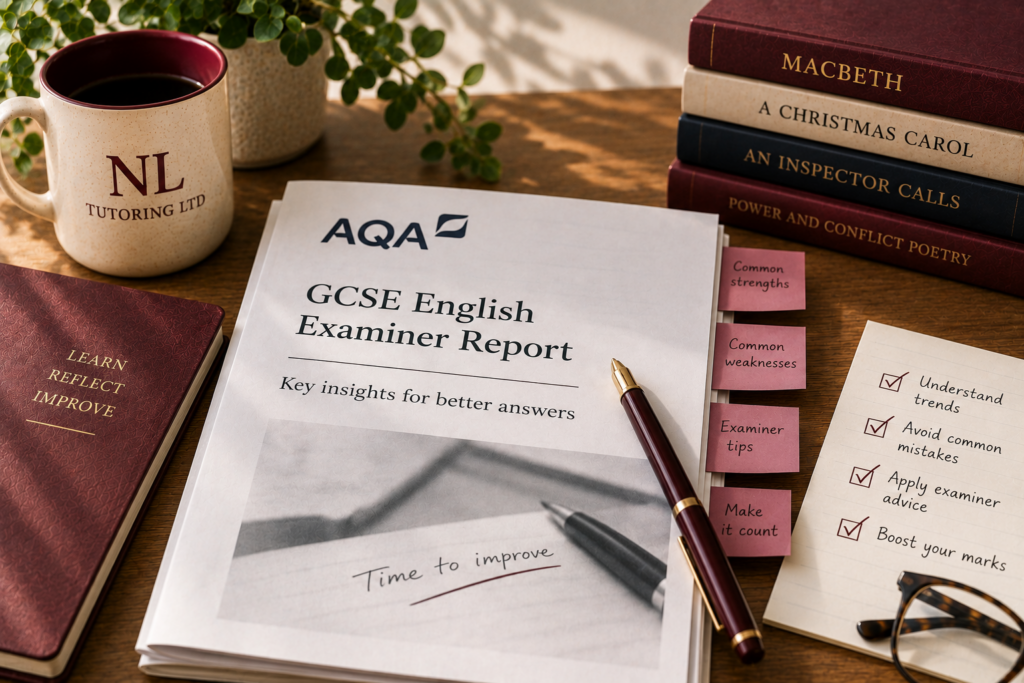
A student can spend hours revising quotations, completing practice papers, and still repeat the same costly mistake: answering the question in a way that feels sensible but does not earn the marks available. Learning how to use examiner reports changes that. These documents show where real candidates gained credit, where they lost it, and what examiners needed to see more clearly.
For GCSE English Language and Literature students, examiner reports are not model answers to copy. They are evidence. Used well, they help a student move from vague advice such as “analyze more” to precise improvements in planning, paragraph structure, textual references, and exam timing.
What an examiner report can tell your child
After each exam series, AQA publishes examiner reports alongside other assessment materials. They are written by senior examiners and comment on patterns seen across a large number of scripts. Rather than focusing on one student, they identify common strengths, recurring misunderstandings, and features of answers that separated different levels of performance.
This makes them especially useful when a student feels stuck. A report may explain that candidates selected relevant quotations but did not explore the writer’s methods. It may show that students wrote at length on a Language question without maintaining a clear focus on the task. For Literature, it may highlight weak contextual links, insecure knowledge of the text, or an over-reliance on prepared paragraphs that did not answer the specific question.
Parents should see these reports as a bridge between revision and performance. Revision builds knowledge. Examiner reports help students understand how to turn that knowledge into marks under exam conditions.
How to use examiner reports without overwhelming revision
An examiner report can be dense, particularly for a Year 10 student beginning to think about the final exams. There is no need to read every page or turn it into another piece of homework. A focused approach is far more effective.
Start with the correct exam board, qualification, paper, and most recent available series. For many NL Tutoring families, that will mean AQA GCSE English Language and AQA GCSE English Literature. Check the paper carefully. English Language Paper 1 tests fiction reading and creative writing, while Paper 2 focuses on writers’ viewpoints and perspectives, followed by transactional writing. The reports address different skills, so advice from one paper cannot simply be transferred to another.
Read the comments for one question at a time. Ask your child to highlight three things: what successful candidates did, what weaker responses tended to do, and one action they can take in their next practice answer. This keeps the report practical.
For example, if the report says candidates often identified language devices but did not explain their effects, the action is not “use more terminology.” It might be: “After naming a method, explain how the specific word or phrase shapes the reader’s impression, then connect it back to the question.” That is a teachable, repeatable process.
Turn examiner comments into a personal checklist
The most useful output from an examiner report is a short checklist tied to the student’s own writing. It should be specific enough to use while planning or checking a response.
A Literature checklist might include maintaining a clear argument from the first paragraph, choosing short and accurate quotations, analyzing the writer’s choices rather than retelling the plot, and linking context only where it genuinely strengthens the interpretation. A Language checklist may focus on selecting precise evidence, explaining effects in detail, comparing both texts throughout a comparison response, or allocating enough time to the writing question.
Avoid creating a checklist with fifteen items. Students under pressure cannot hold that much in mind. Choose two priorities for the next piece of work. Once those become secure, add another. Consistent progress comes from deliberate practice, not from trying to fix every weakness at once.
Compare the report with an actual answer
Examiner reports become far more valuable when students use them alongside a marked practice response. If a student has received teacher feedback, place the report beside it and look for the pattern. Perhaps both point to undeveloped analysis. Perhaps the student understands the poem or novel but drifts away from the question. Perhaps their ideas are strong but the final writing response is rushed.
This comparison matters because not every comment in a national report will apply to every child. A Grade 5 student who struggles to organize paragraphs needs a different next step from a Grade 8 student who writes thoughtfully but needs more conceptual precision. The goal is diagnosis, not panic.
A helpful conversation can be simple: “Which comment sounds most like your answer?” Then ask: “What would an examiner need to see in your next paragraph to know you have improved?” Students often make faster progress when they can name the gap for themselves.
Use model answers carefully
Model answers can help students see what successful writing looks like, but they should never replace independent thinking. An examiner report may praise a response for its detailed focus on a word, a clear line of argument, or purposeful comparison. Help your child identify the underlying skill rather than memorizing the wording.
Copying a polished paragraph can create a false sense of security. In the exam, the question, extract, and source material will change. Students need flexible structures that allow them to respond accurately to what is in front of them.
For ambitious Grades 7 to 9 students, reports are particularly useful for refining quality. They can reveal when sophisticated vocabulary becomes unclear, when interpretations need firmer textual support, or when context is added mechanically. Higher-level responses are not simply longer or packed with terminology. They are controlled, relevant, and consistently analytical.
Build examiner-report insights into weekly revision
The best time to use a report is not the night before an exam. Build one insight into a weekly practice routine. A student might complete one reading paragraph, one Literature paragraph, or a timed section of a writing task, with a single examiner-informed target in mind.
Afterward, they should review the work before looking at a model response. Did they meet the target? Where is the evidence? What would they change in one sentence or paragraph? This self-check develops the habit of evaluating writing through the assessment criteria, rather than relying only on whether it “sounds good.”
Timing should also be part of the process. Examiner reports frequently point to questions that were rushed, misunderstood, or left incomplete. If a student repeatedly produces stronger work at home than in timed practice, the issue may be exam management rather than subject knowledge. Practice must reflect the real demands of the paper.
It depends on the student’s current confidence. A child working toward a secure pass may benefit most from clear paragraph organization and completing every question. A student aiming for the top grades may need to sharpen interpretations, evaluate effects with greater precision, and sustain a convincing argument across an essay. Both students need targets that are challenging but achievable.
What examiner reports cannot do
Examiner reports are powerful, but they are not a substitute for knowing the texts, practicing writing, or receiving feedback. They describe trends from a particular exam series, not a guaranteed formula for future papers. AQA questions change, and students must remain responsive to the wording of each task.
They can also be misread. If a report says many candidates struggled with a question, that does not mean the question is impossible or that a student should avoid it. It means they should learn the relevant skill with care. Likewise, a comment about ambitious vocabulary is not permission to write simply. It is a reminder that clarity and accuracy matter more than impressive-sounding words.
The strongest approach combines examiner insight with structured teaching, regular practice, and targeted feedback. At NL Tutoring, this is the purpose of an Assess, Build, Achieve approach: identify the precise gap, teach the skill explicitly, then give students opportunities to apply it with growing confidence.
The next time your child opens an examiner report, do not ask them to read it all. Ask them to find one comment that could improve their very next answer. Small, well-chosen changes are often where stronger GCSE English results begin.