
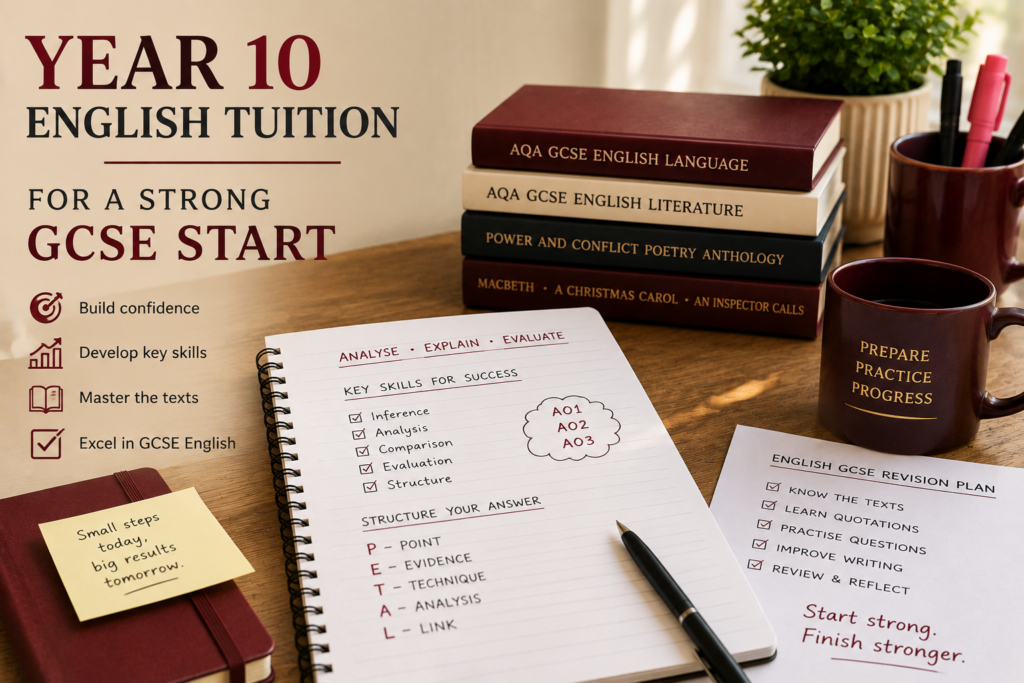
A Year 10 student can appear to be doing well in English while still lacking the skills that decide GCSE grades. They may read confidently, complete homework, and have sensible ideas in class, yet struggle to turn those ideas into a focused analytical paragraph under exam conditions. Year 10 English tuition is most valuable when it addresses this gap early, before rushed revision becomes the only plan.
For families, Year 10 is the point at which GCSE English Language and English Literature stop feeling distant. Set texts are being taught, key knowledge needs to stick, and writing habits begin to shape performance. The right support does not simply add more work. It gives students a clear structure for knowing what to improve, practicing it consistently, and seeing how that practice translates into marks.
Why Year 10 Matters for GCSE English
Year 11 is often dominated by revision, mock exams, coursework demands where applicable, and the pressure of final assessments. By contrast, Year 10 offers enough time to strengthen the foundations without every lesson feeling like a countdown. This matters particularly in English, where progress is cumulative.
A student cannot reliably produce a perceptive literature essay simply by memorizing quotations in the final term. They need to understand the text, select evidence with purpose, explain a writer’s methods accurately, and develop an argument that answers the question. Similarly, strong English Language responses depend on practiced reading habits, precise analysis, controlled writing, and secure time management.
Students working toward a secure pass need an organized route to the marks they may currently miss. Students aiming for Grades 7, 8, and 9 need greater depth, accuracy, and independence. The starting point differs, but both groups benefit from targeted teaching rather than generic homework help.
What Year 10 English Tuition Should Build
Effective support should make the assessment criteria feel understandable, not mysterious. Students do not need to write like university academics. They need to know how to communicate a clear interpretation, support it with relevant evidence, and explain their thinking in a way that meets GCSE expectations.
Analytical writing that earns marks
Many students are told to “analyze” but are not shown exactly how to do it. As a result, their essays can become a sequence of quotations followed by broad comments such as “this shows he is angry.” That may demonstrate basic understanding, but it rarely reaches the higher levels of the mark scheme.
Structured tuition teaches students how to build a paragraph with a purposeful point, carefully chosen evidence, and an explanation of the writer’s choices. They learn to explore the effect of language, structure, and form without forcing techniques into every sentence. A strong response is not a list of terminology. It is a convincing argument supported by precise analysis.
This is also where feedback matters. A student needs more than a score and a vague instruction to add detail. They need to see which sentence was effective, where their explanation stopped too soon, and what a stronger version would look like. Small, repeated improvements in paragraph construction can make a substantial difference over the course of a year.
Secure knowledge of texts and themes
For English Literature, knowledge is the material students think with. If a student only vaguely remembers the plot of a play or novel, their essay will be vague too. They need a secure grasp of characters, relationships, themes, context, and the writer’s intentions.
However, memorizing every possible quotation is not always the best use of time. A smaller bank of flexible, well-understood quotations is often more useful than pages of disconnected notes. Students should be able to adapt their knowledge to different questions, rather than waiting for the exact topic they revised to appear.
A good program also helps students distinguish between useful contextual understanding and context that has been added mechanically. Examiners reward context when it deepens interpretation. A historical fact that is unrelated to the quotation or argument will not strengthen an essay simply because it has been included.
Exam technique without premature pressure
There is a trade-off in Year 10. Students need exposure to exam questions and timed writing, but they should not spend the entire year completing full papers before they have learned the underlying skills. Early practice should be deliberate.
A student may first focus on planning a response in five minutes, then on writing one high-quality paragraph, and later on completing a full answer within the available time. This progression builds confidence because students can see what they are improving. When timed practice begins, it feels like the next logical step rather than a test they are bound to fail.
For English Language, students also need to understand that each question has a different purpose. A reading question requiring close language analysis should not be answered in the same way as a question about structure or evaluation. In creative writing, planning, technical accuracy, vocabulary, and purposeful organization all matter. Examiner-informed teaching can make these distinctions much clearer.
A Structured Route from Gaps to Progress
The most productive tuition begins with an honest assessment of where the student is now. Some students need to rebuild confidence after receiving disappointing feedback. Others are capable but inconsistent, producing strong work one week and rushed, underdeveloped responses the next. A diagnostic approach avoids assuming that every Year 10 student needs the same thing.
At NL Tutoring, the Assess, Build, Achieve framework provides a disciplined route forward. First, assessment identifies the specific gaps affecting performance, whether that is quotation selection, sentence control, essay organization, vocabulary, or timing. Next, focused teaching and guided practice build the relevant skills. Finally, students apply those skills independently through increasingly demanding exam-style tasks.
This approach is especially reassuring for parents because progress becomes visible. Rather than asking whether tuition is “helping,” families can see the areas being addressed and the quality of a student’s written work improving over time. Grades matter, but confident, repeatable habits are what make better grades more likely.
What Parents Should Look for in a Tutor
English tuition is not identical from one provider to another. A student may enjoy weekly sessions but still receive little explicit teaching about assessment objectives, mark schemes, or the difference between an adequate answer and a high-level one. Rapport matters, but it should sit alongside subject expertise and a clear plan.
Look for a qualified English teacher with substantial classroom experience and current knowledge of the exam board being studied. For AQA students, insight from a current examiner can be particularly useful because it connects teaching directly to what examiners reward in real responses. This does not mean predicting questions. It means teaching students how to meet the criteria regardless of the text extract or theme they face.
It is also worth asking how feedback is given, how progress is monitored, and whether support includes both English Language and Literature. Families should expect clear communication about the student’s starting point, the priorities for improvement, and the work needed between sessions. Tuition works best as a partnership: expert teaching, consistent practice, and encouragement at home without parents having to become English teachers themselves.
How Students Can Make Tuition Count
Tuition has the greatest impact when students treat it as a regular part of their learning, not a last-minute rescue. Completing short follow-up tasks, keeping an organized quotation bank, and acting on feedback are often more valuable than occasionally attempting a long essay.
Students should also be encouraged to ask specific questions. “How do I improve my writing?” is a useful starting point, but “How can I explain this quotation in more depth?” leads to teaching they can apply immediately. Over time, that willingness to question, redraft, and try again is what turns uncertainty into independence.
A strong Year 10 does not require perfection. It requires a student who understands where they are, has the right support to improve, and is building the habits that will carry them calmly into Year 11.