
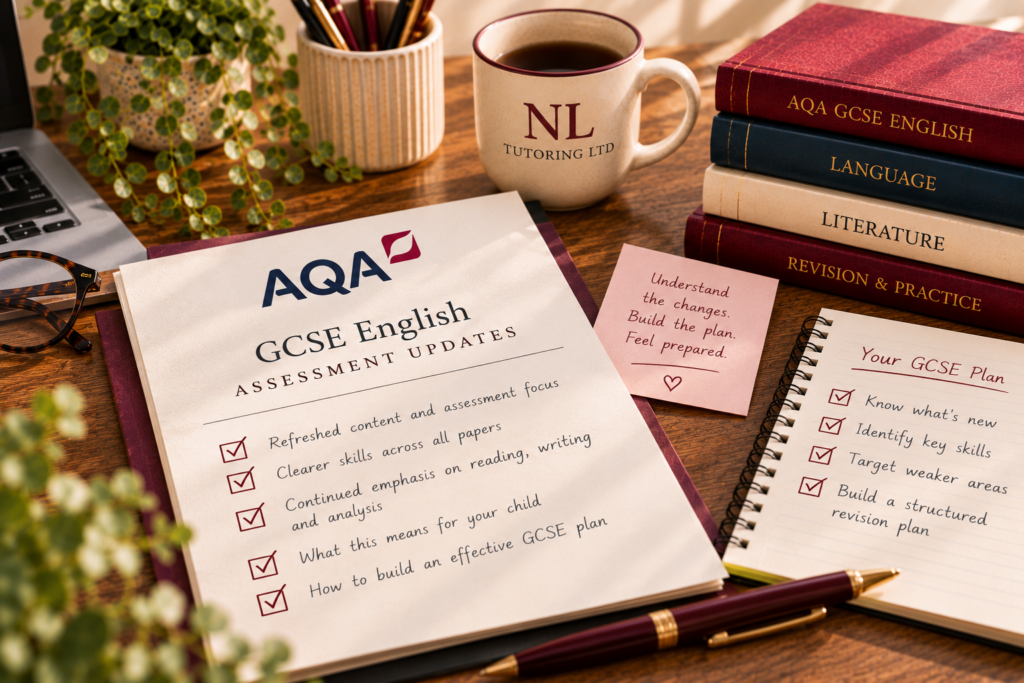
AQA assessment changes can create understandable anxiety for families, especially when a student is already managing revision, coursework, mock exams, and the pressure of final GCSE results. The key is to separate a genuine change that affects your child’s exam from wider discussion about future reform. Once you know what applies to their exam series, preparation becomes much clearer.
For GCSE English, the strongest response is rarely to overhaul everything. Students still need secure reading skills, precise analytical writing, relevant subject knowledge, and the ability to communicate under timed conditions. A change in wording, format, or assessment emphasis may alter how those skills are demonstrated, but it does not remove the need to build them carefully.
What AQA assessment changes can mean
The phrase “assessment changes” can cover several different things. Sometimes it refers to a revised specification for a future cohort. At other times, AQA may update administrative guidance, clarify expectations for a question type, amend support materials, or confirm arrangements for a particular exam series. These are not interchangeable.
Parents should first establish which qualification their child is taking, the specification code used by their school, and the year they will sit their final exams. A student in Year 11 may be preparing under a different set of arrangements from a student beginning GCSE courses in Year 10. Advice shared online can be well-intentioned but outdated, or relevant only to a different cohort.
For English Language and English Literature, it is also useful to distinguish between a change to the assessment itself and a change to the way a school prepares students. A school might adjust its mock exam timetable, set texts, intervention groups, or revision resources without AQA changing the national assessment. Those school-level decisions still matter, but they should not be mistaken for a change in the official exam requirements.
The questions parents should ask
When you hear about a possible change, ask the school or teacher a few focused questions. Which exam series does it affect? Does it alter what students are assessed on, or simply the materials used to prepare them? Will the question format, timing, marks, or grade boundaries be different? What should my child now prioritize?
These questions bring the conversation back to action. They also prevent a common problem: students spending valuable revision time preparing for an issue that will not affect their own papers.
If a change does affect the current cohort, schools should be able to explain the practical implication. For example, a revised approach to assessment may mean students need more experience with a particular task type, closer attention to a certain assessment objective, or greater confidence using evidence independently. The right response is targeted practice, not panic.
What does not change: how English marks are earned
Even when assessment arrangements evolve, GCSE English rewards students who can think clearly and show that thinking on the page. In English Language, that means selecting evidence accurately, explaining effects, comparing ideas where required, and adapting writing to audience, purpose, and form. In English Literature, it means developing a thoughtful interpretation, using the text securely, analyzing writer’s methods, and placing points in relevant context.
Students often know more than their marks suggest. The difficulty is turning that knowledge into a developed, well-organized response within the available time. This is why generic revision can feel productive without reliably improving grades. Re-reading a novel, highlighting quotations, or completing occasional practice papers has value, but it is not enough if the student cannot build a focused paragraph or make a clear argument under pressure.
A student aiming for a secure pass may need to concentrate on answering every part of the question, choosing short and relevant quotations, and writing clear explanations. A student aiming for Grades 7 to 9 needs that same foundation, alongside sharper conceptual thinking, more deliberate method analysis, and greater control over structure. The destination differs, but both students benefit from knowing exactly what the examiner can reward.
Build a revision plan around assessment objectives
Assessment objectives are the bridge between what a student studies and the marks they receive. They should not be treated as jargon to memorize. Instead, students need to understand what each objective looks like in a real answer.
For instance, “analyze language” is not achieved by spotting a technique and naming it. A stronger response explains how a specific word, image, or structural choice shapes meaning and affects the reader. “Use context” in Literature is not a detached history fact added at the end of a paragraph. It is relevant contextual understanding woven into an interpretation of the text.
A useful weekly plan should include knowledge, writing, and review. Knowledge might involve learning quotations, themes, character ideas, or vocabulary. Writing should involve short, timed paragraphs as well as occasional full responses. Review means comparing work against clear success criteria, identifying one or two priorities, and then applying that feedback in the next task.
This cycle matters more than producing large quantities of unreviewed work. Ten essays with the same weaknesses will not move a student forward as effectively as three carefully assessed essays followed by deliberate improvement.
Use timed practice at the right stage
Timed practice is essential, but it should be introduced intelligently. A student who has not yet learned how to structure an analytical paragraph may become discouraged by repeated full papers. Begin by securing the component skills: planning an argument, selecting evidence, explaining a quotation, and writing an effective opening or conclusion.
Once these are more secure, introduce time limits. Students should know how long they can spend reading, planning, writing each section, and checking their work. This is particularly valuable for students who either rush into a response without a plan or spend so long perfecting one paragraph that they cannot finish the paper.
Full exam practice then becomes a diagnostic tool. It reveals whether the student’s knowledge holds up under pressure, whether their writing remains clear when time is short, and whether they can make sensible decisions independently.
Confidence comes from clarity, not reassurance alone
Families often notice confidence falling when assessment information changes. Students may say they are “bad at English” when the real issue is much more specific: they do not know how to begin an answer, they are unsure what a question is asking, or they cannot remember enough evidence quickly.
Those are teachable problems. Confidence grows when students can see a repeatable process. They need to know how to decode the question, make a short plan, choose evidence, develop a point, and check that their answer remains focused. Clear routines reduce uncertainty and help students feel in control during a demanding exam.
At NL Tutoring, this is why support begins with assessment rather than assumptions. Identifying the exact gap – whether it is subject knowledge, essay structure, analysis, timing, or exam technique – makes it possible to build a plan that is appropriately challenging and genuinely useful.
Keep perspective when information changes
GCSE English preparation is a long-term process, not a reaction to every headline or social media post. Of course, official updates should be taken seriously. But students do best when their attention remains on the work that earns marks: understanding the texts, reading closely, writing accurately, developing ideas, and practicing in realistic conditions.
If your child is worried about AQA assessment changes, start with the facts that apply to their own cohort. Then turn those facts into a simple plan for the next week of learning. A calm, structured approach gives students something far more valuable than temporary reassurance: evidence that they are becoming more capable with every piece of purposeful practice.