
A student can spend hours rereading a novel and still struggle to write a high-mark GCSE response. The issue is rarely effort alone. With AQA English Literature set texts, students need to know not only what happens in the story, but why the writer makes particular choices and how to turn that understanding into a focused exam answer.
For parents, the number of texts, characters, themes, quotations, and assessment requirements can make GCSE Literature feel unclear. A well-structured approach brings it back under control. Students do not need to memorize every page. They need secure knowledge of their own texts, carefully selected evidence, and a reliable method for analyzing writer’s methods under timed conditions.
What are AQA English Literature set texts?
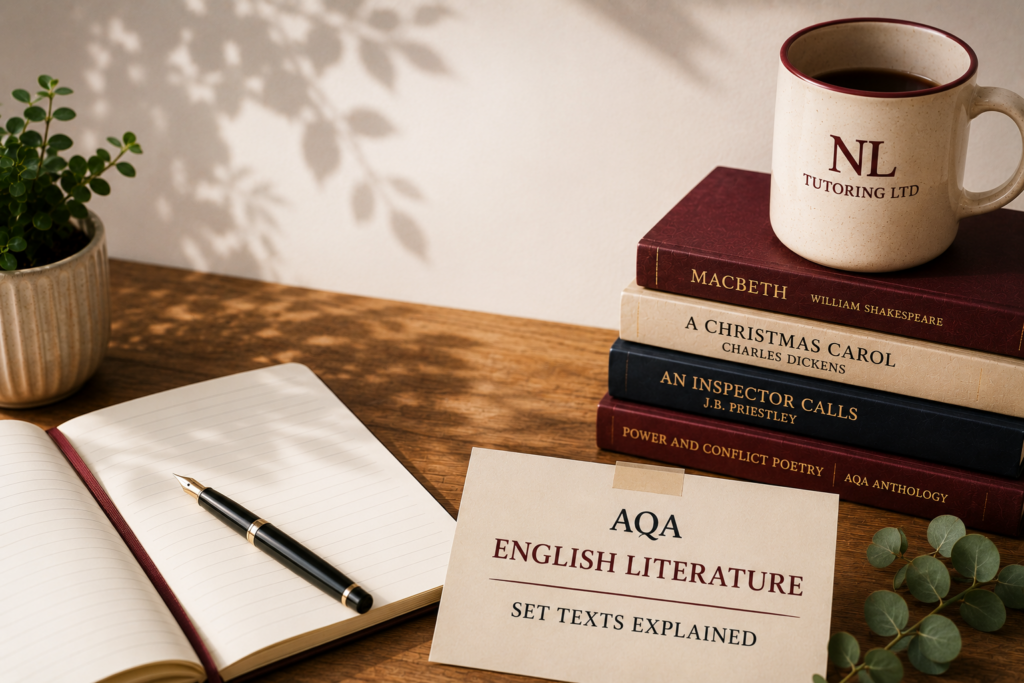
AQA GCSE English Literature assesses students on a selection of studied literary works. Schools choose from AQA’s approved options, so not every student across the country studies exactly the same combination of texts. This is why the first step in effective revision is simple: confirm the exact texts your child’s school has selected and the examination series they are sitting.
The course is typically divided across two exam papers. Paper 1 covers Shakespeare and a 19th-century novel. Paper 2 covers a modern text, poetry from the anthology studied in school, and unseen poetry. Each area asks for a different type of preparation, but the same core skill runs through all of them: students must make a clear argument and support it with precise analysis.
A set text is not just a book or play to finish reading. It is a body of evidence students need to use confidently. They should understand the plot, the characters’ development, key themes, the writer’s purpose, relevant context, and the language and structural choices that shape meaning.
The AQA text categories students study
Shakespeare
For Shakespeare, schools may choose plays such as Macbeth, Romeo and Juliet, The Tempest, or Much Ado About Nothing. In the exam, students respond to an extract and connect it to the play as a whole.
This can be challenging because students must move beyond simply translating older language. A strong response explains how Shakespeare presents an idea, such as ambition, conflict, power, love, or gender, and tracks that idea across different moments in the play. A student aiming for the higher grades needs to select quotations with purpose rather than adding as many quotations as possible.
For example, a response on Macbeth’s ambition becomes stronger when it considers how Shakespeare presents it as tempting and initially controlled, before showing its destructive consequences. That is a developed argument. Retelling that Macbeth wants to be king is not.
The 19th-century novel
AQA’s 19th-century text choices include novels such as A Christmas Carol, The Strange Case of Dr Jekyll and Mr Hyde, Frankenstein, and Pride and Prejudice. Students are given an extract and must write about it in relation to the whole novel.
These texts reward students who understand the writer’s wider message. In A Christmas Carol, for instance, a student should know more than the sequence of Scrooge’s visits from the spirits. They need to consider Dickens’s criticism of poverty, selfishness, and social inequality, as well as his hope that people can change.
Context matters, but it should never be dropped into an essay as a memorized fact. The most effective use of context is connected directly to the writer’s choices. A student might explain how Dickens uses the Cratchit family to challenge wealthy Victorian readers who ignored the hardship around them. The context has a clear job to do: it deepens the analysis.
The modern text
For Paper 2, schools choose a modern prose or drama text. Common choices include An Inspector Calls, Blood Brothers, Lord of the Flies, Animal Farm, DNA, and The Curious Incident of the Dog in the Night-Time.
Modern texts can feel more accessible because the language is often familiar. That can create a false sense of security. Students still need to analyze method, structure, and writer’s intentions in detail. A response on Sheila Birling in An Inspector Calls, for example, should explore how Priestley changes her across the play and why that transformation supports his wider social message.
Students should also be ready for questions focused on a character, relationship, or theme. Revising only one favorite theme leaves gaps. A student may know a great deal about responsibility in An Inspector Calls but lose confidence if the question focuses on gender, class, or generational conflict.
Poetry anthology and unseen poetry
The poetry section requires a different kind of confidence. Students study one AQA anthology cluster, which may include areas such as power and conflict, love and relationships, or worlds and lives, depending on the specification followed by their school.
Students compare a named poem with another poem they have studied. The strongest answers make meaningful comparisons throughout, rather than writing two separate mini-essays joined by a final paragraph. They identify a clear shared or contrasting idea and then explore how each poet presents it.
Unseen poetry cannot be revised by memorizing content, but it can be prepared for. Students need a routine for reading carefully, identifying an initial interpretation, selecting short quotations, and analyzing language and structure without panicking. Regular practice is far more valuable than waiting until the final weeks before the exam.
What AQA examiners are looking for
AQA mark schemes use assessment objectives, but students do not need to recite them to write well. They do need to understand what successful writing looks like in practice.
First, they need a direct and thoughtful response to the question. A clear argument gives an essay direction. Second, they need well-chosen textual references. At GCSE, short embedded quotations are often more useful than long quotations that are difficult to explain. Third, they must analyze the writer’s choices, including language, form, and structure where relevant. Finally, they need to connect the text to its context in a relevant, integrated way.
The trade-off matters here. Some students try to include every technique they can spot, while others focus so heavily on historical context that the text itself disappears. Neither approach is effective. A higher-mark answer is selective. It chooses evidence that proves a point and then explains it carefully.
How to revise set texts without becoming overwhelmed
Start by identifying the gaps. A student who cannot recall the plot securely needs a different plan from a student who understands the text but writes vague paragraphs. Treating both students the same wastes valuable time.
For knowledge gaps, create a clear text map. This should include the plot sequence, key character turning points, central themes, and a manageable bank of quotations. Aim for quotations that can be used flexibly across several questions. One short quotation may support analysis of character, theme, and writer’s purpose when it is understood properly.
Next, move from knowledge to writing. Students should practice planning answers before writing full essays every time. A five-minute plan can reveal whether they have a focused argument, three useful points, and enough evidence. This is particularly helpful for students whose essays lose direction halfway through.
Then build timed practice gradually. Writing a full essay under strict conditions too early can damage confidence. Begin with one analytical paragraph, then an introduction and one paragraph, then a full response. Feedback should be specific: not simply “add more detail,” but guidance such as “explain the effect of this word” or “link this point back to the question.”
A practical revision routine for Year 10 and Year 11
A sustainable routine is better than occasional long revision sessions. A Year 10 student may focus on building knowledge and practicing paragraphs, while a Year 11 student should increasingly use timed plans and complete responses.
Across a week, a student could revisit one text’s plot and quotations, practice one theme or character plan, write one analytical paragraph, and complete a short poetry comparison or unseen poetry task. The exact balance depends on their confidence and how close the exam is. What matters is that revision includes retrieval, analysis, and exam practice, not passive rereading alone.
Parents can support this without becoming the English teacher at home. Ask your child to explain a character’s change, test a small number of quotations, or ask what their essay argument would be. If they cannot explain it clearly, that identifies a useful area for further teaching.
At NL Tutoring, the Assess, Build, Achieve framework begins by identifying whether a student’s main barrier is text knowledge, analytical writing, confidence, or exam technique. With examiner-informed teaching and consistent practice, GCSE Literature becomes far less mysterious.
The most encouraging point is that strong Literature performance is built in stages. When a student knows their texts well, can form an argument, and has practiced turning ideas into precise paragraphs, they walk into the exam with something far more valuable than a folder of notes: a dependable method for showing what they know.