
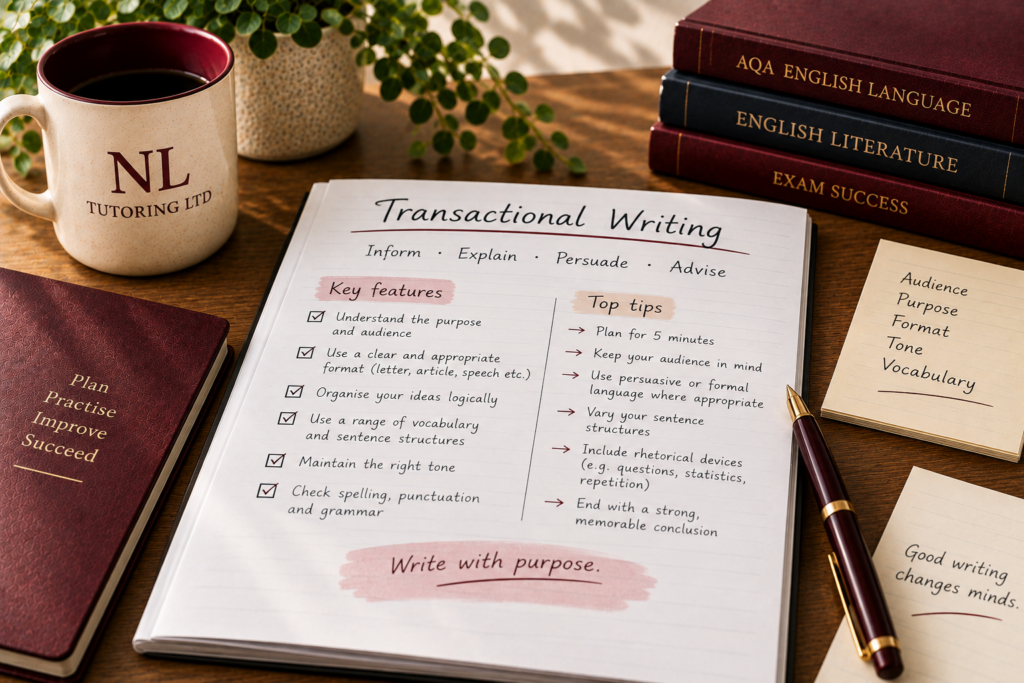
A strong English Language transaction writing response is not simply a piece of persuasive writing with a few ambitious words added in. It is a controlled response to a specific situation, written for a real audience, with a clear purpose and an appropriate voice. This English Language transaction writing guide will help GCSE students turn that brief into marks.
For many students, the challenge is not a lack of ideas. It is deciding what to say first, how formal to sound, and how to sustain a convincing argument under time pressure. AQA rewards writing that feels deliberate. The reader should be able to see that every choice – from the opening line to the final paragraph – has been made for a reason.
What transaction writing means at GCSE
Transaction writing is a useful term for the non-fiction writing tasks that ask students to present a viewpoint. Depending on the question, they may be asked to write an article, speech, letter, essay, leaflet, or another form for a stated audience and purpose.
The subject of the question might be school uniforms, social media, public transport, young people, or community issues. The topic changes, but the core task remains the same: communicate a viewpoint effectively. Students need to shape their ideas around who will read or hear the piece, what they need that audience to think or do, and which form will best deliver that message.
This is why a memorized essay rarely performs as well as students hope. It may contain impressive vocabulary, but if it sounds like the same speech every time, it will not fully meet the demands of the task.
Read the question before planning the argument
The most successful students spend a short, focused period unpacking the prompt. They identify the form, audience, purpose, and topic before they begin to plan. This prevents a common problem: writing a polished response that does not quite answer the question.
If the task asks for a speech to parents, the tone should be respectful, direct, and engaging. A student might use an inclusive opening such as “Good evening, parents and teachers,” followed by carefully chosen rhetorical questions. If the task asks for an article aimed at teenagers, the voice can be more conversational, although it must still be controlled and purposeful.
Purpose matters just as much. A response written to argue will usually take a firm position and develop it. A response written to advise needs practical guidance. A response written to persuade needs to anticipate hesitation and make the reader care. Students should not treat these command words as interchangeable.
Before writing, encourage your child to complete this sentence in their head: “I am writing a [form] for [audience] to [purpose] about [topic].” That small habit gives the response a clear direction.
Build a viewpoint, not a collection of techniques
Examiners do not award high marks because a student has included three rhetorical questions, a statistic, and a rule of three. Those techniques can be effective, but only when they strengthen a genuine line of argument.
A thoughtful plan begins with a clear position. For example, rather than writing broadly that social media is “good and bad,” a student could argue that social media companies should take greater responsibility for protecting younger users. This gives them something precise to develop.
From there, each paragraph should move the argument forward. One paragraph might explain the impact on confidence, another might challenge the claim that responsibility rests entirely with families, and a third might propose realistic action. The final paragraph should leave the audience with a clear impression or call to action.
A useful planning structure is claim, development, and effect. What does the writer believe? Why should the audience accept it? What consequence, example, or appeal makes that point persuasive? This approach produces depth without forcing students into a rigid formula.
For Grade 7 to 9 responses, nuance can make a real difference. Students do not need to make every issue sound simple. Acknowledging a reasonable opposing view before explaining why their own position remains stronger demonstrates maturity and control. The key is to avoid weakening the argument by becoming indecisive.
Choose a voice that fits the audience
Audience awareness is often where capable writers lose marks. They may write eloquently, but the response could be addressed to almost anyone. Strong transaction writing makes the intended reader or listener feel present throughout.
A formal letter to a local official may use measured language, polite challenge, and specific requests. A campaign speech may use short sentences, repetition, and direct address to create energy. An article can balance a compelling headline, an engaging opening, and a more developed discussion of the issue.
Students should be careful not to confuse formality with complicated vocabulary. A formal response does not need to be filled with words they would never normally use. In fact, inaccurate ambitious vocabulary can interrupt the flow and make the writing less convincing. Clear, precise language nearly always has more impact than a thesaurus-heavy paragraph.
Similarly, a lively audience does not give students permission to become careless. Slang, excessive exclamation marks, and informal jokes can quickly make a response feel immature. The best writing sounds natural while remaining controlled.
Structure for clarity and momentum
A reader should never have to work out where the argument is going. Effective paragraphs each have a distinct job, and transitions help the response build momentum.
Openings need to establish the issue quickly. A startling statement, a brief scenario, or a direct challenge can work well, provided it connects to the task. Starting with “Have you ever…” is not automatically wrong, but it is often overused. Students should ask whether their opening genuinely draws in this particular audience.
In the middle of the response, vary paragraph length deliberately. A short paragraph can create emphasis after a longer, developed point. A one-sentence paragraph can be powerful, but only when it earns its place. Used repeatedly, it becomes a pattern rather than a choice.
Endings should do more than repeat the introduction. A speech may finish with a memorable appeal. A letter may state a clear request. An article may leave the reader considering the issue from a new angle. The closing should feel purposeful, not rushed because time has run out.
Accuracy supports every mark
AQA assesses both the content and organization of the response and the accuracy and range of technical control. Students aiming for higher grades need to pay attention to sentence construction, punctuation, spelling, and paragraphing throughout, not only in a final proofread.
The most reliable way to improve accuracy is to write sentences that the student can control. A long sentence with several clauses can be effective, but it must be punctuated accurately. Shorter sentences can add emphasis. Varied sentence lengths create rhythm, but variety is only valuable when it helps the reader.
Save two or three minutes at the end to check the basics: capital letters, sentence boundaries, apostrophes, repeated words, and any vocabulary that felt uncertain while writing. This is not glamorous exam technique, but it protects marks that students have already earned through good ideas.
Practice the English Language transaction writing guide process
Confidence grows when students repeat a dependable process under timed conditions. First, they should annotate the task and decide on their position. Next, they should plan three or four developed points, including the order in which they will present them. Then they write with the audience in mind, leaving time to check accuracy.
After practice, feedback should go beyond “add more techniques.” Ask whether the opening matched the form, whether each paragraph developed the viewpoint, and whether the tone stayed consistent. It is also useful to identify one priority rather than trying to fix everything at once. A student who needs to improve paragraph development needs a different next step from a student whose main barrier is punctuation.
At NL Tutoring, this kind of focused diagnosis is central to helping students build confidence and make measurable progress. Examiner-informed feedback can show them not just that a response needs improvement, but exactly how to make it more effective next time.
The goal is not for your child to sound like someone else in the exam. It is for them to have a clear method, a purposeful voice, and the confidence to show what they can do when the question is in front of them.