
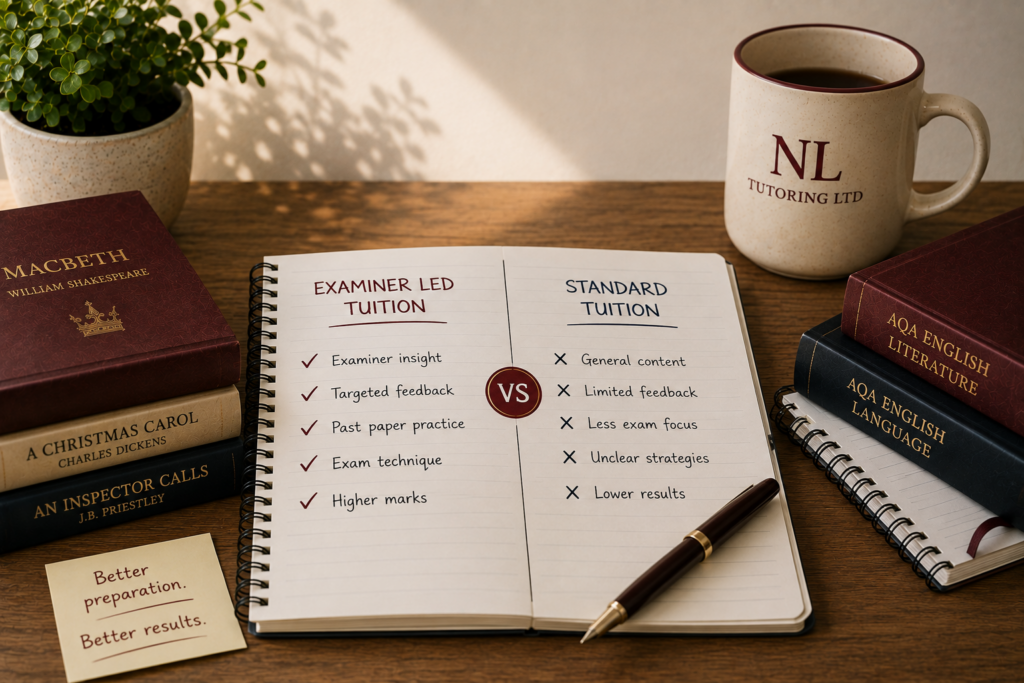
A student can spend an hour on a GCSE English essay, follow every piece of general advice they have been given, and still not know why it would earn a Grade 5 rather than a Grade 8. That is the practical difference at the heart of examiner led versus standard tuition. Both can offer useful support, but they do not necessarily teach students how marks are awarded or what must change in their writing to move up a grade.
For families investing in tuition during Years 10 and 11, the question is not simply whether a tutor is kind, knowledgeable, or able to help with homework. It is whether the support gives a student a clear, structured route from their current performance to stronger work in the exam room.
What standard tuition often provides
Standard tuition varies enormously. A skilled tutor may explain difficult classwork, improve a student’s understanding of a text, help them complete assignments, or provide a regular space to revise. For a student who has missed lessons, lacks confidence, or needs more time to understand a topic, that additional attention can be genuinely valuable.
The limitation is that standard tuition can become reactive. The student brings in whatever homework is due that week, the tutor helps them finish it, and both move on. This may reduce immediate stress, but it does not always identify the underlying issue. A student may repeatedly struggle with analysis, for example, while receiving help with several separate essays without ever being explicitly taught how to develop an argument, select evidence, and explain effects with precision.
Generic English support can also blur two very different goals: understanding the subject and succeeding in a specific assessment. GCSE English Language and English Literature require both. Students need secure knowledge of methods, texts, context, vocabulary, and writing craft. They also need to apply that knowledge under time pressure to questions shaped by an exam board’s assessment objectives.
A general tutor may know English well. That is not automatically the same as knowing what AQA examiners reward in a response, where marks are commonly lost, or how to turn broad feedback such as “analyze more” into an achievable next step for a Year 11 student.
Examiner led versus standard tuition: the key distinction
Examiner-led tuition starts from the assessment itself. It is informed by direct knowledge of how responses are judged against the mark scheme and how differences in quality appear in real student work. Rather than offering vague reassurance that an essay is “good,” an examiner-led teacher can explain what the response is doing, what it is not yet doing, and which improvement would have the greatest impact on the final mark.
That does not mean teaching students to memorize a formula or write what they think an examiner wants to hear. Strong GCSE English teaching should never flatten a student’s ideas into a collection of stock phrases. It means giving students a reliable framework for expressing thoughtful ideas in a way that earns credit.
For instance, a student may spot a metaphor in a poem and identify that it creates a dark mood. That is a start, but it is unlikely to be enough for the highest grades. Examiner-led guidance helps the student ask better questions: Why this image? What associations does the word choice carry? How does it connect to the writer’s wider viewpoint? How can this point be developed clearly without drifting into unsupported claims?
The same principle applies to English Language. Many students know they should “use techniques” in creative writing or “analyze language” in a reading response. They need to know how to make purposeful choices, sustain a viewpoint, organize a response, and manage time. They also need feedback that distinguishes between a promising idea and an exam-ready answer.
Feedback becomes more precise
The quality of feedback is often where families notice the biggest difference. Comments such as “add more quotes” or “write in more detail” may be well meant, but they leave students to guess what to do next. Specific feedback tells them which skill to practice and how.
A student might need to move from feature spotting to explaining the writer’s intention. Another may have perceptive ideas but lose marks because their paragraphs lack a clear line of argument. A third may be capable of Grade 7 analysis in class but write too slowly to complete the paper. These are different problems, so they need different teaching.
An examiner-informed approach can diagnose those patterns early. It allows tuition to focus on the exact barriers standing between the student and the next level of performance, rather than treating every weak answer as a lack of effort.
Revision is connected to performance
Many students revise English by rereading notes, highlighting quotations, or watching videos. These activities can support learning, but they do not always test whether the student can use knowledge independently in an unfamiliar question.
Effective GCSE revision connects knowledge to application. A student may learn key quotations from Macbeth, but they must also be able to choose the most relevant quotation, integrate it into a response, analyze it closely, and link it to a focused argument. In Language, they may understand persuasive devices but still need practice shaping an effective response for a particular audience, purpose, and format.
Examiner-led tuition makes that connection explicit. Students are taught not just what to revise, but how to convert revision into marks. Timed practice, model analysis, focused redrafting, and carefully selected questions all have a role when they are used with a clear purpose.
The importance of a structured starting point
Tuition is most effective when it begins with an honest picture of where a student is now. Without that, even frequent sessions can become a collection of activities rather than a plan.
A useful assessment should look beyond a reported school grade. It should consider the student’s confidence, subject knowledge, reading habits, ability to plan, writing accuracy, analytical depth, and exam technique. It should also identify whether the student understands feedback well enough to act on it independently.
At NL Tutoring, this is reflected in the Assess, Build, Achieve framework. First, gaps and strengths are identified. Next, teaching builds the specific knowledge and writing habits the student needs. Finally, practice and feedback help them apply those skills with increasing independence. The goal is not to create dependence on a tutor. It is to help students enter the exam knowing what to do when they face the page alone.
This structure benefits students at different starting points. A student working toward a secure pass may need to strengthen sentence control, comprehension, paragraph organization, and confidence with core questions. A student targeting Grades 7 to 9 may need to refine interpretations, write with greater precision, and make consistently deliberate choices under timed conditions. Neither student is helped by one-size-fits-all worksheets.
When standard tuition may be enough
Examiner-led support is not the only worthwhile option. A younger student in Year 7 or Year 8 who needs encouragement with reading, homework routines, or general classroom confidence may benefit greatly from broad English tuition. Likewise, a student who has a short-term gap caused by illness or a school move may only need focused catch-up support.
The case for specialist examiner-led tuition becomes stronger when GCSEs are approaching, progress has stalled, or a student is working hard without seeing their effort reflected in grades. It is particularly valuable when parents hear that their child needs to “develop analysis,” “be more detailed,” or “improve exam technique,” but no one has translated those comments into a practical plan.
There is also a difference between knowing an exam specification and teaching it well. Current examiner insight is most valuable when it is combined with experienced classroom teaching, clear explanations, high expectations, and a supportive relationship. Students need to understand the standard they are working toward, but they also need to believe that improvement is possible and see the steps required to get there.
Choosing support with confidence
Parents do not need tuition that promises effortless top grades. GCSE English improvement takes sustained practice, careful teaching, and a willingness from the student to act on feedback. A credible program should be clear about that.
Ask how a tutor identifies gaps, how feedback is given, whether practice is linked to the relevant exam board, and how progress is measured over time. Look for support that develops knowledge, writing, and exam confidence together rather than treating them as separate problems.
The right tuition should leave a student feeling more capable, not more dependent. When they can explain how to approach a question, shape an analytical paragraph, select evidence with purpose, and improve their own work, they are building skills that matter far beyond the next homework deadline. For a family facing GCSE English, that clarity can turn worry into a focused plan for progress.