
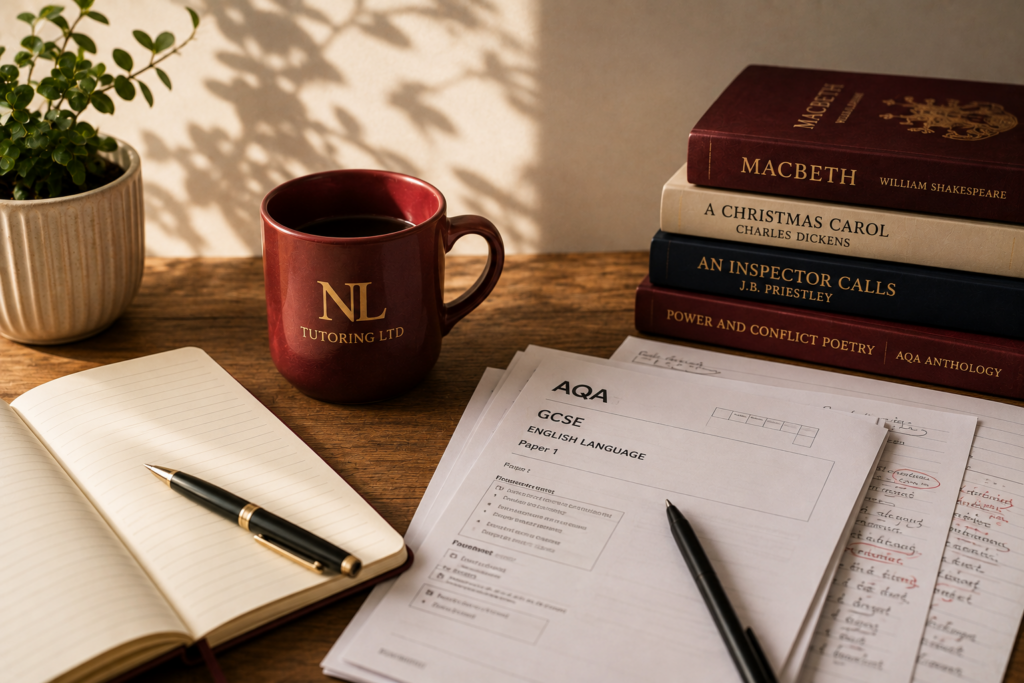
A student can write a thoughtful essay on Macbeth and still struggle with an unfamiliar nonfiction text in English Language. Equally, a confident creative writer may lose marks in Literature because they cannot support an idea with precise quotations. GCSE English Language versus Literature is not a choice between an easier and harder subject. They are two separate qualifications that assess different skills, and students need a clear plan for both.
For parents, this distinction matters because a child’s revision needs can look very different from one paper to the next. More effort is not always the answer. Targeted practice, secure subject knowledge, and an understanding of what examiners reward are what turn effort into marks.
GCSE English Language versus Literature: the core difference
GCSE English Language assesses how well a student reads, analyzes, compares, and writes. The texts in the exam are unseen, meaning students encounter them for the first time in the assessment. They must respond thoughtfully under time pressure, selecting evidence and explaining how writers create effects.
GCSE English Literature assesses a student’s knowledge and interpretation of set texts studied during the course. Depending on the exam board and school, these commonly include a Shakespeare play, a nineteenth-century novel, a modern text, and a poetry anthology. Students are expected to develop an argument about a character, theme, or idea and support it with well-chosen textual evidence.
Both subjects reward clear written communication and thoughtful analysis. The difference is where the student begins. In Language, they must make sense of new material quickly. In Literature, they must recall, select, and apply knowledge built over months or years.
What GCSE English Language assesses
English Language is often misunderstood as simply a test of spelling, grammar, and creative writing. Technical accuracy matters, particularly in longer writing tasks, but it is only one part of the qualification.
In AQA GCSE English Language, students sit two papers. Paper 1 focuses on fiction and imaginative writing. Students read an extract from a literary text, answer questions on language and structure, and complete a descriptive or narrative writing task. Paper 2 focuses on writers’ viewpoints and perspectives, using nonfiction texts from different time periods alongside a transactional writing task, such as an article, speech, letter, or essay.
The strongest responses do not feature complicated vocabulary for its own sake. They are controlled, purposeful, and shaped for the question. A student needs to identify a method, select a short quotation, explain its effect, and link that detail to the writer’s wider intention. For writing tasks, they need to make deliberate choices about tone, organization, sentence variety, and audience.
Why students find Language challenging
The unseen nature of the papers can unsettle students. They cannot revise a set list of quotations or memorize a model answer. However, this does not make English Language impossible to prepare for. Students can build reliable routines: reading questions carefully, budgeting time, annotating efficiently, planning longer answers, and checking their writing.
A common issue is vague analysis. A student may correctly spot that a writer uses a metaphor but then write, “This makes the reader want to read on.” That comment is too general to earn the highest marks. They need to explain what the image suggests, how it shapes the reader’s view of a person or situation, and why it is effective in that moment.
What GCSE English Literature assesses
English Literature asks students to return to familiar texts with fresh focus. The exam question may center on ambition in Macbeth, responsibility in An Inspector Calls, or power in a named poem. Students need enough knowledge to respond flexibly rather than force every question into a rehearsed essay.
For AQA, Literature assessment usually covers Shakespeare, the nineteenth-century novel, modern texts, and poetry. Students are assessed on their ability to maintain a clear argument, use quotations and references, analyze the writer’s methods, and consider relevant context. Poetry comparison also requires students to make meaningful connections between two poems.
Context is sometimes overused. Students may learn facts about Victorian society or the Jacobean era and add them to every paragraph, whether or not they help answer the question. Examiners reward context when it illuminates the text. It should sharpen an interpretation, not replace one.
Why students find Literature challenging
The volume of material can feel overwhelming. A student may be studying several texts at once while trying to remember plots, character journeys, themes, quotations, methods, and contextual ideas. This is why last-minute cramming rarely works well for Literature.
The answer is not to memorize hundreds of quotations. A focused bank of short, versatile quotations is more useful, provided the student understands how each one can support different arguments. For example, a quotation linked to Macbeth’s ambition may also reveal his insecurity, relationship with Lady Macbeth, or changing moral judgment.
Students also need to move beyond retelling. An essay that accurately describes what happens in a novel may demonstrate knowledge, but high-level responses explain how the writer presents an idea and why the writer may have made those choices.
Are the qualifications graded separately?
Yes. GCSE English Language and GCSE English Literature are separate GCSEs, with separate grades. A student can achieve different outcomes in each subject because the skill demands are different.
English Language is generally the qualification most directly linked to post-16 entry requirements. Many colleges, sixth forms, apprenticeships, and employers look for a secure pass in GCSE English Language, often Grade 4 or above. Requirements vary, so families should always check the specific course or institution.
English Literature remains highly valued. It demonstrates sustained reading, analytical thinking, academic writing, and the ability to engage with complex ideas. For students aiming for Grades 7 to 9, strong performance in both qualifications is a powerful foundation for A-level study and beyond.
How revision should differ for each subject
A single “English revision” session is often too broad to be useful. Students benefit from separating their work according to the demands of each qualification.
For Language, regular timed practice is essential. A student should practice short analytical questions as well as extended writing, then review where marks were lost. Did they answer the exact question? Was their analysis developed? Did they spend too long on an earlier section? Improving these habits can create rapid progress because the exam format is predictable even when the texts are not.
For Literature, revision should combine knowledge retrieval with essay practice. Students should revisit plot, character, theme, quotation, and context in small sections, then apply that knowledge to a focused question. Planning several possible essays can be more valuable than repeatedly copying out full essays, especially when time is limited.
In both subjects, feedback matters. Students often repeat the same pattern without realizing it: paragraph openings that do not make an argument, quotations that are too long, comments that name a technique without analyzing it, or conclusions that add no value. Specific feedback helps them see the next improvement clearly.
What parents can look for in a good support plan
The best support begins with diagnosis, not assumptions. A student who says, “I am bad at English,” may actually have a narrow issue: weak question focus, limited quotation recall, insecure sentence control, or anxiety when working against the clock. Each requires a different response.
A disciplined plan should assess current performance, build the relevant skills and knowledge, then test progress through exam-style practice. At NL Tutoring, this Assess, Build, Achieve approach gives students a structured route forward rather than generic homework help. Examiner-informed teaching can also help students understand exactly what separates a secure response from one that reaches the higher bands.
Parents should expect support to build independence, not dependence. The goal is for a student to enter the exam knowing how to decode the question, select evidence, organize an answer, and use their time wisely without relying on a tutor beside them.
The right question is not which subject is harder
Some students prefer the certainty of set texts in Literature. Others enjoy the fresh challenge of unseen extracts and practical writing in Language. Neither preference guarantees a stronger grade. Success depends on whether the student develops the particular habits each subject demands.
When revision feels unfocused, begin with one recent piece of work or one timed paper. Identify the precise barrier, address it deliberately, and revisit it until the improvement holds. That is how confidence becomes something more dependable than a feeling: evidence that a student can meet the next question with a plan.