
A student can write confidently in class yet lose marks in a GCSE exam because they have revised the wrong skill for the paper in front of them. When GCSE English papers compared is the question, the most useful answer is not simply that English Language and English Literature are different qualifications. Families need to understand what each paper asks students to do, how the marks are awarded, and where focused preparation can make the greatest difference.
For students taking AQA GCSE English, success comes from recognizing the demands of each paper early. English Language tests reading, writing, and communication skills under time pressure. English Literature tests students’ knowledge of set texts alongside their ability to develop a well-supported interpretation. Both require clear analytical writing, but they reward it in different ways.
GCSE English Papers Compared: The Big Picture
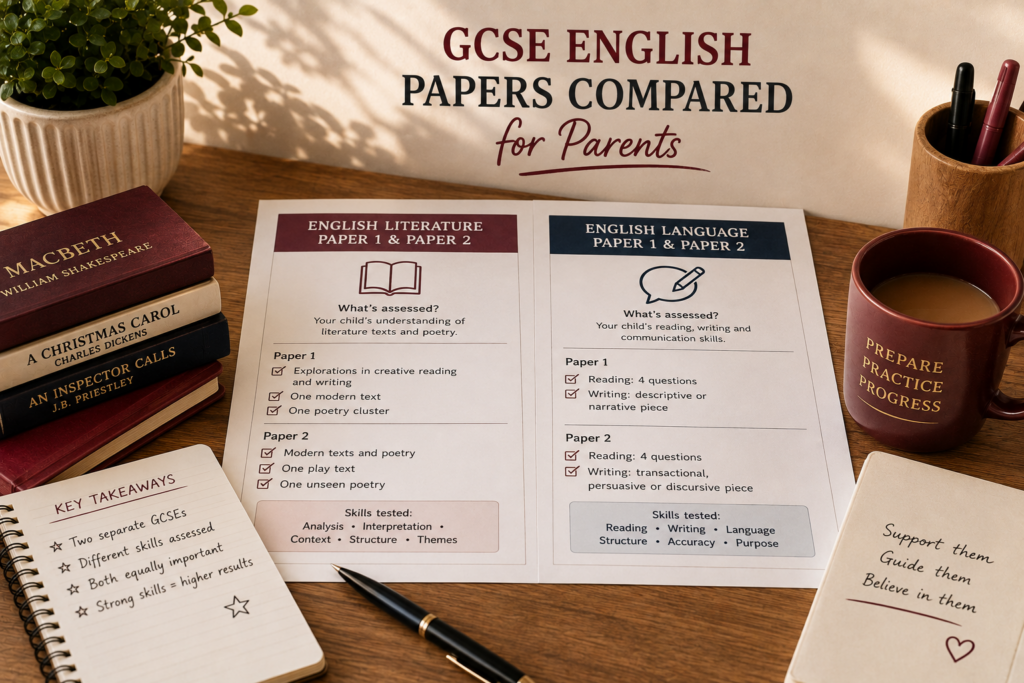
AQA GCSE English Language and GCSE English Literature are separate qualifications, each worth its own GCSE grade. Students typically sit two papers for Language and two papers for Literature. This means four substantial exams across the assessment period, with different timings, source materials, question styles, and revision needs.
English Language is assessed entirely through examination. Its two papers are each worth 50 percent of the qualification. There are no set novels, plays, or poems to memorize for Language. Instead, students must respond thoughtfully to unfamiliar texts and produce original writing at speed.
English Literature is also assessed through two written papers, each worth 50 percent. Here, students study named texts during the course: usually a Shakespeare play, a nineteenth-century novel, a modern text, and a poetry anthology. They also face unseen poetry. Strong results depend on secure text knowledge, carefully selected evidence, and analysis that stays closely connected to the question.
The detail varies across exam boards, so parents should always check their child’s specification. At NL Tutoring, preparation is informed by current AQA examiner knowledge, which helps students understand precisely how AQA questions are framed and what examiners can reward.
English Language: Reading Closely and Writing With Control
AQA English Language Paper 1 focuses on creative reading and writing. Students read an extract from a twentieth- or twenty-first-century literary fiction text, then answer questions that move from retrieving information to analyzing language and structure. The final task asks for descriptive or narrative writing.
Paper 2 focuses on writers’ viewpoints and perspectives. Students compare two nonfiction texts, one from the nineteenth century and one from the modern period, before completing a transactional writing task. That may ask them to write, for example, an article, letter, speech, essay, or leaflet for a specific audience and purpose.
Both papers are 1 hour 45 minutes and worth 80 marks. That timing matters. Many students know what to say but spend too long on an early reading question, leaving insufficient time for the higher-mark writing task. Others write at length without shaping their response for the required audience, form, and purpose.
Language revision should therefore be active and repeated. Reading a model answer may help a student notice effective phrasing, but it does not prove they can plan, select evidence, and write under exam conditions. Regular timed practice reveals whether a student can produce precise analysis in the reading section and a controlled, technically accurate response in the writing section.
What earns marks in Language?
The reading questions reward careful understanding, analysis, comparison, and evaluation. Students need to move beyond spotting a technique. Naming a metaphor is not analysis on its own. The stronger response explains how a deliberate language or structural choice shapes meaning and affects the reader, using short, relevant quotations.
The writing questions carry significant weight. Examiners assess how effectively students communicate and organize ideas, then assess technical accuracy, including vocabulary, sentence control, punctuation, and spelling. A Grade 7 to 9 response is not created by forcing complicated words into every sentence. It is purposeful, controlled, and suited to the task. A clear, engaging article with deliberate paragraphing and accurate punctuation will usually outperform a confused response full of ambitious but misused vocabulary.
A separate spoken language assessment is also part of AQA English Language. It is reported as an endorsement rather than contributing to the GCSE grade, but it remains valuable preparation for confident communication.
English Literature: Knowledge Turned Into an Argument
AQA English Literature Paper 1 covers Shakespeare and the nineteenth-century novel. Students have 1 hour 45 minutes to answer two essay questions, for a total of 64 marks. Each question provides an extract, but students must connect that extract to the wider text. This is where insecure knowledge becomes costly. A student who only knows the extract may struggle to show how a character, theme, or idea develops across the play or novel.
Paper 2 covers the modern text, poetry anthology, and unseen poetry. It lasts 2 hours 15 minutes and is worth 96 marks. The poetry section asks students to compare a named anthology poem with another poem they select from the collection. The unseen section requires close analysis of poetry students have not encountered before.
Literature papers can feel more manageable because students know the texts in advance. However, this can create a false sense of security. Memorizing quotations without understanding their significance does not produce a developed essay. Students need enough textual knowledge to choose evidence flexibly, then use that evidence to build a convincing answer to the specific question asked.
What earns marks in Literature?
AQA Literature assessment focuses on three central areas: maintaining a clear response to the task, analyzing writers’ methods, and showing relevant understanding of context. In practical terms, students need an argument, not a collection of disconnected points.
A strong paragraph might begin with a direct interpretation of the question, support it with a short quotation, and closely analyze the writer’s word choices or structural decisions. It should then develop the idea rather than rush to the next quotation. Context should illuminate the text, not sit awkwardly at the end of a paragraph as a memorized historical fact.
For example, a student writing about power in Macbeth needs more than a list of quotations about kingship. They need to explain how Shakespeare presents the corrupting nature of unchecked ambition, consider how language changes as Macbeth gains power, and connect this to relevant Jacobean concerns where it genuinely strengthens the interpretation.
The Most Important Differences for Revision
The best revision plan changes according to the paper. For Language, students need frequent exposure to unfamiliar extracts and writing prompts. They should practice planning quickly, annotate with a purpose, and learn how to allocate time according to marks. Feedback should identify patterns: perhaps their analysis is too general, their comparison lacks detail, or their writing loses accuracy when they rush.
For Literature, revision needs a structured knowledge base. Students should know key moments in each text, a carefully chosen bank of flexible quotations, character and theme connections, and relevant contextual ideas. Yet knowledge must be rehearsed through essays. A quotation bank is useful only when the student can select from it independently and explain why it matters.
There is overlap. Both qualifications reward precise expression, thoughtful analysis, and well-organized paragraphs. A student who learns to make a clear point, select concise evidence, and explain its effect will benefit in both subjects. The trade-off is that Language requires adaptability with new material, while Literature requires depth and security with familiar material.
How Parents Can Spot the Real Gap
A student’s overall English grade can hide the problem. They may be strong at creative writing but weak at comparing nonfiction sources. They may know An Inspector Calls well but struggle to analyze unseen poetry. A general instruction to “revise English” is too broad to address either issue.
Look at marked work and ask more specific questions. Does your child lose marks because they run out of time? Do they understand a text but struggle to turn ideas into a structured paragraph? Are quotations inaccurate or poorly chosen? Is context being added mechanically? These answers point toward the teaching they need.
An effective support plan begins with assessment rather than assumptions. The Assess, Build, Achieve framework identifies the gap, teaches the relevant skill in a clear sequence, and then checks whether the student can apply it independently in exam-style conditions. This approach supports students working toward a secure pass as well as those aiming for Grades 7, 8, and 9.
A Calmer Route to Exam Readiness
Students do not need to revise every paper in the same way or try to memorize an entire course in one weekend. They need a realistic routine that alternates knowledge-building with timed application. A Literature session might strengthen quotations and a paragraph plan; a Language session might develop a response to an unfamiliar source and improve one writing target.
The most encouraging sign is not a student saying they have “finished revising.” It is seeing them open a paper, identify what it demands, choose an appropriate method, and begin with confidence. That is the kind of exam readiness that gives effort a genuine chance to become marks.