
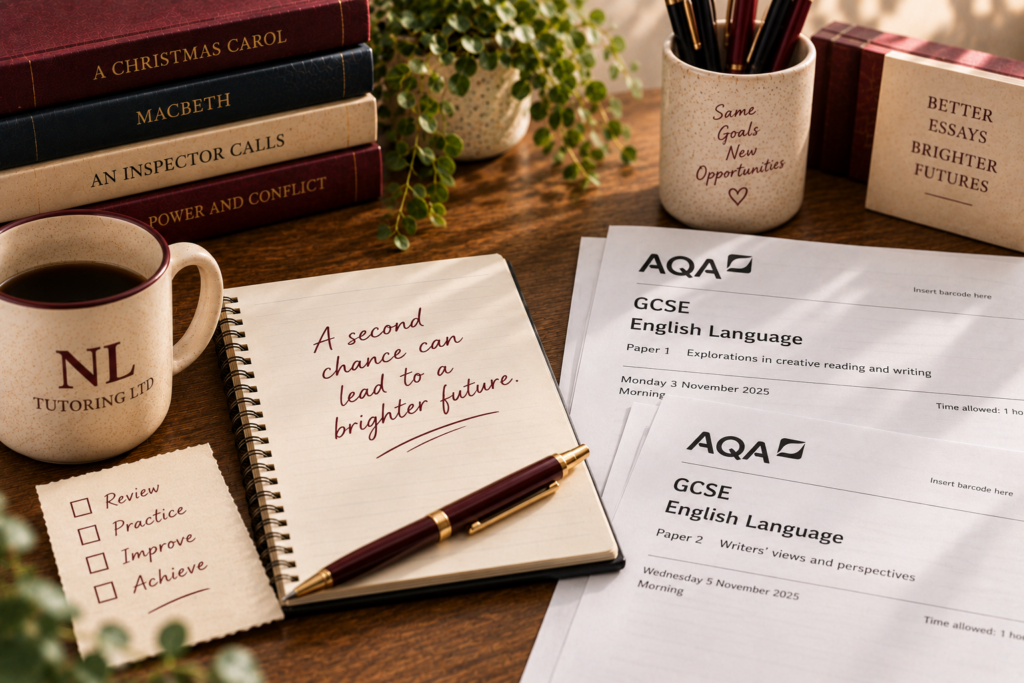
A disappointing GCSE English result can feel final on results day. It is not. There are clear GCSE English retake options, and with the right plan, a retake can be a focused opportunity to build the knowledge, writing control, and exam confidence that were missing the first time.
For many families, the immediate question is whether a student has to retake English at all. The answer depends on the qualification, the grade achieved, the student’s age, and the entry requirements for their next step. What matters most is avoiding a rushed decision. A retake should be based on the grade the student needs and an honest assessment of why they did not achieve it previously.
When does a student need to retake GCSE English?
In England, students aged 16 to 18 who have not achieved a grade 4 in GCSE English Language are generally required to continue studying English as part of their post-16 education. This is why English Language, rather than English Literature, is usually the qualification families need to prioritize.
A grade 4 is commonly treated as a standard pass, but it may not be enough for every route. Some sixth forms, colleges, apprenticeships, and competitive courses ask for a grade 5 or above. A student aiming for a career in healthcare, law, teaching, or a selective academic program may also benefit from improving a borderline result.
English Literature is different. It is not normally a compulsory post-16 retake, but it can matter where a school, course, or future application specifies it. Before entering a retake, check the exact requirements of the destination the student has in mind. Retaking simply because a grade feels disappointing is not always the best use of a demanding year, particularly if English Language already meets every relevant requirement.
GCSE English retake options explained
The most suitable route depends on timing, the student’s confidence, and whether they need English Language, English Literature, or both.
Retake English Language in the fall
For students who need to improve GCSE English Language, an exam series is usually available in the fall. This can be a sensible choice for a student who narrowly missed a grade 4 and has continued studying the subject over the summer. It allows them to secure the required grade earlier in the academic year rather than waiting until the summer.
The trade-off is preparation time. A fall retake comes quickly. If the first result exposed substantial gaps in reading comprehension, transactional writing, creative writing, or timing, a few weeks of unstructured revision is unlikely to change the outcome. The student needs a specific diagnosis and a tightly organized plan from the start of the term.
Retake in the summer exam series
The summer series gives students more time to improve and is usually the route for GCSE English Literature retakes. It can also be a better option for English Language where the student needs to rebuild core skills rather than make a small adjustment.
This route suits students who need to strengthen analytical writing, learn literature texts securely, or develop a more reliable approach to unfamiliar reading extracts. More time is useful only when it is used well. Retaking the same exam with the same revision habits often produces the same frustrations.
Retake through a school or college
Most students retake through their sixth form, college, or training provider. This is often the simplest arrangement because the center can enter the student, organize accommodations where appropriate, and provide scheduled lessons.
However, provision varies. Some colleges offer frequent teaching and close feedback; others provide limited contact time alongside a full vocational schedule. Parents should ask how often English is taught, whether students receive marked practice papers, and how progress is monitored. A weekly lesson without regular writing feedback may not be enough for a student whose main difficulty is turning ideas into marks.
Enter as a private candidate
A student can also enter through an approved private exam center. This can work for those taking a gap year, studying independently, or needing a different timetable. It requires more organization: families must confirm that the center accepts private candidates, offers the correct exam board and paper options, and can meet any approved access arrangements.
Private entry gives flexibility, but it also removes the built-in structure of college lessons. For most students, particularly those who lost confidence after their first attempt, independent study needs a clear timetable, expert feedback, and accountability.
Choosing the right exam board and qualification
A student does not always have to retake with the same exam board, although there are good reasons to do so. For English Language, the assessment approach, question wording, and writing tasks vary between boards. For English Literature, the set texts and exam requirements may differ significantly.
Retaking the original board can reduce unnecessary change because the student may already know the paper format and studied texts. But it only helps if they genuinely understand that format. If the original course was taught poorly or the student has moved to a center that uses another board, a change may be practical.
The key is not choosing a board because it is rumored to be easier. Students gain marks by responding accurately to the assessment objectives: selecting evidence, analyzing language and structure, communicating clearly, and shaping writing for purpose and audience. A strong plan teaches those skills directly.
Why students fall short the first time
A retake result improves when the reason behind the original grade is identified precisely. Students are often told to revise more, yet effort alone does not fix a weak method.
Some students know the literature texts but write broad, repetitive paragraphs that do not analyze the writer’s choices. Others have thoughtful ideas but cannot organize them quickly under timed conditions. In English Language, a student may read accurately but lose marks through vague evidence selection, limited explanation, or writing that does not maintain an appropriate tone.
There are also practical barriers: missed content, anxiety, poor attendance, slow writing speed, or a misunderstanding of the question. These need different solutions. A student who ran out of time needs pacing and timed practice. A student whose essays lack depth needs explicit modeling of analytical sentences and feedback that shows how to improve each paragraph.
A stronger retake preparation plan
The most effective retake preparation begins with a diagnostic assessment. Rather than revising every topic equally, identify the exact questions and skills that limited the student’s grade. This creates a realistic baseline and prevents weeks being spent on work they can already do.
From there, preparation should combine subject knowledge with deliberate writing practice. For Literature, that means secure knowledge of the text, characters, themes, context where relevant, and a bank of well-chosen quotations. For Language, it means repeated practice in reading analysis and writing for different purposes, audiences, and forms.
Feedback is central. Students need more than a score on a practice paper. They need to understand why one quotation was effective, where an explanation became descriptive, how a topic sentence could be more precise, and which technical errors are costing marks. Examiner-informed feedback makes the mark scheme practical instead of mysterious.
Timed practice should be introduced progressively. Early work can focus on one paragraph or one question so the student can improve technique without panic. Closer to the exam, complete papers build stamina, timing, and confidence. Every practice paper should lead to a targeted next step, not simply another grade in a notebook.
At NL Tutoring, this reflects the Assess, Build, Achieve framework: establish the gaps, teach the missing skills with clear structure, then apply them under exam conditions. For retake students, that disciplined approach is particularly valuable because time is limited and confidence may be fragile.
What parents can do now
Start by confirming the student’s required grade and exam deadline with their school, college, or intended provider. Then ask for the exam board, paper details, and the level of support available. Do not assume that a retake will be entered automatically or that English Literature is included alongside English Language.
Next, look beyond the overall grade. Request copies of marked work, teacher feedback, or a conversation about the areas that need attention. A grade 3 achieved because of weak writing requires a different plan from a grade 3 caused by one difficult exam day.
A retake is not a measure of a student’s potential. It is a second assessment opportunity, and it responds best to calm decisions, consistent practice, and teaching that shows the student exactly how to turn stronger thinking into stronger marks.