
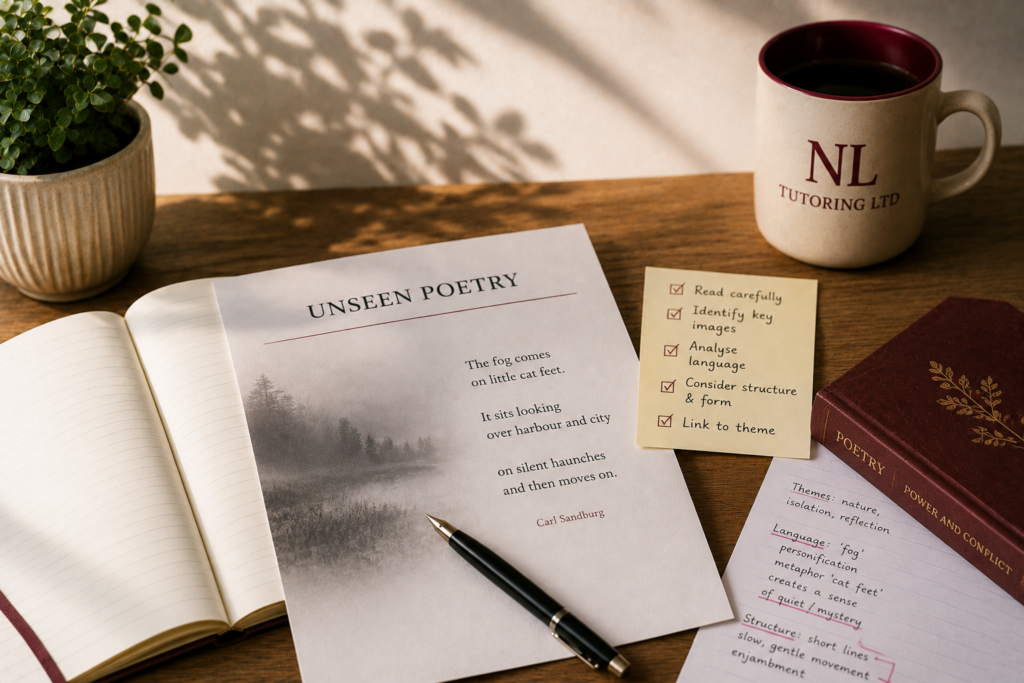
A student can know plenty of literary techniques and still freeze when faced with an unfamiliar poem. That is the challenge of unseen poetry: there is no revision guide to memorize and no teacher-led class discussion to rely on. Learning how to answer unseen poetry is therefore less about guessing what a poem “means” and more about following a dependable process under exam conditions.
For GCSE English Literature students, especially those sitting AQA, strong unseen poetry answers come from careful reading, precise evidence, and clear explanations. The poem may be new, but the skills required are not. Students need to show an examiner how the poet creates an effect, rather than simply spotting techniques or retelling the poem.
What examiners are looking for in unseen poetry
In an unseen poetry response, examiners reward a student’s ability to form a thoughtful interpretation and support it with references to the text. A high-quality answer explains how language and structure shape meaning, uses short quotations purposefully, and stays focused on the question throughout.
This is reassuring for students who worry that they will not “get” the poem. There is rarely one secret interpretation that must be found. A sensible, well-supported reading will earn credit. If a student can explain what a word, image, contrast, or structural choice suggests, and connect that idea directly to the question, they are doing the work that earns marks.
For the first AQA unseen poetry question, students generally need to analyze one poem in depth. The comparison question then asks them to compare the methods or attitudes presented in two poems. The first task needs developed analysis; the second needs focused, direct comparison. Treating both questions in exactly the same way can waste valuable time.
How to answer unseen poetry: a reliable exam method
The best responses are built in stages. Students should not begin writing the moment they have read the question. A few purposeful minutes of planning often produces a more confident, organized answer.
Read the question before reading closely
Start by identifying the key focus. Is the question asking about feelings, a relationship, a place, an experience, or an attitude? Underline the central word or phrase. This gives the reading a clear purpose.
For example, if the question asks how the poet presents isolation, the student should look for details connected to distance, silence, separation, exclusion, emptiness, or a desire for connection. They do not need to comment on every technique in the poem. They need to select the details that help answer that specific question.
Read the poem twice
The first reading is for the overall situation. Who is speaking? What is happening? What changes, if anything, from beginning to end? A student should be able to explain the poem’s basic story in one or two sentences before analyzing it.
The second reading is for annotation. Students should circle or underline words and phrases that feel striking, repeated, contrasting, unusual, or emotionally charged. They should also look at the poem’s shape: stanza breaks, short lines, punctuation, shifts in tone, and the ending.
Annotation should be useful, not decorative. Writing labels such as “metaphor” or “alliteration” is not enough on its own. Next to a quotation, students should jot down an idea: “suggests fear,” “sounds trapped,” “change to hope,” or “speaker becomes more certain.” Those quick notes make paragraph planning much easier.
Choose three strong moments
A common mistake is trying to use too many quotations. This leads to rushed explanation and a response that feels like a list. It is usually better to choose three or four moments that give the student something substantial to say.
The strongest choices often include a detail from the beginning, one from the middle, and one from the end. This naturally allows students to comment on how the poem develops. A poem may begin with confidence before becoming uncertain, or move from a concrete description toward a wider reflection. That movement is structure, and it can be analyzed even if the student does not use technical terminology.
Build paragraphs around an idea, not a technique
A useful paragraph structure is point, evidence, analysis, and link. However, students should think of it as a way to develop an argument, not as a rigid formula.
A paragraph might begin: “The poet initially presents the speaker as overwhelmed by the setting.” The student can then select a short quotation and zoom in on one or two key words. They should explain the associations of those words, the effect created, and why this matters in relation to the question.
For instance, rather than writing, “The poet uses a metaphor,” a stronger response would say: “The description of the street as a ‘cage’ suggests that the speaker feels confined rather than protected. The noun ‘cage’ has associations of captivity, making the ordinary setting seem hostile and inescapable.” The technique is present, but the analysis is doing the real work.
Analyze language with precision
Students aiming for higher grades need to move beyond broad comments such as “this makes the reader want to read on” or “this creates an image.” Those phrases do not explain enough. The question is always: what image, what feeling, and why?
Encourage students to zoom in on individual words. Verbs can reveal action and control. Adjectives can shape atmosphere. Nouns can carry powerful associations. Sound patterns may create softness, violence, urgency, or monotony. Figurative language can turn an emotion into something physical and vivid.
It also helps to acknowledge ambiguity when it is genuinely present. A word may suggest both comfort and confinement, or a description may sound hopeful while hinting at loss. This kind of thoughtful interpretation can be particularly effective for students working toward Grades 7 to 9, provided it remains rooted in the text.
Students do not need to name every method perfectly. An accurate explanation of a word’s effect is more valuable than incorrectly identifying a technique. Clear analysis beats feature spotting every time.
Do not forget structure
Structure is often where students lose marks because they only discuss it in a final sentence. Instead, they should consider how the poem unfolds from the beginning to the end.
Useful structural questions include: Does the focus shift? Does the pace change? Is there a contrast between stanzas? Does repetition make an idea feel obsessive, comforting, or unavoidable? Does the final line resolve the poem, or leave the reader uncertain?
A student might write: “The short sentence near the end interrupts the longer description, reflecting the speaker’s sudden realization.” This is a clear structural comment because it explains both the choice and its effect. There is no need to force a comment about every stanza break. Structure should be discussed where it adds meaning.
How to compare unseen poems effectively
The comparison question can feel demanding because students must work quickly. However, it is worth remembering that it carries fewer marks than the main analysis question. Students should give it focused attention without allowing it to take over the exam.
The clearest approach is to compare as they write. Rather than completing one full paragraph on Poem A and then another on Poem B, students should make links throughout: “Both poets present nature as powerful; however, the first poet finds it threatening, while the second presents it as freeing.”
They can compare ideas, language, and structural choices. A well-developed comparison does not require equal numbers of quotations from each poem, but both poems must be addressed. Short, carefully chosen evidence is enough when the explanation is specific.
Students should avoid claiming that poems are similar simply because they share a subject. Two poems about family, for example, may present entirely different attitudes. The comparison becomes meaningful when students explain the difference in viewpoint and the methods each poet uses to create it.
Common mistakes that limit marks
The most frequent issue is retelling the poem. A student may accurately explain what happens, but an examiner needs analysis of how the poet presents it. Retelling can be useful for a brief opening idea, then the response must move into evidence and interpretation.
Another problem is using long quotations. Long quotations take time to copy and make close analysis harder. Short embedded quotations allow students to focus on the most revealing language.
Finally, students should not wait for the “perfect” interpretation. In the exam, a clear first response is often the best starting point. They can refine it as they write, provided every paragraph returns to the question.
At NL Tutoring, students are taught to approach unfamiliar texts with the same Assess, Build, Achieve discipline used across GCSE English preparation: identify the gap, develop a repeatable method, and practice until the method feels secure. Confidence in unseen poetry grows through regular timed practice and feedback that shows students exactly how to turn a promising idea into a higher-mark response.
The next time an unseen poem appears on the page, students should pause, read with purpose, and trust the evidence in front of them. They do not need to know the poem already. They need to show, step by step, what they can see and why it matters.