
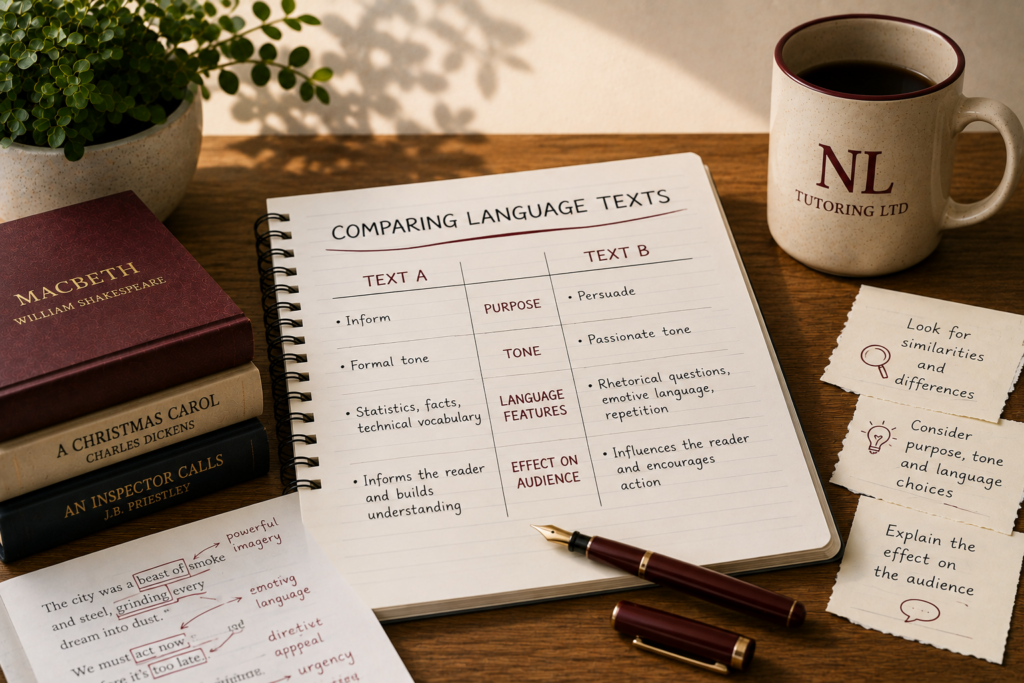
A comparison question can feel difficult because students are asked to hold two texts in their minds at once while writing a clear, focused response. The key to how to compare language texts is not finding every similarity and difference. It is showing how each writer uses language to present an idea, viewpoint, feeling, or experience – and making purposeful links between their methods.
For GCSE English Language students, this is where strong exam technique makes a measurable difference. A student may understand both extracts perfectly but still lose marks if their response becomes two separate mini-essays, relies on feature spotting, or makes broad comparisons without evidence. The goal is a controlled argument that keeps both writers in view.
Start With the Comparison Focus
Before selecting quotations, identify exactly what the question is asking you to compare. In many GCSE comparison questions, the focus is on a writer’s perspective or attitude. The question might ask how writers convey their views about a place, an event, a person, or an experience.
Turn that question into a simple statement about each text. For example, one writer may present a journey as exhausting and threatening, while the other presents a journey as demanding but rewarding. This gives the response a direction from the first sentence.
Students often rush straight to language techniques. That creates a common problem: they identify a metaphor or a list, but they do not explain what it reveals about the writer’s viewpoint. Begin with meaning. Then examine how the language creates that meaning.
Read for Attitude, Not Just Information
When students first read two sources, they can become absorbed in what happens. In a comparison response, the more useful question is: what does each writer want the reader to feel or think?
Look closely at word choices that reveal tone. Is the writer enthusiastic, resentful, amused, fearful, dismissive, nostalgic, or admiring? Notice where that attitude becomes strongest. A shift in tone can be especially useful because it gives students something meaningful to compare.
For instance, a writer describing a crowded city may use words such as “crushing,” “relentless,” and “suffocating.” Another writer may describe the same type of setting as “alive,” “vibrant,” and “electric.” The setting is similar, but the perspectives are sharply different. This is a much stronger comparison than simply saying that both writers use adjectives.
A helpful annotation system is to mark each text with a short phrase that captures the writer’s overall attitude. Then underline two or three quotations that best prove it. There is no prize for collecting six weak quotations when two precise choices can be analyzed in depth.
Choose Evidence That Creates a Real Link
The best quotations do more than sound impressive. They allow students to make a direct comparison. Select evidence that relates to the same aspect of the question: perhaps both writers’ descriptions of danger, their reactions to other people, or their feelings about a challenging environment.
Avoid forcing a comparison between unrelated ideas. If one quotation is about weather and another is about family relationships, the link may become artificial unless the student can clearly explain how both shape the writer’s perspective.
Short quotations are usually more effective than long ones. A single loaded word can provide plenty to analyze and is easier to integrate smoothly into a sentence. Students should aim to embed evidence rather than dropping in a full sentence from the extract.
Use a Clear Paragraph Structure
A strong comparison paragraph needs a point about both texts, evidence from both writers, and explanation of how language shapes meaning. The order can vary, but the comparison should remain active throughout.
A useful structure is:
- Make a comparative point about the writers’ views.
- Analyze a quotation from the first text.
- Link directly to the second text using a comparison word.
- Analyze evidence from the second text.
- Explain the key similarity, difference, or effect on the reader.
This is not a formula to repeat mechanically. It is a way to prevent the response from becoming a Text 1 paragraph followed by a Text 2 paragraph. Examiners reward students who compare ideas and methods, rather than simply writing about each source separately.
Here is the difference in practice:
Weak: “In Source A, the writer uses the word ‘crushing.’ In Source B, the writer uses the word ‘vibrant.’”
Stronger: “While the writer in Source A presents the city as physically overwhelming through the adjective ‘crushing,’ the writer in Source B sees its energy positively, calling it ‘vibrant.’ This contrast suggests that the same crowded environment feels imprisoning to one writer but exciting to the other.”
The stronger version does not just identify words. It explains the contrast in perspective and makes a clear judgment about the writers’ intentions.
Compare Methods With Purpose
Language methods matter, but they should serve the interpretation. Students do not need to hunt for unusual terminology. Accurate analysis of a verb, adjective, image, contrast, or sentence pattern will earn more than an insecure attempt to label every device.
Ask three questions about each quotation: What is the writer suggesting? Which word or method creates that impression? Why might the writer want the reader to respond in that way?
For example, if a writer describes waves as “clawing” at a boat, the verb personifies the sea as aggressive and predatory. If another writer calls the waves “playful,” the contrast is not merely between two verbs. It shows one writer’s fear against the other’s enjoyment and confidence.
Students aiming for the higher grades should also consider nuance. A writer may not be completely positive or negative. They may admire a place while feeling uneasy about it, or begin confidently before becoming frustrated. Recognizing this complexity can make a response more convincing, provided it is supported by the text.
Use Comparative Language Naturally
Comparison words should help the reader follow the argument. Useful choices include “similarly,” “likewise,” “in contrast,” “whereas,” “however,” “more intensely,” and “less directly.” Use them to express a genuine relationship between the texts, not as decoration at the start of every sentence.
It also helps to vary the type of comparison. Students can compare the writers’ viewpoints, their language choices, the strength of their feelings, and the effect created for the reader. If every paragraph only says “both writers use descriptive language,” the response will quickly become repetitive.
A thoughtful comparison might explain that both writers feel isolated, but one uses bleak imagery to show despair while the other uses reflective language to show a peaceful sense of independence. This shows both similarity and difference in one developed point.
Plan Briefly, Then Write With Control
Under exam conditions, students do not need a long plan. Two or three minutes is enough to identify each writer’s viewpoint and choose the strongest paired quotations. A simple grid can work well: one column for Source A, one for Source B, with a row for each main comparison.
Most students benefit from planning two or three developed points rather than trying to cover every paragraph of both texts. Depth is more valuable than a rushed tour of the extracts. Each paragraph should add something new to the answer.
Keep an eye on time. If the comparison question carries a high number of marks, it deserves a proportionate share of the exam. Leaving several minutes to reread the response can help students spot missing comparisons, repeated points, or quotations that have not been explained.
Common Mistakes That Hold Students Back
The first is writing two separate analyses. Even if both sections are thoughtful, the answer is not fully comparing unless it draws links between the writers.
The second is feature spotting. Saying “the writer uses a metaphor” does not explain the writer’s perspective. Follow every method with a clear comment on meaning and effect.
The third is making unsupported claims. Statements such as “the writer feels angry” need precise evidence. Students should let carefully chosen words do the work.
Finally, avoid treating one text as more important than the other. A balanced response does not have to give each source exactly the same number of words, but both should be analyzed with equal care.
Confidence in comparison grows through deliberate practice, feedback, and a method students can rely on when the clock is running. Encourage your child to practice linking two short quotations at a time before attempting a full response. Once they can explain the connection clearly, they are building the examiner-focused habits that lead to stronger GCSE English answers.