
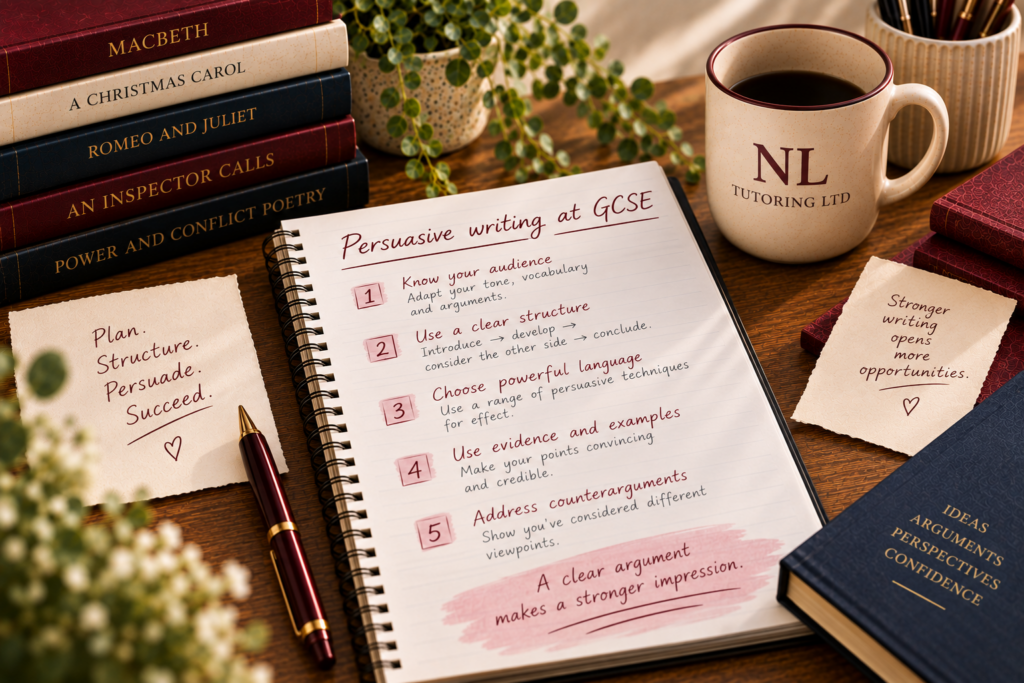
A persuasive writing question can look deceptively simple: write an article, letter, speech, or essay giving your viewpoint. Yet many students lose marks because they rely on strong opinions rather than strong crafting. The top strategies for persuasive writing help students turn a clear viewpoint into a controlled, convincing response that meets GCSE English Language assessment objectives.
For parents, the key message is reassuring. Persuasive writing is not a matter of having naturally forceful opinions or using the longest words possible. It is a set of teachable decisions: choosing an audience, shaping a logical argument, selecting language carefully, and checking technical accuracy under time pressure.
Top Strategies for Persuasive Writing That Earn Marks
Start with a precise viewpoint
Students should decide exactly what they believe before they plan their first sentence. A vague position such as “school should change” gives them very little to develop. A precise viewpoint, such as “secondary schools should begin later to improve students’ well-being and learning,” creates a clear line of argument.
Encourage your child to write their viewpoint in one sentence at the top of their plan. Every paragraph should then support, explain, or develop that position. This prevents a common GCSE issue: a response that starts confidently but drifts into a series of disconnected points.
A persuasive piece can acknowledge complexity. For example, a student might accept that later start times would create transport challenges, then explain why the educational benefits outweigh them. This is often more convincing than pretending there is no opposing view at all.
Match the voice to the audience and purpose
Before writing, students need to identify who they are addressing. The same argument will sound different in a speech to fellow students, a formal letter to a principal, and an article for a local newspaper.
A speech may open with direct address: “Students deserve to arrive at school ready to learn, not exhausted before first period.” A formal letter requires more restrained language and a clear sign-off. An article can use a strong headline, an engaging opening, and a conversational but purposeful tone.
This is not simply a presentation detail. Audience awareness helps students make deliberate language choices, which is central to successful writing. They should ask: What will this reader care about? What concern might they have? What tone will make them listen?
Build each paragraph around one developed point
Persuasive writing needs structure, not a collection of techniques. A reliable paragraph pattern is point, explanation, evidence or example, and impact. The evidence does not need to be a real statistic unless the task provides one. Students can use plausible examples, carefully phrased generalizations, or a hypothetical scenario to make an argument feel real.
For instance, rather than writing, “Homework is stressful,” a student could develop the thought: “After six hours of focused lessons, many students return home facing another two or three hours of work. The result is not greater learning, but tiredness, resentment, and less time for family life.”
The second version explains the consequence. It gives the reader a reason to care. Depth is usually more effective than racing through five undeveloped ideas.
Use rhetorical devices with purpose
Rhetorical questions, repetition, rule of three, emotive language, facts, and direct address all have a place in persuasive writing. The issue is not whether a student can spot these devices. It is whether they can use them naturally to influence a reader.
A rhetorical question can introduce a concern: “How can we expect young people to protect their mental health when they are given no time to rest?” Repetition can emphasize a key demand: “We need safer streets. We need cleaner air. We need leaders who will act.” A rule of three can create rhythm and clarity.
However, too many devices in one paragraph can feel forced. Exclamation marks, capital letters, and dramatic claims do not automatically create persuasion. Students aiming for higher grades should prioritize control. One well-placed rhetorical question is stronger than three in a row.
Balance emotion with reasoning
Emotion makes writing memorable, but reasoning makes it credible. Strong GCSE responses often combine the two. Students can make a reader feel concern, hope, frustration, or responsibility, then support that feeling with a logical explanation.
Consider the difference between “Plastic pollution is terrible” and “Every discarded bottle may seem insignificant, but millions enter rivers and oceans each year, damaging habitats long after we have forgotten throwing them away.” The second example gives the claim a human and environmental impact.
Students should avoid inventing wildly specific facts they cannot support. Instead, they can use measured phrasing such as “many families,” “too often,” “research has repeatedly shown,” or “the consequences can be serious.” Their argument remains persuasive without becoming unreliable.
Vary sentences for emphasis and control
Sentence variety is one of the most practical ways to improve a piece of writing quickly. Short sentences can create impact: “Enough is enough.” Longer sentences can explain a more complex idea and show mature control.
Students should also use a range of openings. Starting every sentence with “I think” or “This” makes writing repetitive. They might begin with an adverb, a connective, a subordinate clause, or a deliberate command: “Instead of ignoring this issue, we must address it now.”
Accuracy still matters. Ambitious punctuation only earns credit when it is used correctly. A clear sentence with a secure comma is always better than a confusing sentence overloaded with semicolons. At NL Tutoring, this balance between ambitious choices and reliable technical accuracy is a core part of examiner-informed writing practice.
Plan Before Writing, Then Leave Time to Edit
Under exam conditions, planning can feel like lost time. In reality, two or three focused minutes can protect a student from repetition and weak organization. A simple plan should include a clear viewpoint, three main points, the order in which they will appear, and one possible counterargument.
A purposeful opening should establish the issue and viewpoint quickly. The middle paragraphs should develop the strongest reasons, often building toward the most powerful point. The ending should not merely repeat the introduction. It should leave the reader with a final challenge, warning, or call to action that fits the form.
Students also need time to reread their work. A final check for capital letters, sentence boundaries, apostrophes, and missing words can make a meaningful difference. For students working toward Grades 7 to 9, editing is also the moment to replace repeated vocabulary, sharpen vague phrases, and check that their tone remains consistent.
Practice Persuasion as an Exam Skill
The best preparation is not writing one perfect response after hours of work. It is regular, focused practice followed by useful feedback. A student might spend one session planning and writing an opening, another improving a weak paragraph, and another completing a timed response. This builds confidence without making writing practice feel overwhelming.
When reviewing work, parents can ask a few constructive questions: Is the viewpoint clear? Does every paragraph add a new reason? Where does the writing make the reader feel or think something? Which sentence is most effective, and why? These questions encourage students to make choices rather than simply hunt for mistakes.
It also helps to compare the response against the task before judging it. A lively speech may be less formal than a letter by design. A highly emotional charity appeal may use different techniques from a reasoned article about school policy. Effective persuasion depends on purpose, audience, and form.
A student does not need to sound like an adult columnist to write persuasively. They need a clear opinion, a well-shaped argument, and the confidence to make every language choice count. With structured practice, persuasive writing becomes less about filling a page and more about giving the reader a compelling reason to agree.