
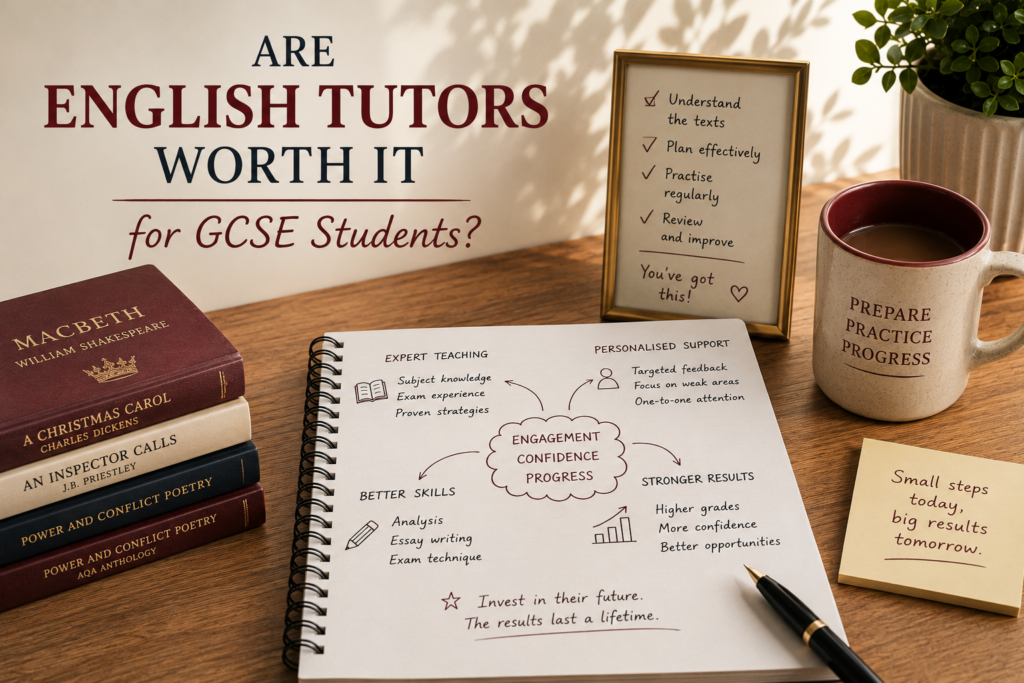
A student can spend hours revising Macbeth, completing practice papers, and making flashcards, yet still freeze when faced with a 40-minute English exam response. The issue is rarely a lack of effort. More often, they do not know how to turn their knowledge into the precise, developed analysis that earns marks. So, are English tutors worth it? For many GCSE students, the answer depends on whether tuition addresses that gap with expert teaching, clear structure, and consistent practice.
English tuition is not automatically the right choice for every family. A confident student who is already receiving detailed feedback at school and can act on it independently may need little beyond focused revision. But when a student is stuck, losing confidence, or working hard without seeing their grades move, specialist support can make a meaningful difference.
Are English Tutors Worth It? Start With the Real Problem
Parents often look for an English tutor after a disappointing test result. That is understandable, but the grade itself is only the starting point. A useful decision begins with a more specific question: what is preventing this student from progressing?
For some students, the difficulty is subject knowledge. They may not fully understand a set text, struggle to remember quotations, or lack the vocabulary to discuss a writer’s methods. For others, knowledge is not the problem at all. They can talk intelligently about a character or theme, but their written responses become vague, repetitive, or rushed.
GCSE English also asks students to manage several skills at once. In English Literature, they need to select relevant evidence, analyze language and structure, maintain a clear argument, and connect ideas to the question. In English Language, they must read closely, write accurately for a purpose and audience, and make good decisions under time pressure. A student may be secure in one area and weak in another.
Generic homework help can ease the immediate pressure, but it may not solve the underlying issue. Effective tuition identifies the barrier first, then teaches the student how to overcome it. That is the difference between simply completing another essay and learning how to write a better one independently.
What Specialist GCSE English Tuition Can Change
The strongest tuition gives students a repeatable process, rather than a collection of model answers to memorize. They learn how to read a question carefully, plan a focused response, choose evidence with purpose, and explain its effects in a way that meets the assessment criteria.
This matters because English grades can feel subjective to students. They may believe they have made a good point, only to receive limited marks because the point is not developed, linked to the question, or supported with precise evidence. A qualified teacher with current examiner insight can make the marking process clearer. Students begin to understand what separates a simple comment from convincing analysis, and what moves a response toward the higher levels.
A good tutor also provides the feedback that busy classrooms cannot always offer in depth. “Add more detail” is not enough for a student who does not know what detail to add. Specific feedback might show them how to embed a quotation, explore a key word, shape a paragraph around an argument, or improve sentence control so their ideas are easier to follow.
Over time, that clarity builds confidence. Students no longer approach every essay as a blank page. They have methods they can trust.
Confidence is an academic issue, not a bonus
A student who expects to fail often avoids the very practice that would help them improve. They may rush work, leave questions incomplete, or say they are “bad at English” because they cannot immediately find the perfect idea.
Supportive tuition should challenge this belief without offering false reassurance. Confidence grows when students can see evidence of progress: a clearer paragraph, stronger use of quotations, more accurate timing, or a practice response that reaches a higher mark. Small, visible wins create momentum.
For students aiming for Grades 7 to 9, confidence has a different role. They may already be capable, but need to sharpen their interpretation, conceptual argument, and control of structure. Their tuition should stretch them beyond safe, familiar points and help them produce sophisticated work consistently under exam conditions.
When Tuition Is Most Likely to Be Worth the Investment
Tuition tends to deliver the greatest value when it is timely and targeted. Waiting until the final few weeks before exams can still help with priorities and exam technique, but it leaves less time for deeper writing habits to develop.
Year 10 is often an excellent time to begin structured support. Students have enough exposure to GCSE content to reveal where their gaps are, while still having time to improve without the pressure of imminent exams. They can strengthen core skills, build subject knowledge, and establish revision routines before Year 11 becomes more demanding.
In Year 11, tuition can be especially valuable when it is disciplined and focused. Students need to know what to revise, how to practice, and how to respond to feedback. Re-reading notes is not the same as preparing for an exam. A strong program uses timed work, retrieval of quotations and concepts, modeled responses, and deliberate practice of weaker question types.
It may also be worth considering tuition earlier, in Years 7 through 9, if a student has persistent difficulty with reading comprehension, writing structure, grammar, or confidence. Early support should not turn school into constant test preparation. Its purpose is to build the foundations that GCSE English later depends on.
The Difference Between a Tutor and GCSE Expertise
Not all English tuition is equivalent. A tutor may be kind, well read, and good at helping with homework, yet still have limited knowledge of the GCSE specifications, assessment objectives, or the demands of a particular exam board.
For families preparing for AQA GCSE English Language and Literature, subject-specific expertise matters. Students need teaching that reflects the wording and expectations of their papers, not broad advice that could apply to any essay. They also benefit from someone who understands common marking mistakes and can explain how examiners reward responses.
At NL Tutoring, the Assess, Build, Achieve framework reflects this approach. The process starts by assessing where a student is now, rather than assuming every student needs the same lessons. From there, teaching builds knowledge, analytical writing, and exam technique before focusing on the performance needed to achieve their best result.
That structure is valuable because it gives parents something more concrete than the promise of “extra help.” They can understand what their child is working on, why it matters, and how progress will be developed over time.
Questions to Ask Before Choosing an English Tutor
The right tutor should be able to explain their approach clearly. Before committing, ask how they assess a student’s current level, how often they give and discuss written feedback, and how they adapt teaching for a student who is working toward a pass compared with one targeting top grades.
It is also sensible to ask about GCSE experience. Do they know the relevant exam board? Can they teach both English Language and English Literature? Do they use timed practice and teach students how to interpret mark schemes without becoming dependent on them?
Finally, consider the relationship between student, tutor, and family. The student should feel safe admitting what they do not understand, but the work should still be purposeful. The best tuition is warm and encouraging while holding clear expectations around practice, attendance, and acting on feedback.
Tuition Works Best Alongside the Student’s Own Effort
Even excellent teaching cannot replace practice. A tutor can show a student how to build a strong paragraph, but the student needs opportunities to use that method until it becomes familiar. They need to revisit feedback, learn quotations or key ideas, and complete independent work between sessions.
Parents can help without becoming the English teacher at home. Ask what the student is working on this week, make space for a regular study routine, and focus praise on effort and improvement rather than only on grades. If a student says they have revised, asking what they can now explain or write is often more useful than asking how long they sat at a desk.
The goal is not to make a student reliant on tutoring. It is to give them the knowledge, habits, and confidence to approach unfamiliar questions with a clear plan. When a student can explain why a paragraph works, improve it after feedback, and manage their time in a practice paper, the value of tuition is already showing.
For families considering support, a consultation should provide clarity rather than pressure. Bring recent work, test results, and an honest picture of where English feels difficult. The right next step is one that gives the student a focused plan and the confidence that progress is achievable.