
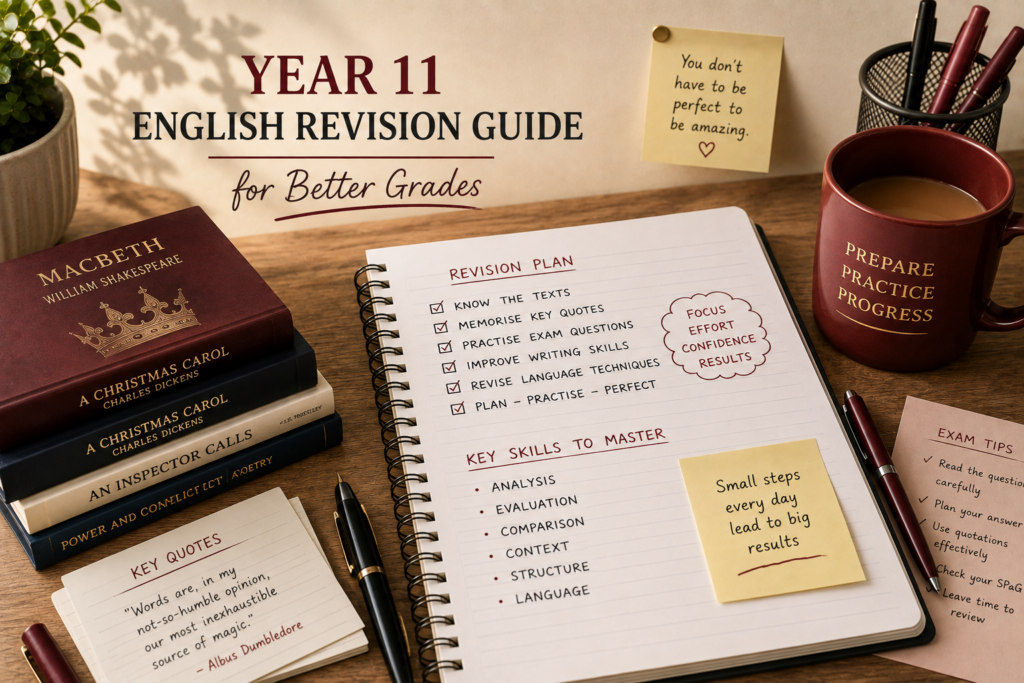
A good Year 11 English revision guide should do more than fill evenings with quotes, practice papers, and colored notes. GCSE English marks are earned when a student can select the right knowledge, shape it into a clear response, and communicate it under time pressure. That is why some hardworking students still feel disappointed after a mock exam: effort matters, but effort needs direction.
For families preparing for AQA GCSE English Language and English Literature, the most useful revision plan is structured, realistic, and responsive to the student’s actual gaps. It should build knowledge, improve writing, and make exam practice routine rather than frightening.
Start with an honest assessment
Revision becomes much more effective when students stop treating every topic as equally urgent. A student who knows Macbeth well but struggles to explain language choices needs a different plan from a student who can write fluently but cannot recall key moments from An Inspector Calls.
Begin by looking at recent classwork, teacher feedback, and mock papers. Identify patterns, not just individual mistakes. Is the student losing marks because their paragraphs are too short? Do they retell the plot instead of analyzing the writer’s methods? Are they running out of time? Do they avoid unseen texts because they are unsure where to begin?
This assessment stage is central to the Assess, Build, Achieve approach. It replaces vague goals such as “revise English more” with specific priorities. For example, a student might need to strengthen Literature quotation recall, practice Language Paper 1 Question 5 descriptions, and learn how to make a developed point about context without bolting it awkwardly onto every paragraph.
Parents can help by asking one simple question after a marked task: “What is the one improvement you will make next time?” This keeps feedback practical and prevents revision from becoming a collection of half-finished tasks.
Build a revision timetable students can maintain
A complicated timetable is rarely followed for long. A better approach is to schedule short, focused English sessions alongside other subjects, with a clear purpose for each one. Three or four English sessions a week can be enough when they are purposeful and consistently completed.
A balanced week might include one Literature knowledge session, one analytical-writing session, one English Language question practice, and one timed response or feedback session. The balance matters. Memorizing quotations without writing essays does not prepare a student to use them. Writing essay after essay without revisiting the text can lead to repetitive, thin analysis.
Each session should answer a clear question: what will the student know or do better by the end? “Revise poetry” is too broad. “Learn four flexible quotes for the power and conflict poem comparison” is manageable. “Write an introduction and two paragraphs for a Macbeth ambition question in 25 minutes” gives the student a measurable task.
It also depends on how close the exams are. Earlier in Year 11, students benefit from building knowledge carefully and practicing one skill at a time. In the final weeks, timed practice and exam stamina deserve more space. Neither stage should be skipped.
Revise English Literature through ideas, not quote lists
Students often make long lists of quotations, then discover in the exam that they cannot choose or explain them effectively. Strong Literature revision organizes knowledge around the big ideas that could appear in many questions: power, responsibility, conflict, gender, family, inequality, ambition, identity, and change.
For each set text, students should know the key turning points, a small bank of adaptable quotations, and the methods that make those quotations useful. A quote is not valuable simply because it sounds impressive. It needs to support an argument.
Take a quotation from Macbeth such as “vaulting ambition.” A secure response may identify ambition as Macbeth’s tragic flaw. A stronger response can explore the metaphor of reckless movement, suggesting that his desire exceeds control and foreshadows collapse. The difference is not more quotation recall. It is knowing how to turn a short quotation into analysis.
Context should support this interpretation, not replace it. A student might connect Macbeth’s fear of disorder to Jacobean beliefs about kingship, but the paragraph still needs to stay rooted in Shakespeare’s language and dramatic choices. Examiners reward relevant context that deepens a point, not a detached history lesson.
For poetry, comparison should begin early. Rather than revising each poem in isolation, pair poems by theme and contrast the poets’ viewpoints, structures, and methods. Students need to be able to move between two poems with purpose, not write one mini-essay followed by another.
Improve English Language by practicing the process
English Language revision can feel less straightforward because students are working with unfamiliar texts. Yet the skills are highly teachable. Students need a reliable process for reading, selecting evidence, analyzing methods, and managing time.
For reading questions, encourage students to read the wording carefully before they write. They should know whether the question asks them to identify information, analyze language, consider structure, or evaluate a statement. Many avoidable marks are lost when a student writes a thoughtful answer to the wrong question.
For writing questions, planning is not wasted time. A brief plan can prevent a descriptive piece from becoming a list of unrelated images or an argument from losing its direction halfway through. Students should decide on audience, purpose, tone, and a simple sequence before they begin.
Sentence variety matters, but it should serve clarity. Forced “fancy vocabulary” and punctuation tricks can make writing sound less controlled. A Grade 7 to 9 response is not defined by obscure words. It is purposeful, accurate, engaging, and crafted for the task.
Make feedback part of revision
Completing a practice paper is only the first half of revision. The real progress comes from reviewing the response with honesty. Students should compare their work against the question, identify where marks were earned, and choose a precise target for the next attempt.
Useful feedback sounds specific: “Explain the effect of the verb more closely,” “Compare both poets throughout,” or “Leave five minutes to check accuracy.” Unhelpful feedback sounds like “add more detail” because it does not tell the student what to do differently.
A simple improvement cycle works well:
- Complete one focused question or timed section.
- Review it using teacher feedback or clear success criteria.
- Rewrite one paragraph or plan a stronger version.
- Apply that improvement in the next task.
This is where specialist, examiner-informed guidance can make a substantial difference. Students often know that an answer is “not good enough” but cannot see the move that would raise it. Clear teaching turns an uncertain instinct into a repeatable method.
Practice under exam conditions before exam day
Confidence is built through evidence. When students have completed timed questions, improved them, and tried again, the exam feels more familiar. They know how long a paragraph takes, where they tend to lose focus, and how to recover if a difficult question appears.
Start with short timed tasks. A student may first write one Language analysis paragraph in eight minutes or plan a Literature essay in five. Then build toward full sections and complete papers. Timing should be practiced alongside quality, not introduced as a last-minute test of endurance.
After each timed task, review the practical habits as well as the content. Did the student spend too long choosing a quotation? Did they leave enough time for the final question? Did they check spelling, punctuation, and paragraphing? Small adjustments can protect valuable marks.
Help students protect confidence and momentum
Year 11 is demanding, and English revision should not become a nightly battle. Students need routines, encouragement, and breaks, but they also need accountability. The goal is steady progress, not perfect motivation every day.
Parents do not need to become English teachers. Providing a quiet routine, noticing completed work, and keeping conversations focused on the next manageable step can be enormously helpful. If a student is stuck, anxious, or repeatedly making the same errors, targeted support can provide the structure and expert feedback that independent revision cannot always supply.
The best revision plan leaves a student with more than a folder of notes. It gives them the calm knowledge that, whatever the question asks, they have a method for meeting it.