
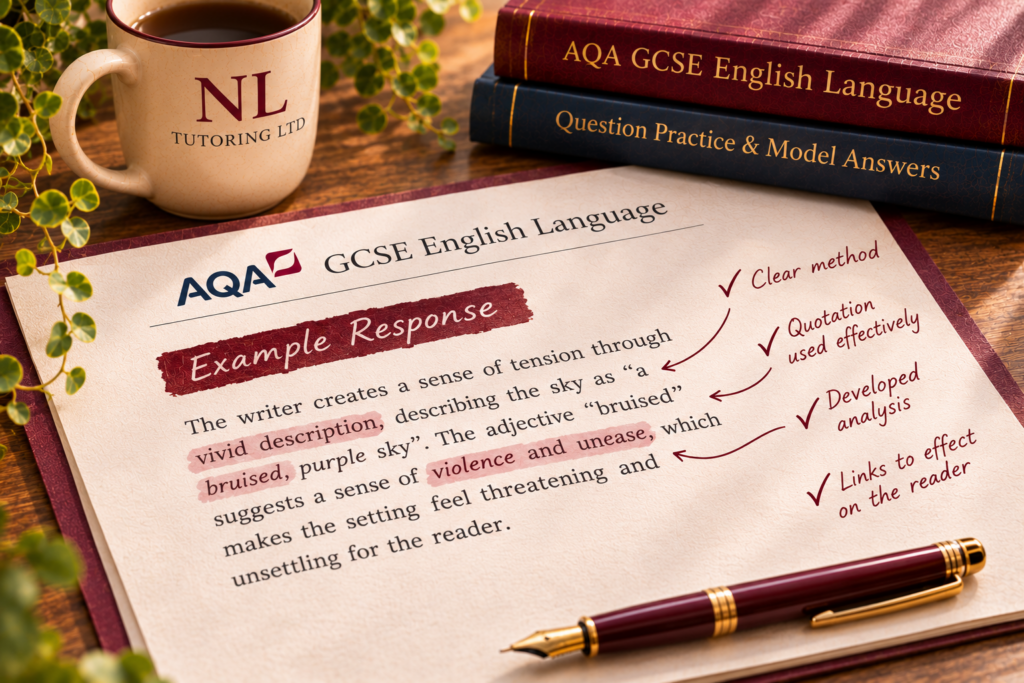
A student can know what a metaphor is and still lose marks if their response stops at, “This makes the reader want to read on.” Strong English Language response examples show the missing step: explain how the writer’s choice creates a specific effect, then connect that effect to the question. That is the difference between spotting a technique and producing an answer an examiner can reward.
For GCSE English Language, students do not need to write pages of complicated ideas. They need a clear method for selecting evidence, analyzing it precisely, and maintaining focus under time pressure. The examples below are designed to show what that method looks like on the page.
What Strong English Language Responses Do Differently
High-scoring responses are not simply longer. They are purposeful. They answer the exact question, choose evidence carefully, and explain meaning rather than listing language devices.
A useful rule is this: every quotation must earn its place. If a student uses a word or phrase, they should be ready to say what it suggests and why the writer may have chosen it. General comments such as “this creates imagery” or “this engages the reader” rarely take an answer far enough on their own.
For students working toward a secure pass, this means moving from a point to a supported explanation. For students aiming for Grades 7 to 9, it means exploring layers of meaning, writer’s intentions, and the effect of structural choices without forcing an interpretation that the text cannot support.
English Language Response Examples for Analysis Questions
The following examples use invented extracts, so students can focus on the method rather than memorizing an answer. They reflect the kinds of skills tested in AQA-style reading questions.
Language analysis: explain the writer’s choice
Question: How does the writer use language to describe the storm?
Extract: “Rain hammered the roof, while the wind clawed at the loose gate.”
A weak response might say: “The writer uses personification to make the storm sound scary.” This identifies a method, but it does not explain enough.
A stronger response could be:
> The verb “hammered” makes the rain seem forceful and relentless, as if the house is being attacked from above. The writer also personifies the wind as it “clawed” at the gate. “Clawed” suggests an animal trying to get inside, which creates a threatening atmosphere and makes the setting feel unsafe.
Notice the sequence. The student selects a precise word, explores its associations, and links those associations to the atmosphere. There is no need to name every possible technique. Accurate analysis matters more than feature-spotting.
Students sometimes worry that they must find a hidden meaning in every word. They do not. A sensible interpretation, clearly explained and rooted in the quotation, is far more valuable than an imaginative point with no textual support.
Structure analysis: track the reader’s attention
Question: How has the writer structured the text to interest the reader?
Extract summary: The passage begins with a calm description of an empty street, then narrows its focus to a child waiting at a window. In the final paragraph, the child sees a figure approaching.
A weak answer often says: “The writer uses short sentences to build tension.” That may be true, but structure questions require students to consider the movement of the text as a whole.
A stronger response could be:
> At the beginning, the writer focuses on the empty street, creating a calm but isolated setting. The focus then shifts indoors to the child at the window, making the moment feel more personal because the reader is now close to their thoughts and fears. In the final paragraph, the approaching figure introduces a new threat. By delaying this reveal until the end, the writer creates suspense and leaves the reader wanting to know whether the child is in danger.
This response follows the text from beginning to end. It discusses shifts in focus and the delayed reveal, rather than treating structure as a list of sentence types. That is the key distinction.
Evaluation: make a judgment and prove it
Question: A student says, “The writer makes the character seem completely powerless.” To what extent do you agree?
Extract: “Maya pressed her back against the wall, but her fingers tightened around the flashlight.”
A balanced response is often stronger than automatic agreement:
> I mostly agree that Maya appears powerless because she “pressed her back against the wall,” suggesting that she is trapped and has nowhere left to go. The wall may also act as a barrier, emphasizing her isolation. However, the detail that her fingers “tightened around the flashlight” suggests she has not given up. The verb “tightened” shows determination, so the writer presents Maya as frightened but still prepared to defend herself.
The phrase “mostly agree” gives the student room to evaluate. They do not need to disagree for the sake of it, but they should consider whether the evidence supports a more nuanced judgment.
How to Build a Better Response Under Exam Pressure
A reliable paragraph structure can prevent a student from freezing when the clock is running. Start with a direct answer to the question. Add a short quotation, zoom in on a key word or phrase, and explain its implications. Then return to the writer’s purpose, the character, the atmosphere, or the reader’s response – whichever the question requires.
For example, instead of writing, “The writer uses the word ‘dark’ to make it scary,” a student could write, “The adjective ‘dark’ suggests uncertainty because the character cannot see what may be ahead. This makes the setting feel threatening.” The second version is still concise, but it contains a developed explanation.
Students should also match the size of their response to the marks available. A short retrieval question does not need a full analytical paragraph. A larger evaluation question needs a clear line of argument and several developed references. Knowing this helps students spend their time where it will make the greatest difference.
Common Habits That Limit Marks
The most common problem is retelling the extract. If a student writes what happened but not how the writer presents it, they may understand the text but will not show enough analysis.
Another limiting habit is using oversized quotations. A whole sentence can feel safer, but it often leads to vague comments. Short, well-chosen quotations make it easier to zoom in on the writer’s language. “Clawed,” “tightened,” and “empty” can often give a student more to analyze than a long quotation copied without a clear purpose.
Finally, students should avoid pre-prepared phrases that do not fit the text. “This makes the reader want to read on” is not always wrong, but it is usually too broad. Ask: what exactly does the reader feel? Concern? Curiosity? Unease? Sympathy? Precise vocabulary leads to precise analysis.
Turning Model Answers Into Independent Skill
Model answers are useful when students actively study them. Reading a strong paragraph once is not enough. They should identify the point, underline the selected evidence, and label where the explanation becomes more detailed. Then they should try the same question with a different quotation or a new extract.
This is where guided feedback matters. A student may write a sensible paragraph but repeatedly miss the final analytical step. Another may have excellent ideas but lose clarity through rushed organization. An experienced teacher can identify the pattern quickly and build practice around it.
At NL Tutoring, the Assess, Build, Achieve approach begins by identifying these individual gaps. From there, students are taught the habits that make responses clearer, more confident, and more rewarding under exam conditions. Examiner-informed support is particularly valuable because students learn not just what sounds impressive, but what demonstrates the skills the assessment is designed to reward.
The goal is not for students to memorize perfect paragraphs. Texts change, questions change, and a memorized response can become a distraction. The goal is for them to recognize what a question is asking, select the right evidence, and explain their ideas with control. With consistent practice, that process becomes familiar enough for confidence to replace panic when the paper is in front of them.