
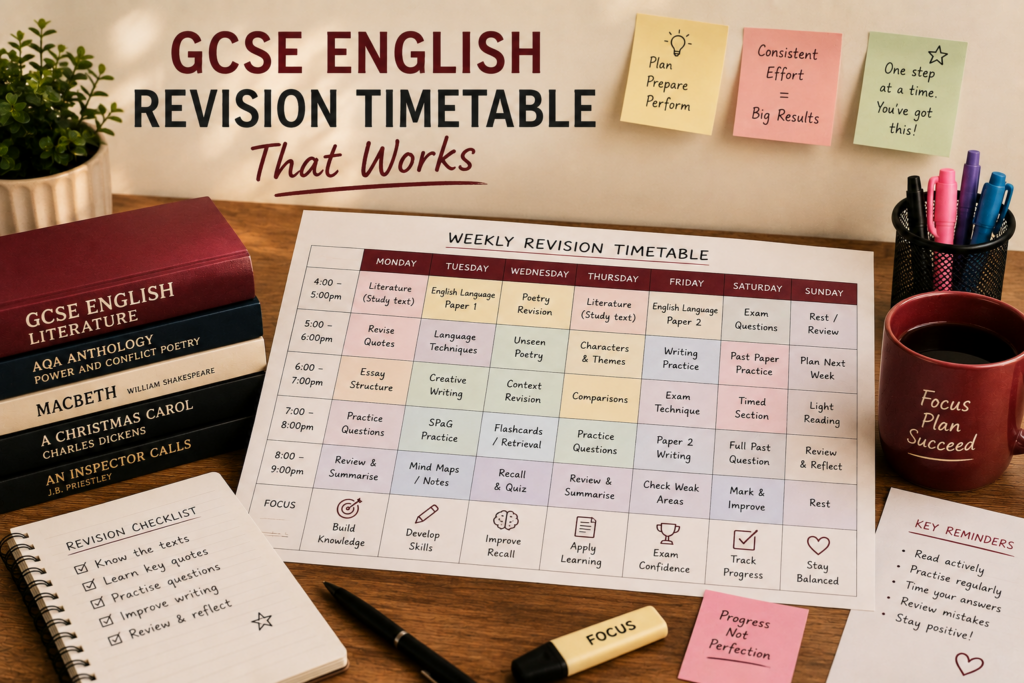
A blank revision schedule can feel reassuring for about ten minutes. Then the real questions arrive: Which text should come first? How much time should go to English Language? Is rereading a quote sheet really revision? A strong GCSE English revision timetable answers those questions before pressure builds. It gives students a clear route from what they find difficult now to the marks they need in the exam.
For families preparing for AQA GCSE English, the aim is not to fill every evening with work. It is to use limited time well: build secure knowledge, improve analytical writing, and practice applying both under timed conditions. Students targeting a Grade 4 need a different balance from those pushing for Grades 7 to 9, but every effective plan begins with an honest picture of current strengths and gaps.
Start with an assessment, not a calendar
Many students make a timetable first and decide what to revise afterward. That often creates a neat-looking plan with very little impact. Revision should be driven by evidence. Look at recent class assessments, marked essays, mock papers, teacher feedback, and past homework. Identify patterns rather than focusing on a single disappointing mark.
A student may know Macbeth well but lose marks because their paragraphs do not develop a clear argument. Another may write fluently in English Language but struggle to select precise evidence for Question 3 or Question 4. A third may have strong ideas but run out of time. These are different problems, so they need different revision tasks.
At NL Tutoring, this is the thinking behind the Assess, Build, Achieve framework. Before adding more work, establish what will make the greatest difference. Parents can support this by asking one practical question: “What will you be able to do better after this revision session?” If the answer is vague, such as “revise poetry,” the task is probably too broad.
Build a GCSE English revision timetable around both subjects
GCSE English Language and GCSE English Literature reward overlapping skills, but they are not the same subject. Literature requires secure text knowledge, purposeful quotation selection, contextual understanding where relevant, and analytical essay writing. Language requires students to read unseen texts carefully, explain effects, compare perspectives, and craft purposeful writing under time pressure.
Students should revise both every week. Leaving English Language until the final few weeks is a common mistake because it can seem harder to “learn.” Yet Language skills improve through repeated, specific practice and feedback. Equally, leaving Literature texts untouched for long periods makes quotation knowledge less secure.
For most Year 11 students, three to five focused English sessions each week is realistic alongside other subjects. The number depends on how close exams are, current performance, and the student’s wider workload. A student with significant gaps may need more frequent short sessions. A confident student may benefit more from fewer, longer sessions centered on timed responses and detailed feedback.
A balanced week might include Literature knowledge retrieval, a Literature paragraph or essay, English Language reading practice, English Language writing practice, and one session to review feedback or improve previous work. This is not a rule that every student must follow exactly. It is a useful structure that prevents one area from quietly taking over.
Give each session one clear outcome
“English revision” is too vague to schedule well. A revision session should have a narrow, measurable focus. For example, a student might learn and test six flexible quotations for a character, write one developed paragraph on a theme, complete one Language question in the correct time, or improve an old response using feedback.
This matters because GCSE English is not only about knowing information. Students must turn knowledge into clear, relevant writing. A 45-minute session spent actively recalling quotations and using two of them in a paragraph is usually more valuable than 45 minutes spent highlighting a study guide.
Use a weekly rhythm students can sustain
Consistency matters more than an ambitious plan that disappears after four days. Students have school, homework, other GCSE subjects, sports, family commitments, and a genuine need for rest. A timetable that assumes three hours of English every night is unlikely to last and can damage confidence.
A practical approach is to assign particular purposes to particular days. For instance, one weekday session can focus on Literature knowledge, another on Language reading, and a third on writing. A longer weekend session can be used for an essay, a section of a past paper, or improving a piece after feedback. Keeping one evening free from English is sensible, especially in the earlier stages of revision.
Short, focused sessions work well for quotation retrieval, vocabulary, planning, and reviewing model paragraphs. Longer sessions are needed for timed practice because students must experience the concentration and pacing required in the exam room. As exams approach, the timetable should gradually include more timed work, but only after students understand what strong answers require.
Plan revision in three phases
The best GCSE English revision timetable changes as the exam period gets closer. Students should not be doing the same tasks in January that they do in May.
Phase 1: Secure the foundations
In the first phase, prioritize subject knowledge and core writing skills. For Literature, this means revisiting plots, characters, themes, key moments, and adaptable quotations. Students should practice explaining how a writer’s methods shape meaning, rather than simply collecting quotations.
For Language, focus on understanding question requirements and learning a dependable approach to reading and writing tasks. Students need to know how to select evidence, comment on language and structure, compare effectively, and organize creative or transactional writing for purpose and audience.
Phase 2: Apply knowledge in focused practice
Once the foundations are more secure, revision should become more exam-shaped. Students can plan responses, write individual paragraphs, answer selected questions, and compare their work with success criteria. This is where feedback becomes essential.
A student does not improve simply by completing more papers. They improve when they understand why a response earned its mark and what specific change would move it forward. One carefully reviewed paragraph can be more valuable than a rushed full essay that is never revisited.
Phase 3: Rehearse under exam conditions
In the final weeks, students need regular timed practice. This helps with stamina, planning speed, and the ability to make decisions under pressure. Timed work should still be reviewed. If a student repeatedly loses marks for weak analysis, limited textual references, or unfinished answers, the timetable should return to that specific issue rather than simply adding another paper.
This flexibility is important. A revision plan is a tool, not a test of willpower. If mock feedback reveals a problem, the timetable should change.
Make room for review and retrieval
Revision only becomes secure when students return to material over time. A timetable should therefore include brief review sessions. At the start of each week, students might test themselves on quotations, character ideas, terminology, or writing structures studied previously. At the end of the week, they can identify one success and one priority for the next session.
Active recall is particularly useful for Literature. Covering a quotation and trying to reproduce it, creating a quick mind map from memory, or explaining a theme aloud without notes reveals what students genuinely know. For English Language, retrieval might mean recalling the steps for a question or planning a response from a fresh prompt in five minutes.
Parents do not need to become English teachers to help. A calm weekly check-in can be enough: ask to see the timetable, ask what was completed, and ask what needs adjusting. Praise effort that is specific and purposeful, not just the number of hours spent at a desk.
Avoid the timetable traps that waste time
The most common problem is overplanning. Students sometimes create color-coded schedules that leave no room for school deadlines, fatigue, or slower tasks. Build in flexibility. If a session is missed, move it rather than treating the entire week as failed.
Another trap is spending every session making notes. Notes can be useful at the beginning, particularly where knowledge is weak, but GCSE English grades are earned through reading, thinking, and writing. The timetable must include regular opportunities to produce answers.
Finally, avoid revising only favorite texts or question types. Confidence grows when students tackle areas they would rather avoid and discover that a clear method makes them manageable.
A good timetable should make revision feel less like a constant worry and more like a sequence of achievable next steps. When students know what to practice, why it matters, and how feedback will shape the next session, they are far more likely to build the confidence and exam control that lead to their best GCSE English result.