A student can have thoughtful ideas and still lose marks in transactional writing if their response feels like the wrong piece of writing. A formal letter written like a speech, an article with no clear viewpoint, or a persuasive response that ignores its audience can all limit a grade. This GCSE transaction writing guide explains how students can make deliberate choices under exam conditions – and show examiners that they understand purpose, audience, form, and technical accuracy.
For families preparing for GCSE English Language, the key message is reassuring: strong transactional writing is not about sounding unusually clever. It is about writing with control. Students need a clear plan, a convincing voice, well-chosen language, and enough time at the end to check their work.
What is transactional writing at GCSE?
Transactional writing is practical, purposeful nonfiction writing. The task will give students a reason to communicate and an audience to address. They may be asked to write an article, speech, letter, essay, leaflet, review, or report. The wording of the question matters because it tells students what their writing needs to achieve.
For example, a task may ask a student to write a speech arguing that schools should change their approach to homework. That response must do more than present opinions. It needs to sound as though it is being spoken to a real audience, have a persuasive purpose, and use a suitable level of formality.
At GCSE, students are rewarded for two broad areas. They need to communicate ideas clearly and organize them effectively. They also need to use vocabulary, sentences, punctuation, and spelling accurately. For AQA English Language Paper 2, this is assessed through AO5 and AO6. Assessment arrangements can differ between exam boards, so students should always practice the formats and expectations used in their own course.
The GCSE transaction writing guide: start with the task
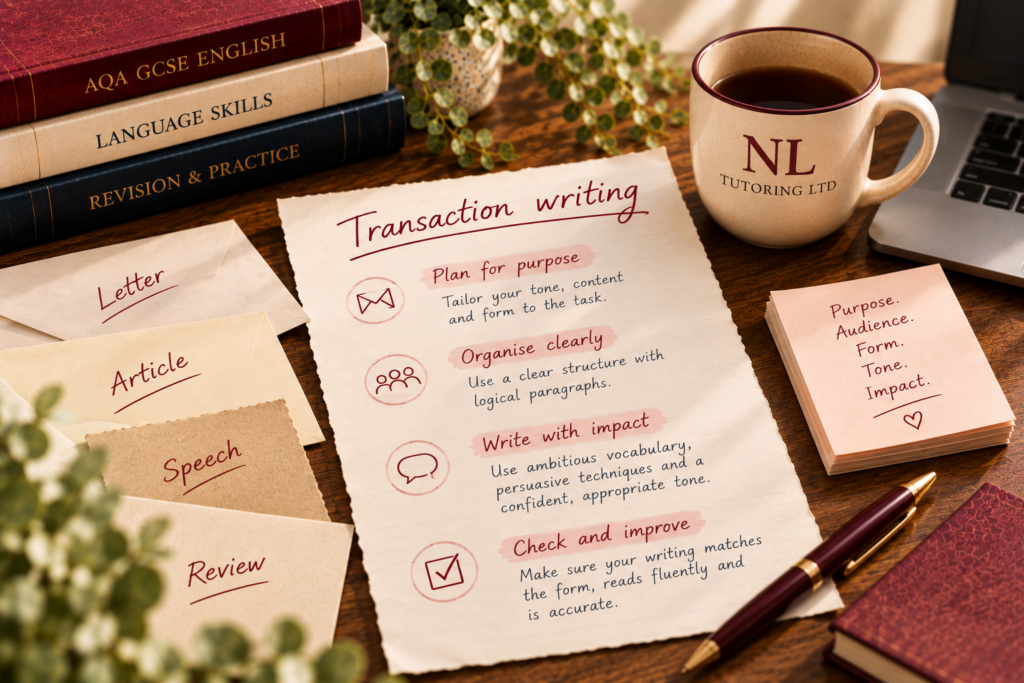
Before writing a single sentence, students should pause and identify four things: form, audience, purpose, and viewpoint. This takes less than a minute, but it prevents the most common mistake in transactional writing: producing a generic essay that could answer almost any question.
A helpful way to think about it is this: What am I writing, who is receiving it, what do I want them to think or do, and what is my position?
If the task is a letter to a local council, the audience is likely adults in authority. The register should be respectful and clear, even when the student feels strongly about the issue. If the task is an article for other young people, the voice can be more direct and conversational. A speech needs moments that sound spoken aloud, such as a greeting, direct address, repetition, and a memorable ending.
Students do not need to force every feature of a form into their response. An article does not need a dozen subheadings. A letter does not need an invented address. What matters is that the form feels convincing throughout.
Build a quick, usable plan
A plan should give the student direction, not consume ten minutes of the exam. Four or five short paragraph ideas are enough. Each paragraph should have a distinct job: introduce the viewpoint, develop a main reason, explore another angle or example, address a counterargument, and finish with a clear call to action or final thought.
The best plans include specific examples. Instead of writing “social media is bad,” a student could plan a paragraph about the pressure to appear perfect online, another about useful communities and information, and a final paragraph about responsible use. This gives the response balance and prevents repeated points.
Write with a clear voice, not a list of techniques
Many students have been taught persuasive devices, and these can be useful. Rhetorical questions, repetition, emotive language, facts, direct address, and the rule of three all have a place. However, examiners do not award high marks simply because a response contains a rhetorical question in every paragraph.
The question is whether the technique works for the audience and purpose. A measured statistic may strengthen a formal report. A short sentence may add impact in a speech. A personal anecdote may make an article feel engaging and credible. Students should choose methods that support their message rather than naming or stacking techniques mechanically.
A strong opening establishes a position quickly. Compare these two approaches:
“Homework is a topic that many people have different opinions about.”
“Every evening, thousands of students begin a second school day at the kitchen table.”
The second opening is more focused. It creates an image, suggests a viewpoint, and gives the writer somewhere to go. It is still controlled rather than exaggerated.
Students aiming for the highest grades should also show flexibility. Not every paragraph needs the same length, sentence pattern, or tone. A longer paragraph that explains an idea can sit alongside a brief, forceful line. This variation creates an intentional voice.
Organization is what makes an argument persuasive
High-quality transactional writing has a logical journey. The reader should never have to work out why a point has appeared or how it connects to the argument.
Topic sentences are valuable because they signpost the paragraph’s main idea. Connectives can help, but students should avoid relying on repetitive openings such as “Firstly,” “Secondly,” and “Finally.” More natural transitions include “More worrying still,” “Supporters of this idea may argue,” “Yet this misses the bigger issue,” or “The practical result is clear.”
A counterargument is particularly effective when it is handled fairly. If a student is arguing against homework, they might acknowledge that independent practice can be useful. They can then explain why excessive or poorly designed homework does not achieve that aim. This shows maturity and helps the writing feel considered rather than one-sided.
The ending should do more than repeat the introduction. A speech might finish with a challenge to the audience. An article may leave the reader with a final image or question. A letter could make a clear, realistic request. The goal is to leave the reader certain about the writer’s message.
Accuracy matters because it protects good ideas
A student may produce an engaging argument, but frequent technical errors can make the writing harder to follow and restrict marks. Accuracy is not about using the longest possible words. It is about showing secure control.
Students should prioritize full stops, capital letters, sentence boundaries, apostrophes, and commonly misspelled words. They should use ambitious vocabulary only where they are confident it is accurate and appropriate. “Important” is better than an incorrect synonym chosen to sound sophisticated.
Sentence variety is equally valuable. A sequence of short sentences can create urgency, while a carefully controlled longer sentence can develop a complex point. The aim is clarity. If a sentence becomes difficult to punctuate, it is often better to split it into two.
Saving three to five minutes to proofread is a practical exam habit that can protect marks. Students should check for missing words, repeated phrases, spelling slips, and punctuation mistakes. Reading the final lines quietly in their head often reveals sentences that do not make sense.
A timed approach that builds confidence
Many students struggle not because they cannot write, but because they rush the planning stage or run out of time. Regular timed practice makes a genuine difference. It teaches students how much they can realistically produce while maintaining quality.
For a longer writing question, students can spend a few minutes decoding the task and planning, most of the available time writing, and the final few minutes checking. The exact timing depends on the paper and the student’s pace, but the principle remains the same: planning and proofreading are part of the answer, not optional extras.
After each practice response, feedback should be specific. Rather than hearing “add more techniques,” students need to know whether their register matched the audience, whether each paragraph developed a separate idea, and which technical errors recur. This is where examiner-informed teaching can turn effort into measurable improvement. At NL Tutoring, students are taught to assess their starting point, build the precise skills they need, and practice applying them under exam conditions.
The most useful next step is simple: choose one past-style question, give your child a realistic time limit, and ask them to plan for purpose before they write. One controlled response, reviewed carefully, will do more for confidence than several rushed pages.