
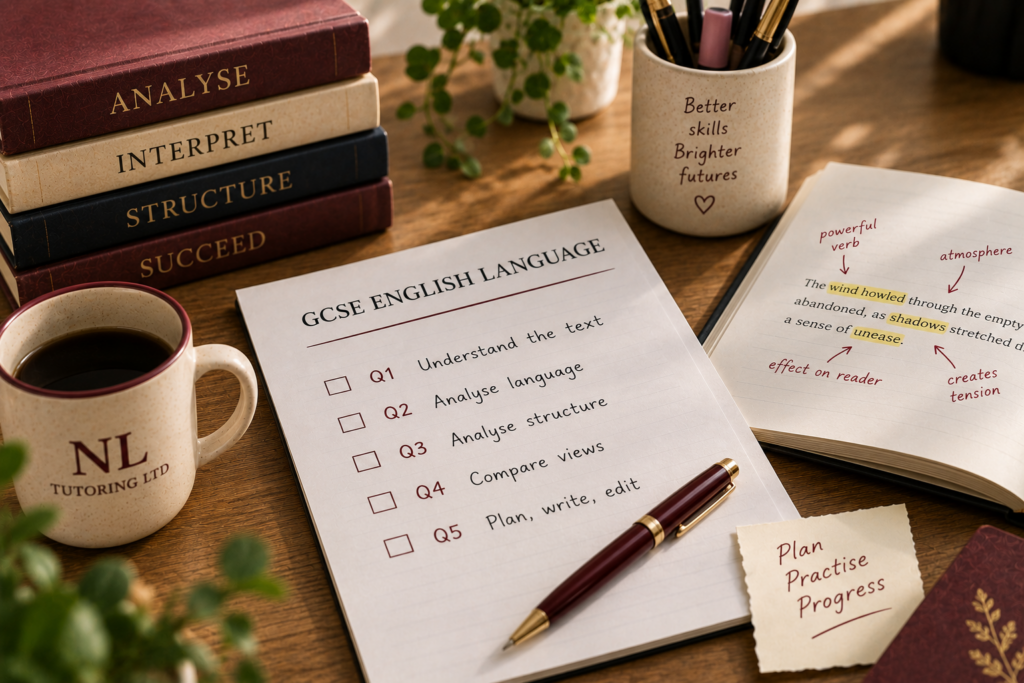
A student can know that a writer uses a metaphor, repetition, or short sentence and still lose marks. The difference is not spotting a technique. It is explaining a deliberate choice, using precise evidence, and showing its effect on the reader. That is the foundation of how to tackle language questions successfully in GCSE English Language.
For many students, Language papers feel unpredictable because the extracts are unfamiliar. In reality, the assessment rewards a repeatable set of reading and writing habits. Once students know what each question is asking, how much to write, and how to build an analytical paragraph, they can approach a new text with far more confidence.
Start With the Question, Not the Extract
A common mistake is reading every line in equal detail before looking at the questions. This uses valuable time and can leave students unsure what matters. Instead, read the question first. Identify the focus, the line reference, and the key command word.
If a question asks, “How does the writer use language to describe…?” the task is analytical. Students need to explore word choices and methods. If it asks them to list four things, it is a retrieval question. No explanation is needed. If the question asks how the writer structures the text to interest the reader, the answer must focus on shifts in the text rather than individual language techniques.
Encourage students to underline the key focus in the question before returning to the extract. This creates a clear purpose for reading. They are not searching for every possible technique; they are selecting evidence that directly answers the question.
How to Tackle Language Questions With a Clear Method
For language analysis questions, a reliable approach is to use a simple sequence: make a point, select a short quotation, zoom in on a word or phrase, and explain the effect in relation to the question.
Students do not need to force a complicated acronym into every answer. What matters is the thinking behind the paragraph. A strong response moves beyond, “This makes the reader want to read on,” or, “This creates an image.” It explains what image is created, what feeling it suggests, and why that matters in this moment of the text.
For example, if a writer describes a house as “crouching” at the end of a street, a student might explain that the verb “crouching” personifies the house as if it is an animal preparing to attack. This makes the setting feel threatening and predatory, suggesting that the character may be entering danger. The response stays focused on the writer’s language and develops a clear interpretation.
The quotation is short, the analysis is precise, and the point is relevant. That is far more effective than copying a full sentence and naming three techniques without exploring any of them.
Choose Evidence You Can Analyze
Students often believe that the longest quotation will give them the most to say. Usually, the opposite is true. One well-chosen word can provide more material for analysis than two lines of text.
Look for verbs, adjectives, adverbs, comparisons, and unusual nouns. Repeated words can be useful too, particularly when their meaning changes or builds across the extract. Punctuation and sentence length may matter, but only when they contribute to the writer’s purpose. A one-word sentence, for instance, may convey shock, finality, or a character’s sudden realization. It does not automatically create “tension.”
The best evidence gives the student something specific to discuss. Before using a quotation, they should ask: what does this word suggest, and how does it support my answer?
Explain Effects Precisely
Vague effect statements limit progress. Phrases such as “it makes the reader feel interested” can be a starting point, but they are rarely enough for higher marks. Readers may feel uneasy, trapped, sympathetic, suspicious, reassured, or shocked. The job is to name the response accurately and connect it to the detail in the text.
It also helps to remember that writers do not control every reader’s reaction. Higher-level analysis can use careful phrasing such as “this may suggest,” “the reader may begin to feel,” or “the writer positions the reader to see.” This shows confidence without making unsupported claims.
For students aiming at Grades 7 to 9, thoughtful alternatives are particularly valuable. A word may suggest more than one idea. A dark setting might imply danger, but it could also reflect a character’s confusion or isolation. Exploring a second plausible interpretation, where the evidence supports it, shows a mature response.
Know What Each Language Paper Question Requires
Exam technique improves when students understand that not all questions demand the same style of answer. On AQA GCSE English Language Paper 1, Question 2 assesses language, while Question 3 assesses structure. Question 4 asks students to evaluate a statement using evidence from the text. On Paper 2, Question 3 focuses on language, and Question 4 requires comparison of writers’ viewpoints and methods.
A retrieval question should be answered efficiently. There is no benefit in analyzing when the question only asks for information.
A language question needs developed paragraphs with precise quotations. A student should generally aim to make several clear points rather than writing one lengthy paragraph about a single device. The exact number depends on the quality and depth of the analysis, but a useful target is three well-developed selections of evidence.
A structure question is different. Students should track how the writer moves the reader through the extract. They may comment on a shift from a broad setting to a close-up detail, a change in focus between characters, a revelation held back until the end, or a contrast between the opening and closing. Listing techniques such as metaphors is not enough because the question is about organization.
Evaluation questions require a judgment. Students must decide how far they agree with a statement and then support that view with analysis. They do not need to agree completely. A balanced answer can be effective if it is decisive and well evidenced.
Build Answers Under Timed Conditions
Knowing what to write is only part of the challenge. Students must produce it in the exam room, under pressure. The solution is not simply to complete more papers. Timed practice works best when it is followed by focused review.
Begin by practicing one question type at a time. A student who struggles to analyze a quotation needs direct practice selecting words and explaining implications, not another full paper completed in a rush. Once the method is secure, introduce time limits.
Students should also plan briefly before writing. Thirty seconds spent choosing the strongest three quotations can prevent a rambling response. A quick plan might include the quotation, the main idea, and one word to zoom in on. It is enough to give the answer direction without taking time away from writing.
After practice, review the response against the assessment focus. Did the answer stay on the question? Are quotations short and well selected? Has the student explained meanings rather than merely identified devices? Is every paragraph developed? This kind of feedback turns practice into progress.
Avoid the Habits That Cost Marks
The most frequent issue is feature spotting: “The writer uses a simile. The writer uses alliteration. The writer uses a short sentence.” These comments identify methods but do not demonstrate analysis. A technique only earns credit when the student explains how it shapes meaning or affects the reader.
Another issue is overcomplicating the answer. Students sometimes search for impressive terminology and lose sight of the text. Clear, accurate analysis of a verb is stronger than an uncertain claim about obscure terminology. Examiners reward relevant interpretation, not a list of labels.
Finally, students should avoid treating every language question as identical. The wording of the question determines the response. A confident reader adapts their method while keeping the same core discipline: understand the task, select evidence, analyze precisely, and check that every point answers the question.
At NL Tutoring, this is developed through an Assess, Build, Achieve approach: identify the exact gap, teach the method explicitly, then apply it repeatedly until it becomes dependable. With structured practice and examiner-informed feedback, language questions stop being a guessing game and become an opportunity for students to show what they can do.